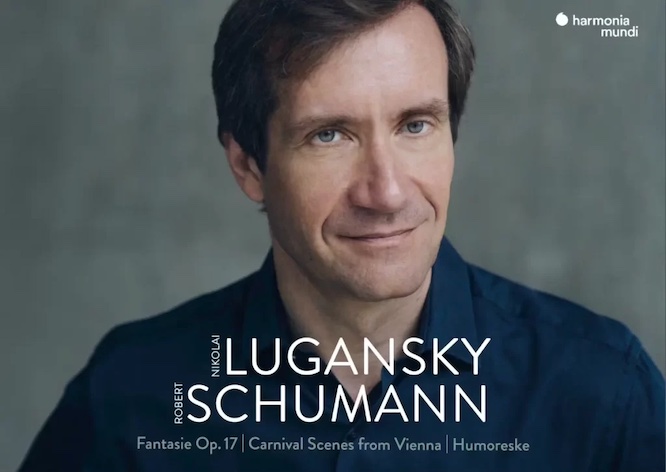
SCHUMANN: Fantasia in C Major, Op. 17; Faschingsschwank aus Wien, Op. 26; Humoreske in B-flat aor, Op. 20 – Nikolai Lugansky, piano – Harmonia mundi HMM 902753 (84:11) (2/6/26)[Distr. by PIAS] ****:
Pianist Nikolai Lugansky (26-28 May 2025) addresses three of Robert Schumann’s brilliant, imaginative constructs: the 1836 Fantasie in C; the Carnival-Jest from Vienna of 1839; and the Humoreske in B-flat Major, also from 1839. Inspired as much by his literary tastes as by his often frustrated romance with his future wife, Clara Wieck, Schumann experimented by subjecting his rhapsodic and spontaneous musical impulses to classical procedures, often with novel, startling results. Unlike his admired Beethoven, Schumann did not conquer large forms with easy security, and his extended pieces reveal a tendency to recycle short phrases in rondo form to achieve extended continuity. Nevertheless, Schumann’s simultaneous capacity for buoyantly exuberant spirits and refined, intimately passionate melodies guarantees the enduring status his body of piano works, some of which have gained high eminence in the canon of Romantic Music.
While I appreciate passion in performance, I take some umbrage at the clangor permitted Lugansky’s Steinway at the outset of the Fantasie, attributable to Nicolas Bartholomée for having rendered Lugansky more percussive than persuasive at several key points in this project. But Lugansky possesses a natural flair in Schumann, and his first movement of the Fantasie enjoys poise and poetic feeling, especially as he prepares to launch into the “legend” touched by Schlegel and Novalis. At moments, the music proceeds as a ballad in contrapuntally vocal motifs, addressed to Beethoven’s “distant beloved.” Lugansky’s florid runs and bass chords testify to a fluent technique in the service of noble aspirations, the pauses pregnant with attendant – if sonically inflated – drama.
Many commentators find parallels between Schumann’s martial middle movement and its parallel in Beethoven’s Sonata No. 31 in A-flat Major, Op. 110. A truly challenging, virtuoso, syncopated showpiece, especially in tis demonic coda, the movement alludes to Beethoven in his operatic guise, quoting from Fidelio. The Steinway tone once more proves trying, effecting a persistent fortissimo where softer nuances should be. The middle section relents a bit, allowing Schumann’s playful side some latitude. As energized as Lugansky performs this section, I had my first impression formed by a master colorist, Robert Casadesus.
The last movement shimmers with impulses from Beethoven’s Sonata quasi fantasia, the “Moonlight Sonata.” The sense of a haunting or haunted atmosphere permeates the progression, the tracery delicately intimate. Schumann regarded his Fantasie, dedicated to Franz Liszt, as among the most passionate pieces he ever conceived. Both Schumann and Liszt had engaged in a project to build, in Bonn, a monument to Beethoven; and this Fantasie served as a Greek obol, a symbolic coin to pay for traversal across the mythical Styx. A small but necessary token of love for the dead and for the ever much alive passion in Schumann’s heart for his absent Clara.
The year 1839 found Schumann in Imperial Vienna, and the engaging spirit of the city appealed to both Florestan and Eusebius, the duality in Schumann’s psyche. His five-movement Carnival-Prank, his self-styled “Romantic showpiece,” assumes some political irreverence when he parodies in the expansive, opening rondo the French patriotic song La Marseillaise, banned in Vienna since the time of Metternich. Again, Lugansky’s bold chords overly resonate with close microphone placement, but the antic humor of the piece shines through. The “jest” motif will serve as a unifying device throughout the composition. Follows a slow, wistful Romanze that utters a few terse phrases in obsessive plaints. The Scherzino enjoys a dotted-rhythm swagger that never quits its self-assured buoyancy, even as its chords modulate in unexpected directions. Intermezzo erupts with the passion of Schumann’s intensely personal Eusebius, a potent, ardent ( G minor) song rife with tender arpeggios. The last movement Finale offers a full-blooded toccata that Florestan asserts with flippant aggression, hand over hand. The secondary theme, too, casts a romantic ardor that ingratiates the piece to our collective memory, a phenomenon first revealed to me by Arturo Benedetti Michelangeli.
Set in the same B-flat major (and G minor) as the “Vienna Carnival,” Schumann’s 1839 Humoreske capitalizes on the German sense of synoptic perspective, a la Dante, whose Divine Comedy passes through stages of dire, grotesque tragedy and spiritual contemplation to a cosmic appreciation of the totality of Life. Recall that mit humour constitutes one of the tempos of initiation in the Dances of the Davids-League. Like Vladimir Ashkenazy, Lugansky savors this mesmerizing piece of “inwardness,” opening with a lovely Einfach that is soon countered by Sehr rasch redolent with the writings of Jean-Paul Richter that literally “gallop” in Schumann’s often martial sensibility. The force of Lugansky’s attacks enjoy a piercing resonance, the kind of vibrancy in Schumann that Horowitz would project.
Hastig plays like a powerfully extended, sectionalized Chopin étude in dynamics and color combinations. More delicate, chromatic colors ensue from Lugansky in the ternary Einfach und zart, which begins contemplatively but urges forward into another toccata. The soft return of the initial material has a decided poignancy from Lugansky. Innig defines one of the true essences in Schumann, a charming, dotted dance emergent from the tender, opening musings. Eusebius has spoken, so Florestan must declaim in Mit einegem Pomp, a multi-knuckled, vehement exercise in layered, chordal chromatics and shifting metrics. A little softer, in my estimation, would have been preferred. Schumann marks his finale, Zum Beschluss, or “onwards to decision,” which has the quality of a contemplative ballade, a rather puzzling postlude in terms of its searching, dark chromatic line. If humor inhabits this canonic study, it lies in subtle contrasts of chiaroscuro and a gentle reprise of small melodic kernels that have permeated and tied the whole together.
—Gary Lemco
.