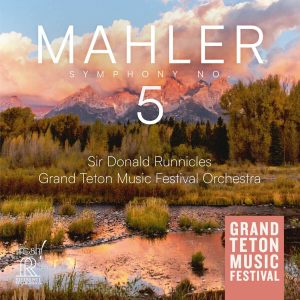
MAHLER: Symphony No. 5 in C# Minor – Grand Teton Music Festival Orchestra/ Sir Donald Runnicles – Reference Recordings FR-763SACD (72:57) (5/1/26) [Distr. by Naxos] ****:
Recorded 26-27 July 2024 at the Teton Village, Wyoming, we have a sober, stylistic performance of Gustav Mahler’s 1902 Fifth Symphony, led by Scottish conductor Sir Donald Runnicles (b. 1954), who has enjoyed a long, esteemed career in opera and symphonic music. At this period in the composer’s life, both mortality and conjugal bliss competed for primacy in his consciousness, the result of intestinal hemorrhage and his engagement to Alma Schindler. So, the Fifth Symphony realizes dual impulses, an awareness of tragic fate, via Beethoven’s Fifth motif in movement one, and the passionate “love letter” of the fourth movement Adagietto for strings and harp. If the first movement projects a funeral cortege, its ensuing, stormy, second movement announces a spiritual defiance to forces emanating from without. Mahler has turned away from folk song and lieder as sources of expressive power, and he becomes quite capable of inventing a hymn to affirm his faith, if not in an Almighty, then in the persistence of his will.
In three parts, the Fifth Symphony does not entirely reject Mahler’s avowed pantheism in his prior two symphonic works. Given that the expansive Scherzo (Part II) likewise serves two masters, the Viennese rural environs and the social world of the Strauss waltzes, we can appreciate the spiritual ambiguity that haunted Mahler. Horn principal Gail Willaims contributes a soulful emanation of the Vienna woods, after having intoned – with principal trumpet Thomas Hooten – the visceral energy of the opening movement’s motto. Mahler characterized his (contorted) central movement as “Mankind. . .at the zenith of life.” The initially charming dance pattern at times becomes persistent, even menacing, almost an adumbration of Ravel’s 1911 La Valse. Runnicles’ control of the many competing metrics proves persuasive and transparent at once, rather reminiscent of what Abbado, Boulez, and Haitink had achieved in this score. No less tonally ambiguous, the lovely, ever-familiar, anguished Adagietto flows at a calm but steady pace, avoiding bluster and sentimental ostentation. Musically, the movement lies along a continuum from Wagner to Debussy, a model of luminous, mystically diaphanous intimacy. Harp principal Allegra Lilly paints the various, modulating hues of this refined vision with intimations of a better world.
The last movement transitions to an essentially happy D major, a circuitous course that embraces much of the Adagietto’s motif but now within a contrapuntal context whose rustic energy occasionally reminds us of a whirling motif in Weinberger’s Schwanda the Bagpiper. Runnicles charters Mahler’s complex odyssey with a light hand, fervent and optimistic in tone. Mahler often spoke of the many “interruptions” that mark his movements’ progression. The sudden, intrusive energies herein somehow coalesce into a meaningful whole, legitimized by the Adagietto trope and the blazing chorale with which this last movement climaxes. Those last, sonically spectacular, 42 bars, Presto, argue for a vital resurgence of—if not rebellion against—the obstacles that do not originate from within.
—Gary Lemco