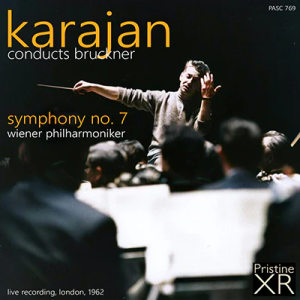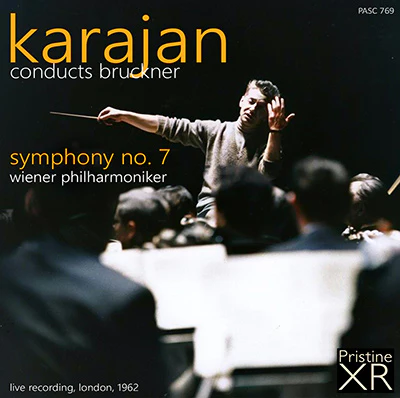
BRUCKNER: Symphony No. 7 in E Major, WAB 107 – Vienna Philharmonic Orchestra/ Herbert von Karajan – Pristine Audio PASC 769 (64:14) [www.pristineclassical.com] *****:
Pristine’s issue of the 6 April 1962 performance in Vienna of the Bruckner Seventh Symphony, with the Vienna Philharmonic led by Herbert von Karajan (1908-1989) resonates rather personally for me, since I experienced my first Bruckner in concert with this very same work under Karajan’s direction in New York, with that city’s Philharmonic Orchestra. Karajan’s tenure in Vienna and Berlin posed some problems for music connoisseurs, entirely discounting Karajan’s political affiliations. Karajan boasted a refined, homogeneous sonic image, literally devoid of “rough edges.” The smooth gloss he achieved, the blending of a luminous whole, became his especial pride, which combined with his closed eyes during performance, added a decidedly aesthetic mystique to the occasion. Karajan managed to create a temenos, a sacred space, a rarified bower of musical execution, virtually unmatched – excepting Furtwaengler, Horenstein, and Celibidache – by any other interpreter.
By now, the etiology of the 1884 Seventh Symphony has become common parlance, with its homages to Richard Wagner, especially in the scoring of tubas and the liturgical character of the C# minor Adagio, by which time Wagner’s death in 1883 had been announced. The Allegro moderato’s opening sequence – the tremolando strings that reveal a cello melody that floats over two octaves in just over 24 measures – leading to a pair of melodies that woodwinds and brass, respectively, deliver Bruckner’s epic scope with a contradictory, “leisurely urgency” under Karajan, whose forces weave a seamless progress in dignified periods. I recall, at age fourteen, my uneasy resolve to hear this huge work through, having not yet uncovered the nasty epithet from Brahms that Bruckner’s symphonies were “tortured boa constrictors.” Then, as now in this Royal Festival Hall performance, Karajan urges the music with a logical, emotional rigor that never sacrifices lyricism for bombast. The richness of Bruckner’s interior lines compels us at each moment to consider Bruckner’s mode of musical development as unique to himself. Potent, hymnal orisons alternate with whimsical, Austrian dances in rustic figures. Somehow, by circuitous intricacy, the coda has become colossal, a revelation of “God’s Grandeur” akin to the best lines from Gerard Manley Hopkins.
Karajan molds the great Adagio movement, conscious that its chromatic contours maintain a chorale of immense power and beauty, a rare distillation of Bach, Schubert, Wagner, and Beethoven, that relishes blazing fanfares and luxurious pedal points. The deep majesty – especially poignant in the F# major period and its deep strettos – of the low strings and high horns bestows an uncanny measure of solemnity to the occasion; no wonder that this one movement “redeemed” Bruckner for many skeptical listeners. Rarely has Bruckner’s written designation Sehr feierlich sustained such regal intensity. The overwhelming climax, marked by cymbal crashes and thunderous timpani, resolves into a simple flute call over pizzicato strings and a another orison from the French horns, eventually finding a long-sought peace in haunted, heart-throbbing acceptance close to Valhalla.
The A minor Scherzo ever suggests a cross between a trumpet, barnyard call and Wagner’s “Ride of the Valkyries,” and the Vienna audience, after the long vigil of the Adagio, feels alert to the robust energies Karajan releases in pungent regalia. In advance of the Trio, Karajan milks the swaggering hunting rhythm so it resembles a peasant waltz. The Trio proper enjoys a grateful repose, constant shifts in the orchestral texture remind us of Bruckner’s fondness for the diapason of his chosen instrument, the church organ. The voluptuous, earthy rhythm takes up the da capo, enriched by competing, syncopated impulses, the various choirs sharing alternating, four-bar phrases. The “Valkyries” win, defiantly.
And so on to the last movement, Finale, opening with he first of three intertwined themes. Strings and woodwinds vibrate in Austrian nature sounds, but the second theme, a poised chorale worthy of Schubert, will soon prove its ascendancy over all rival motifs. The third motif, ff, an athletic fanfare, presents a martial bias, emblematic of the “Wagner tubas” idea with their invocation from Das Rheingold. Bruckner’s various inversions of his motifs testify to long study of Beethoven, but the declamatory mode remains kindred to Wagner. The sweet, secondary theme leads the recapitulation, enhanced by glowing brass colors. The initial opening arises, now in full brass pageantry, the string almost manic in their insistence. A concession to cyclic form ensues, with allusions from movement one, but the massive momentum to a solid E major triumph cannot, will not, be denied. Pristine has cut short what must have been a Saturnalia of enthusiastic applause.
—Gary Lemco