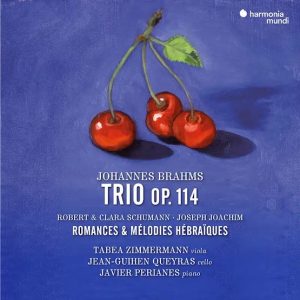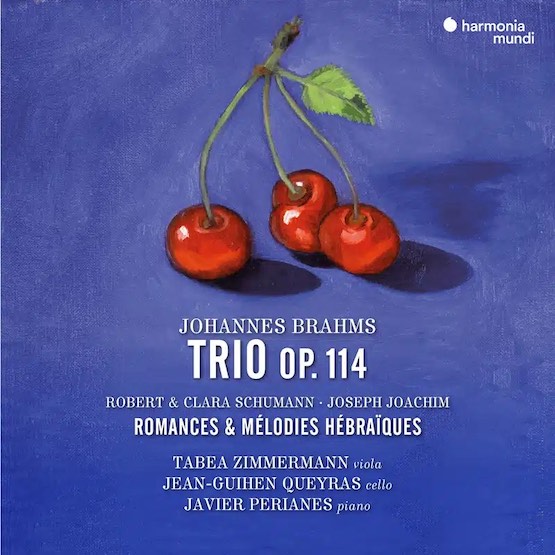
BRAHMS: Clarinet Trio in A Minor, Op. 114; BRAHMS/DIETRICH/R. SCHUMANN: F.A.E. Sonata: Scherzo in C Minor (arr. Zimmermann); C. SCHUMANN: Three Romances, Op. 22; R. SCHUMANN: Three Romances, Op. 94; JOACHIM: Hebrew Melodies for Viola and Piano, Op. 9 – Tabia Zimmermann, viola/ Jean-Guihen Queyras, cello/ Javier Perianes, piano – Harmonia mundi HMM 902789 (73:28) (3/13/26) [Distr. by PIAS] ****:
By 1891 Johannes Brahms seemed resigned to fade into obscurity, having composed nothing for over a year, and making only occasional visits musically since having completed his formal will. Yet, by chance, almost akin to Mozart’s discovery of a clarinet player, Anton Stadler, the city of Meiningen delivered to Brahms a rare talent in clarinet artistry, Richard Mühlfeld (1856-1907), a former violinist who became, through self-teaching, the orchestra’s principal clarinet player, who suddenly inspired Brahms to four significant works: two Sonatas, Op. 120; the Trio, Op. 114; and the Quintet, Op. 115. Having considered his Op. 111 String Quintet his last piece prior to official retirement, Brahms finds a melodic wellspring in the tone colors of the clarinet, and he offers love songs to the instrument proper. This disc (rec. 14-17 September 2025) places the Brahms Trio in the context of his inner circle of musical colleagues, the Robert Schumanns and violin virtuoso and pedagogue Joseph Joachim (1831-1907).
The disc proper opens with the hybrid collaborative piece, the so-called F.A.E. Sonata’s Scherzo movement, written in 1853 for violin and piano by Brahms as part of a four-movement that remained unpublished until 1935. Initially, as a kind of party joke for violinist Joseph Joachim, Brahms, Robert Schumann, and one of Schumann’s pupils Albert Dietrich (1829-1908) wrote the frei aber einsam (free but lonely) motto work “in expectation of the arrival of a revered friend,” with the proviso that Joachim identify each composer of the four movements, which he subsequently did. This C minor movement first revealed itself to this listener by way of Yehudi Menuhin. Zimmermann’s transcription captures the athletic, throaty vigor of the ternary-form work, whose middle section admits an ardent romantic’s sensibility.
The application of ternary, song-form no less dominates the Three Romances, Op. 94 by Robert Schumann, his sole composition (1849) for oboe and piano. While each of the triptych gravitates between the major and minor mode of A, They do betray that homogeneity of affect that infiltrates virtually all the late Schumann works with a tendency to repetition-in-variation. The first in A minor proceeds tranquilly, and Zimmermann’s transcription brings out the long, liquid capacities of her instrument (by Patrick Robin, 2019). Romance No. 2 enjoys a folk element in A major, whose middle section becomes increasingly, inwardly passionate. The last of the set, though marked Nicht schnell, exhibits the most agitated rhythmic impulses and sudden shifts of mood. Once more the middle section sounds much like something by his musical progeny, Brahms.
Clara Schumann (1819-1896), the composer, lists a brief catalogue, regrettably, since she possessed a distinctive voice apart from her husband’s influence. The Three Romances, Op. 22 (1853) were composed specifically for Joachim as a result if his performance of the Beethoven Concerto with conductor Robert Schumann. The long lines of the opening Andante molto do include a reference to Robert’s first violin sonata. The second movement Allegretto engages in playful dialogue with (transcribed) viola and piano. The third of the set, Leidenschaftlich Schnell, possesses a passionate intensity that Joachim declared “a delight to play, marvelous and heavenly.” Zimmermann’s persuasive arrangement makes of the viola – with some sweeping, ardent accompaniment from Perianes – a sweetly aerial vehicle for Clara Schumann’s ideas in homage to a gifted friend.
The musical catalogue for Joseph Joachim the composer remains scanty at best, barring his fine cadenzas for the major concertos of Beethoven and Brahms and an occasional overture or concerto. His three Hebrew Melodies for Viola and Piano (1855), according to the excellent notes by Stephen Pettitt, trace their etiology to 1815 poems by Lord Byron as set to music by one Isaac Nathan. The first, Sostenuto in G minor, proceeds in darkly long phrases and syncopated piano accompaniment, though the sound resembles Scottish rather than Hebraic airs. More “semitic” in sound, perhaps, the extended second Melody, Grave in C minor, might have influenced Max Bruch’s notion of a Hebrew chant in distinctive declamatory and wistfully arioso periods. The last of the set, Andante cantabile in F major, proceeds chromatically in extended viola lines, the piano rhythms in shifting motion.
The viola arrangement of the Brahms Clarinet Trio belongs to the composer himself, a pragmatic gambit to allow Joachim and Clara Schumann to enjoy the score. The dominant character of the mature Brahms style lies in the balance of textures he achieves, given his long experience of instrumental sonorities. Queyras’ Stradivari 1707 cello opens the initial Allegro with two themes, repeated and expanded by the viola. The time values increase in riding arpeggios and falling scales, the piano’s having introduced some broken phraseology. Brahms utilizes his gift for counterpoint and his penchant for falling thirds in the development, the emotional intensity having also increased as much in quiet episodes as in full-throttled, forceful statements. I must confess that, at moments, the proximity of tenor in the viola and cello run dangerously close to an overlap, blurring their individual character.
The calm Adagio that follows lasts for a mere 54 measures; nevertheless, it embraces (in falling thirds) a diapason of emotion, set in two extended themes, the second of which benefits from the cello’s pizzicato. The colloquy of three instruments achieves a mournful but honed sentiment that sustains us to the end with rich and varied tones from Zimmermann. The third movement, Andantino grazioso, provides an Austrian interlude in the form of a waltz, vocally the equivalent of his Opp. 52 and 65 Love-Song Waltzes. The rustic middle section would yodel if the clarinet were present, but the rocking metrics sway and enchant us in their amiable grace.
Brahms intermingles the competing rhythms 2/4 and 6/8 for the final movement, Allegro, with an occasional incursion in 9/8. A gypsy sensibility inflects this passionate music, rife with metrical adjustments in which the three instruments, especially the cello, demonstrate fiery, bravura energy. Perianes, too, comes quite alive in this movement, his Steinway declamatory and resolute. Annotator Pettitt defines the 2/4 coda as “returning us to a somber, if epic landscape.”
—Gary Lemco