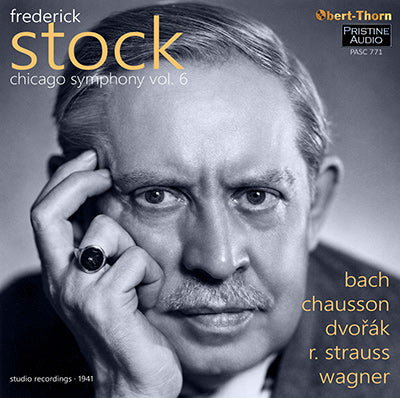
FREDERICK STOCK: Chicago Symphony Vol. 6 = BACH (arr. Stock): Prelude and Fugue in E-flat Major, BWV 552 “St. Anne”; WAGNER: Siegfried: Forest Murmurs; DVORAK: In Nature’s Realm, Op. 91; R. Strauss: Aus Italien, Op. 16: On the Shores of Sorrento; CHAUSSON: Symphony n B-flat Major, Op. 20 – Chicago Symphony Orchestra/ Frederick Stock – Pristine Audio PASC 771 (75:40) [www.pristineclassical.com] *****:
Producer and Audio Restoration Engineer Mark Obert-Thorn concludes his ambitious revival of conductor Frederick Stock (1872-1942), whose 37-year tenure in Chicago bequeathed us a powerful musical legacy that well continues to reward listeners. True to his German training, Stock built his honed orchestral sound from the basses upward, and his lithe concept of music-making typically eschews the more turgid of “romantic” tricks of the trade in portamentos and glissandos. This Volume 6 provides the musical energies of two days in December 1941, 22 and 23, just weeks before Stock’s death. The “pristine” clarity of the restorations proves utterly engaging, even startlingly refreshed, with almost no trace of the shellac origins of the preserved performances.
The program begins with Stock’s own transcription of J.S. Bach 1739 “St Anne” Fugue in E-flat Major, the fugue title borrowed from William Croft’s English hymn. The composition abounds in Christian, theological symbolism, synthesized into Bach’s “Organ Mass,” in which the Prelude and Fugue serve as pillars on opposite ends of the colossal structure. The highly chromatic Prelude, constructed on the basis of the Holy Trinity, enjoys a lyrical resonance from Stock’s forces, immediate and pious. The 205 measures of this orison embody the Lord’s perfection, as flute and harp entries, accompanied by chirping woodwinds and strings, and finally brass, elevate the occasion to a thrilling, polyphonic unleashing of cosmic powers. Bach arranges his mercurial Fugue on no less “triadic” terms, setting the respective metrics in 4/4, 6/4, and 12/8. Albert Schweitzer, typical of his metaphysical rhetoric, defines this section as “the Pentecostal wind’s rushing in, roaring from heaven.” Combined choirs state the titular “St. Anne” subject, an aerial dance that exults majestically in a potent affirmation of irresistible faith.
In his liner notes, Obert-Thorn reveals that that the 22-23 December recording of Wagner’s “Forest Murmurs” from Siegfried, Act II had no release in the 78 rpm shellac format. It comes to us now from a vinyl test pressing, immaculate in its sonic presence. The hero Siegfried rests beneath a linden tree, and all Nature responds to the imminent release of Siegfried’s powers, given his calling to awaken Brunnhilde and redeem the honor of the gods. The sheer intensity of the CSO winds, strings, and brass rivals the live Mitropoulos performance from New York that has set my standard for ages.
Dvorak’s In Nature’s Realm, the initial part of his “Nature, Life and Love” symphonic-poem triptych, celebrates the rural ecstasies of his native Bohemia, going so far as to invoke the Czech hymn “Let Us Sing Joyfully, Praise God the Father” to solidify his pantheistic convictions. Also a product of the two-day sessions, 22-23 December 1941, this outpouring of Nature’s rhythmical and melodic bounty may sound a bit hasty in bravura style (11:58) compared to the reading by Vaclav Talich (15:44), which rather basks in Dvorak’s mellifluous gestures. Doubtless, the 78 rpm medium dictated Stock’s approach, but he has captured the elastic inventiveness of Dvorak’s consistent “Nature’s call” motif.
Stock has a fine rendition of the Richrd Strauss Also sprach Zarathustra, included in Volume 4 of the Pristine collection, so his credentials as an exponent of the master orchestrator seems assured; a pity that this single movement from the early 1886 Aus
Italien, a suite inspired by the composer’s sojourn to various areas of Italy, where once more creativity thrived: “being inspired by the beauty of nature; in the Roman ruins. . .the thoughts just flew,” as Strauss stated to the score’s dedicate, Hans von Bülow. “On the Shores of the Sorrento” serves as the third movement of the suite, a serene intermezzo that permits conductor Stock’s CSO winds, brass, and strings to approach something of Wagner’s “Forest Murmurs.” Obert-Thorn comments that Stock’s “way with the graceful swooping birds over Sorrento makes one wish [RCA] Victor had recorded the entire score.”
When we come to the Stock recording of the 1890 Symphony in B-flat Major of Chausson, we recall that the 78 rpm medium offered three fine interpretations: by Piero Coppola (1934), by Frederick Stock (1941), and by Dimitri Mitropoulos (1949). Chausson took Franck’s cyclic principle of symphonic construction to heart, even improving upon sonata-form development and instrumental color. When Stock passes through the dark introduction to the Allegro vivo, the effect startles then sooths us in the suave transitions of gesture. The orchestral definition and vibrancy adumbrate what Fritz Riener would accomplish with this ensemble an administration further in the future.
In the LP era, Charles Munch in Boston would surpass Stock’s achievement. Meanwhile, the D minor Lent movement echoes Wagner’s Tristan momentarily, staidly and sternly chromatic even in its lyrical passages. The second subject in B-flat derives from the man theme of movement one, moving to a glorious peroration in D major. Despite Stock’s penchant for classical literalism in his interpretations, he makes a decisive alteration in the tempestuous, 16th-note-driven Animé finale, his having substituted an organ (at 8:00) for the brass utterance of a (trumpet) chorale tune, perhaps in homage to Saint-Saen’s Third Symphony. The intimate effect proves endearing, if eccentric. Some of the prior marcato passages in fact quote Franck’s D Minor Symphony, as if Chausson were announcing his fellowship of modern triumvirate, the French masters of the symphony genre.
Kudos to Mark Obert-Thorn and the Pristine production team for this fine series to ensure our appreciation of Frederick Stock.
—Gary Lemco
From Pristine, Frederick Stock and the Chicago Symphony Orchsestra concert recordings of Bach Strauss, Wagner Dvorak. Classical Music Review by Gary Lemco.