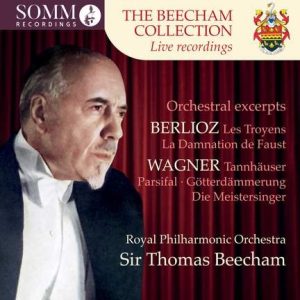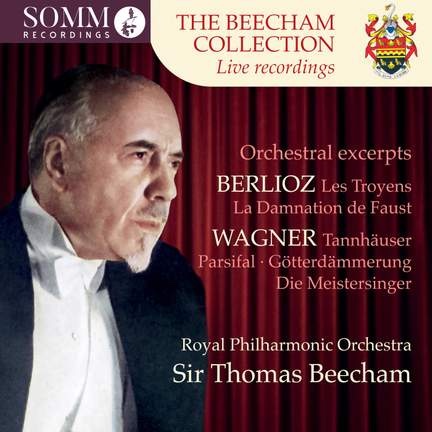
BEECHAM COLLECTION 35 = Orchestral Excerpts from Wagner and Berlioz – Royal Philharmonic Orchestra/ Oxford Bach Choir/ Sir Thomas Beecham – SOMM Recordings (6/19/26) (72:32, complete contents detailed below) [Distr. by Naxos] *****:
Audio restoration engineer and producer Lani Spahr has once more delved into the Sir Thomas Beecham concert archives to unearth excerpts from two distinct appearances at Royal Festival Hall, 7 May 1955 (Berlioz) and 17 December 1958 (Wagner). Along with Sir Hamilton Harty and (later) Sir Colin Davis, Beecham proved a most ardent acolyte of the music of Hector Berlioz. Beginning in 1899, Beecham included many of the French iconoclast’s orchestral and choral works in his repertory, which include recordings both commercial and privately produced of various overtures, oratorios, the Symphonie fantasqique, Harold in Italie, Te Deum, Requiem, Les Troyens, L’Enfance du Christ, and La Damnation de Faust. A muscular, infectious enthusiasm pervades all of Beecham’s Berlioz interpretations, and so having these additions merely confirms our expectations.
Beecham begins with the Prelude to Les Troyens that Berlioz crafted to open Part II of his lengthy narrative, those embracing Acts III-V. Ceremonial and menacing at once, the music serves as a dirge for the fates of Dido and Aeneas. The RPO brass carries the main theme over timpani tremolos that assume a cumulative, chorale-like effect. The Royal Hunt and Storm from Act IV bears a pastoral, idyllic sensibility, as trilled, violin and soft wind bird songs accompany the appearance of water nymphs. Already, intimations of an approaching storm that will drive Dido and Aeneas into a sheltering cave, where they consummate their passion and seal their fates. A potent trombone urges the storm’s progress. Beecham includes the chorus of nymphs and fauns, a decisive element of wild abandon. While Beecham in his 1957 recording had the inimitable Dennis Brain for his horn solos, Alan Civil now takes the French horn part. The storm and “love music” subside, permitting the nymphs and a bucolic serenity to return, and a last horn call heralds the end of the scene.
The popular Hungarian March from Le Damnation de Faust, a dramatic curiosity given its place in the oratorio, enjoys a hearty buoyance, the kind of Beecham “lollipop” that never fails to capture the flamboyant effects in Berlioz with grand aplomb. The coda achieves a momentous, layered surge of colossal energy, quickly greeted by a storm of applause.
To my mind, Britain claims two immensely devoted and successful Wagner conductors: Albert Coates and Sir Thomas Beecham. Beecham had been converted into the Wagner cult in 1899, after his own pilgrimage to Bayreuth. In 1909, Beecham led The Flying Dutchman as his debut Wagner opera. A 1937 rendition of Tristan at Covent Garden elicited from critic Alan Blyth the epithet “zestful conviction” to describe Beecham’s contribution.
Such robust enthusiasm defines the concert of 17 December 1958, opening with a dependable staple, Overture and Venusberg Music from Tannhäuser, Act III, in which the broad arch of the Pilgrim’s Chorus finds an elastically lush exposition, the cadences rich in luxurious color. The RPO trumpets account themselves in clarion transparency, the underlying strings and tympani equally assertive. The move from ardent spirituality to earthbound indulgence occurs seamlessly, the rich chromaticism of the moment colored by selected woodwinds and strings. A Herculean chorale breaks forth, fraught with muscular assertion. The frenzy increases over cymbals and strained strings, a series of rising scalar passages that suggest a cyclonic and obsessive, carnal eddy. As is well documented, Wagner contrived – and loathed – the Venusberg Music for the 1861 Paris production, which demanded an extended ballet sequence. The women’s chorus and harp soften the effect, as if to console the perturbed composer.
The tension between the sacred and profane human impulses finds resolution in Wagner’s final opera Parsifal (1882), freely based on the romance by Wolfram von Eschenbach. The Good Friday Music appears in Act III, in which the leitmotifs of love and death play out against the time of the Crucifixion and the legacy of The Grail. Built on brief but flowing motifs, the music conveys the passion of springtime and paradoxical rebirth amidst the travails of Kundry and a recalcitrant Amfortas, who has refused to reveal the Grail for Communion. Parsifal’s spear becomes the vehicle for redemption and spiritual succession, as the gleaming white chalice signifies. Though Beecham never realized Parsifal in the theater, his performance bears the grip of long experience.
From the opening, orchestral rendering of the emergent dawn duet “Zu neuen Thaten, Theurer Helde,” the tones of Siegfried’s Rhine Journey signal the heroic quest for the finale of Wagner Ring Cycle. Beecham delivers the quick, monumental sweep of the scene, literally catapulting into the frenzy of the occasion. Both dramatic and picturesque, the rendition delivers brilliant wind and brass punctuations, once more urged by horn player Alan Civil. The lively counterpoints enjoy a ardent heft and resolve, the sense of mortality mixed in with the noble heroism, as the “Rheingold!” motif reminds us of the dire source for the entire enterprise. The thunderous coda invokes an unbuttoned applause.
Sir Thomas concludes with Wagner’s Prelude, Act I from Die Meistersinger (1861), a fine example of the composer’s diatonic style that communicates polyphonic exuberance, especially for the redeeming virtues of song. Clarity of line and athleticism of expression mark the performance, etched in bold, vocal C major strokes by Beecham, who basks in the colored sonorities of his RPO. Essentially a comic opera, Die Meistersinger enjoys one of the composer’s better librettos, though the pedantic nature of the text also wanders into blatant, antisemitic “Germanic” dogma. Politics aside, Beecham and his disciplined forces execute a polished, dramatic, and fervently aroused reading, bound for much repetition on auditors’ sound systems.
Kudos to SOMM for this, another gemlike addition for the sustained tribute to the Beecham legacy.
—Gary Lemco
BEECHAM COLLECTION 35
BERLIOZ:
Les Troyens: Prelude;
1Royal Hunt and Storm;
Hungarian March from La Damnation de Faust;
WAGNER:
Tannhäuser: Overture and Venusberg Music;
Parsifal: Good Friday Music;
Götterdämmerung: Siegfried’s Rhine Journey;
Die Meistersinger von Nürnberg: Prelude, Act I
Royal Philharmonic Orchestra
1Oxford Bach Choir