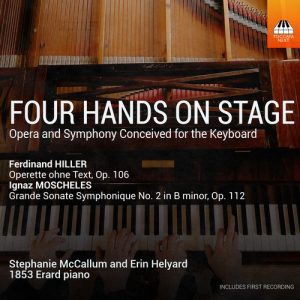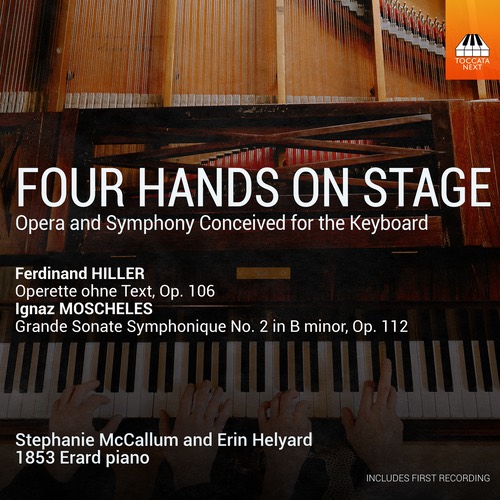
Four Hands on Stage = HILLER: Operette ohne Text, Op. 106; MOSCHELES: Grands Sonate Symphonique No. 2 in B Minor, Op. 112 – Stephanie McCallum and Erin Heyland, Érard piano – Toccata Classics TOCN 0042 (8/21/26) (79:05) [Distr. by Naxos] ****:
Even though the Beidermeier movement (c. 1815-1848) encouraged the European middle class to aspire to artistic aims – mainly in the form of possessing pianos for household music – a tendency to complacent mediocrity set in, blunting the more lofty sensibilities from achieving their fullest expression, as in the case of many communities’ lack of any orchestral ensemble. There also arose a succession of composers intent only on empty bravura display, amassing notes and velocities merely to show off their individual accomplishment.
To compensate for the penchant to trade depth for spectacle, masters of the keyboard began conceiving of their instrument as a medium of “symphonic” potential, especially after the advent of the Érard piano (1777) and its noted development in 1821 of the supple, double-escapement action, allowing for the raid repeat of notes with the delay of the hammers’ return. Besides the huge numbers of transcriptions of large-ensemble pieces, often edited to allow non-professionals technical access, a dedicated cadre of virtuoso composers submitted autonomous scores entirely devoted to the most ample and voluptuous orchestral medium in four-hand piano form, of which Ferdinand Hiller (1811-1885) and Ignaz Moscheles (1794-1870) stand as outstanding examples.
This disc opens with Ferdinand Hiller’s1864 Operette ohne Text, a substantial drama for a pair of accomplished keyboard players. Without recourse to written plot, the music advances in twelve episodes that draw from theatrical tropes in German Romantic opera and French opéra-comique. The Ouverture takes its natural place in a series of fanfares, easily invoking the sound of trumpets. A thoughtful cantabile melody marks the “Romance of the Young Maidens,” a soaring, tender aria for soprano. Poltarie introduces a noisy street scene, a collective tumult similar to the first scene in Shakespeare’s Romeo and Juliet.
The model of the Huntmen’s Chorus from Weber’s Der Freischuetz infltrates the “Hunting Choir and Ensemble,” a jaunty drinking song with a meditative trio. “Romance of the Youths” provides a lyrical balanced to the earlier soprano aria with a male tenor offering. A dialogue follows in literal fashion, the Duettino moves in nervous motion, the agitation easily reminiscent of filigree in Schumann. Trinklied mit Chor, the essential community drinking song, here set in a mocking, satiric tone that E.T.A. Hoffmann might claim.
The last five sections insist on operatic conventions: the Marsch invites comparison to Beethoven, Schumann, and Gounod, at once. The martial tune carries a vague sense of “Waltzing Matilda.” Terzett proffers a vocal ensemble piece, as three voices engage in complex, even canonic exchange. A female chorus, Frauenchor, proceeds in homely terms, the arrangement sounding – as it evolves more maestoso – like diluted Mendelssohn. The penultimate section, Tanz, gathers the social forces together once more; here, a sturdy march-mazurka that often ripples then thunders playfully. A Schubertian graciousness injects a degree of charm into the divertissement. Schlussgesang indicates the final scene, cyclically quoting themes from the Ouverture as so nostalgically serving as an epilogue for communal harmony and cooperation. Whether this ambitious hybrid satisfies the requirements of opera and duo-piano composition shall remain debatable.
Ignaz Moscheles’ 1845 Grande Sonate Symphonique No. 2 in B Minor pays homage both to Felix Mendelssohn and Charles-Valentin Alkan (1813-1888), each of whom expanded the breadth of the orchestral and keyboard media, respectively. Moscheles’ editorial work of transcribing music of Beethoven no less influenced his sense of orchestral sonorities, and the opening tremolandos for the Andante patetico – Allegro agitato command our attention, moving to aerial, melodic tissue indicative of divided strings. Dotted filigree in the manner of punctuated horn motifs surround us with a sense of trombones and woodwinds in the Berlioz manner, especially in potent, rising scalar patterns. Two major thematic groups evolve, the second more breezy and galloping The Andante patetico returns before the intertwined coda coalesces their energies.
Marked Andante espressivo, the second movement reveals Moscheles’ capacities in delicate color combinations, allotting to the primo part an operatic cantilena over strummed effects in the second piano voice. At moments, we may feel a Chopin or Mendelssohn nocturne has whispered to Moscheles. Extended periods of pp or ff pedal proceed in tinted, stately processions. Robert Schumann’s journal, the Neue Zeitschrift für Musik, praised the Scherzo alla tedesca antica for its “classically poised humor,” set in a rather staggered, pesante mode with a percussive trio section.
The big finale opens Andante patetico, with some sweeping filigree and a steady, meditative pace. The effect suggests chorale sensibility, the truth of which asserts itself later on. Moscheles allows in the Allegro con brio the Alkan penchant for the grandiose to assert itself in colors that include organ, orchestra, and chorus – perhaps even an homage to Mendelssohn’s Symphony No. 2, his ‘Song of Praise.” Some colorful exchange between the four hands breaks out voluptuously into dazzling bravura; and here, from McCallum and Heyland, listeners will recall the virtuosity of the Labeque sisters.
Note that this document provides us the first recording of the Hiller piece and the first recording on the Érard instrument of the Moscheles.
–Gary Lemco