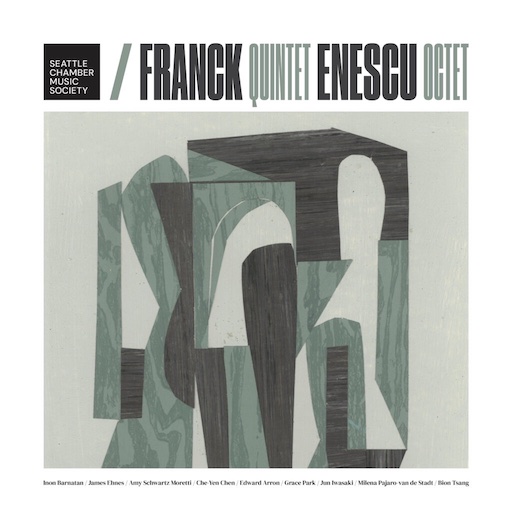
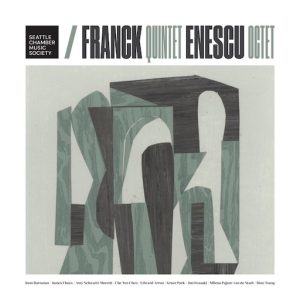
FRANCK: Piano Quintet in F Minor; ENESCU: Octet in C Major, Op. 7 – Seattle Chamber Music Society SCMS0003 (10/2/26) (71:28, complete credits listed below) [Distr. by Naxos] *****:
After a long hiatus from the chamber music medium, composer César Franck (1822-1890), passionately inspired by his ardor for musician Augusta Holmès (1847-1903), conceived his Piano Quintet in F Minor (1880). The premiere became a piece de scandale when Camille Saint-Saens, serving as pianist but also an admirer of Ms. Holmès, denied the dedicated manuscript and stormed out of the concert hall as soon as applause erupted. In this recording, Israeli-American pianist Inon Barnatan (b. 1979) joins Canadian-American violin virtuoso James Ehnes (b. 1976) and distinguished players for a performance from 8-9 July, 2025.
Franck’s opening Allegro moderato, quasi lento assigns impassioned, double-dotted rhythms to Ehnes’ first violin, answered by a lyrically flowing figure from Barnatan’s keyboard. At first, a soft dialogue ensues, but only so the other instruments may increase the intensity. The dynamics temporarily relent, then rush forward with passionate momentum to the sonata form Allegro. The descending, chromatic scale begins to dominate the texture, with the lyrical violin’s finding, impulsive, jarring gestures below.
Some canonic motion reminds us of Franck’s organ background, rooted in J.S. Bach. The development has embraced an emotional paroxysm that will recur as the entire Quintet proceeds. Alternate textures provide moments of relative peace in the midst of tempests that erupt with staggering force. The rhythmic impulse has become rather manic and obsessive, for which the individual stringed instruments give briefly intimate comfort. The piano emerges, solo, for a reflective moment, answered by muted strings. But the threatening impulse of the original theme and its dark bass line have arisen with an ineluctable resolve which exhaust the piano’s input, so that, after a crashing sequence of block chords and the strings’ resigned figures, only staggered, keyboard eighth notes remain.
The second movement, a sonata-form Lento con sentimento, begins with refuge from the preceding vehemence of movement one. Typical of Franck, this “new” music evolves, cyclically, from fragments of the opening movement. Franck’s especial sense of chiaroscuro operates with alternations of light and dark, major and minor. Delicately intimate, we sense that Wagner’s Tristan has been a palpable influence. The anguish in the music will seek a potent climax, given the chromatic instability of the haunted melodic line, which asks the cello and piano to delve into the subterranean throes of unfulfilled passion. Some lovely string harmonies conclude the movement, pizzicato and arco.
A haunted, persistent tremolo buzzing opens the finale, Allegro non troppo, ma con fuoco, with the emphasis on what we may, a la Wagner, term “fire music.” The main theme of the Lento will erupt in the four strings, which when combined with Barnatan’s voluptuously grim piano, create a splendidly rich, “symphonic” sonority. The dotted rhythmic pattern gains syncopation and a procession of augmented triads.
The keyboard sets a pattern of pulsating gestures to which the strings respond in unison, then with ardent, chromatic appeal. The various modulations, the “circuitous routes” to a final F major, have accumulated their own, interior logic, marked by passion and foreboding. How often the subterranean currents yield to moments of painful clarity! Ehnes’ violin once more sings the grund-gestalt motif that has generated the entire score. But now the rampant intensity will not be curtailed, and the persistent last cadence, abrupt as it feels decisive, marks a coda of Pyrrhic victory.
In my Atlanta, Georgia conversation with Hungarian cello virtuoso Janos Starker (1924-2013), I asked him whose music he most enjoyed reading and performing. Starker replied, “If you ask me specifically as to ‘reading,’ then I say Brahms. But if you inquire as to whom I consider the ‘most complete’ musician, then I say Enescu.” A master of the violin and the piano, Enescu had equally full command of the symphony orchestra, and his 1900 Octet in C Major, dedicated to his Conservatory teacher André Gedalge, assumes a more “symphonic” character than that by Felix Mendelssohn, since Enescu assigns major roles to each of the eight instruments involved. Eclectic in style, the Octet reveals influences from Franck’s cyclicism, Debussy’s chromatic harmony, the flamboyant extravagance of Berlioz, and the symphonic scale of both Beethoven and Richard Strauss.
Commentator for the CD booklet Eric Bromberg cites the “world of violence, sonority, and conflict” and quips on conductor Edouard Colonne’s contemporary remark of the work’s “awful beauty.” Might we counter with W.B. Yeats’ s “a terrible beauty is born”? A huge, modal impulse opens the elongated melody of the Très modéré first movement, with the second cello’s steady accompaniment. Typical of those composers devoted to cyclical evolution, this sinuous theme will generate the colossal structure that ensues.
After some canonic development, the first viola states a richly sensuous second theme, itself a derivative of the long, initial tune. The entire movement, in fact, serves as an exposition for the remaining movements, which constitute an organic whole. The texture becomes alternately lush and sparse, with meditative figures from the violin over a sustained pedal point that crate an eerie context leading to the quietly calm, muted reiteration of the main theme.
The second movement, marked Très fougueux (very fiery), without the mutes, bursts forth, unisono, tempestuous and unruly, stringently insistent. Once more, Enescu employs a series of enriched canons to proceed, vibrantly active and chromatically haunted. Contrast occurs in passages marked “caressing,” though they provide but temporary relief from the emotional maelstrom, a torrential fugue. The initial theme of movement one recurs, though its content has been subverted by demonic possession. Fierce scalar passages and broken phraseology compete for dominance, collide, and the fuse together in brilliant, virtuoso fashion for stunning effect. The storm abates, leaving us rather spent.
Movement three, Lentement, proceeds in muted figures derived from movement one, and the soft mood reminds one of the lyricism in Beethoven’s slow movement in his Op. 135 F Major Quartet. Enescu marks this movement “velvety,” to characterize its piquant melancholy. New themes add to the lush blend of instruments, with the solo violin dominant in its extended, luxurious plaint. A degree of conflicted anguish palpably evolves, with voices in the violas and cellos that invite resignation. The music virtually sways in melodic harmony, then dances ever so briefly in a moment of “Paradise Lost.” The texture simplifies, becomes agitated once more in the main, chromatic melody, now harshly accompanied and then – halts.
The finale, Mouvement de valse bien rythmée, offers an eccentric waltz, whose direct parent likely claims Berlioz of the Fantastic Symphony, for vivacity and symphonic sweep. Bustling interjections infiltrate the rhythmic motion, becoming quite dense, stringent, and intricately fugal. When the texture clears, Ehnes’ first violin, which has rarely ceased its convoluted flourishes, intones a direct Berlioz, loving quotation. The calm dissipates immediately, so that the furious propulsion of the occasion catapults us to a tempestuous coda. Grand ensemble, this performance!
–Gary Lemco
Seattle Chamber Music Society – Franck Quintet, Enescu Octet
1FRANCK: Piano Quintet in F Minor;
2ENESCU: Octet in C Major, Op. 7
1Inon Barnatan, piano/
1,2James Ehnes, violin/
1,2Amy Schwartz Moretti, violin/
1,2Che-Yen Chen, viola/
1,2Edward Arron, cello/
2Grace Park, violin/
2Jun Iwasaki, violin/
2Milena Pajaro-van de Stadt, viola,
2Bion Tsang, cello
More info at Amazon