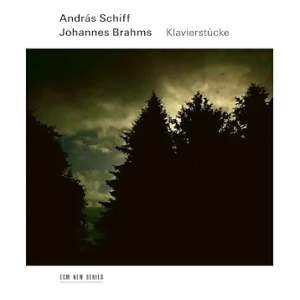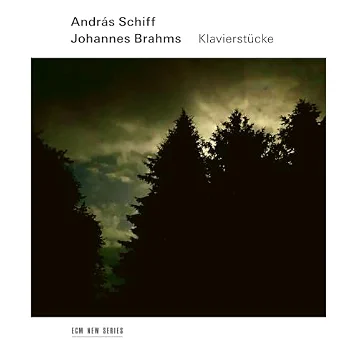
BRAHMS: Albumblatt (1853); Klavierstücke, Op. 76; Fantasien, Op. 116; Intermezzi, Op. 117; Klavierstücke, Op. 118; Klavierstücke, Op. 119 – Andras Schiff, piano – ECM New Series ECM 2730/31 (2 CDs = 48:38; 49:20) [Distrib. by Universal Music Group] ****:
Hungarian pianist Andras Schiff (b. 1953), despite a stellar career and an extesive recoreded legacy, has for some listeners and critics, elicited controversy. Those unhappy with Schiff point to his dynamic range, which relies on the middle registers for expressive power, but invites some acoustical shatter in his upper registers. Schiff’s repeated programming of two works for an entire concert, Bach’s Goldberg Variations and Beethoven’s Diabeli Variations, while demonstrating intellectual and digital prowess, suggest either “routine” or “specialty” emphases that limit our sense of musical adventure. The present, all-Brahms program, recorded in March 2021, represents a delayed wish-fufillment for Schiff, who also has recorded the 1853 Albumbtatt in A Minor as an adumbration of “the old bachelor music” from the 1890s.
The Albumblatt, in its later incarnation in A-flat minor, we immediately recognize provides the melody for the slow movement of the 1865 Op. 40 Horn Trio in E-flat Major. In brief, ternary form, the music projects a lyrical melancholy, a quasi song without words that appeals to our sense of nostalgia.
We move forward to 1871 and 1878 fr the eight pieces of Op. 76: For twenty or so intermezzi Brahms created for his opera 116-119, he favored the term klavierstücke, a non-committal designation that would not limit a work’s character, despite the term fantasy or capriccio. Brahms would refer to the late works as “songs to my sorrows” given their introverted, resigned character. Brahms loved the 1868 Streicher instrument for the performance of his works, given its light action and its salon intimacy. Restlessness marks the Capriccio in f#, Un poco agitato that refers, curiously, to Mozart’s Jupiter Symphony. The ensuing Capriccio in b became favored by Artur Rubinstein for its concise, acerbic, staccato wit and its moments of nostalgia.
The Intermezzo in A-flat major proceeds as rippling water music, a bit precious. The Intermezzo in B-flat major points to the Piano Concerto No. 2 in the same key. A nervous energy underlies the grazioso impulse guiding the piece. A decided menace infiltrates the Capriccio in c#, played with a heavy, marcato tread by Schiff, who emphasizes the cross rhythms. The Intermezzo in A means to offer contrast to the preceding piece, with its agogic (triplets versus eighths) shifts that melt into wistfulness in the central episode. The A minor Intermezzo, another Rubinstein specialty, proffers a tearful hymn, an orison to the transience of existence. Schiff treates the final Capriccio in C, Presto energico, as an operatic declamation, rhythmically intricate but no less stentorian in its assertiveness.
Schiff then proceeds to the seven pieces comprising Op. 116, the Fantasien that embody a cycle in the Schumann tradition. If capriccio means to invoke a piece of invigorated, aggressive vitality, then certainly Schiff’s fierce attack upon the D minor, Op. 116, No. 1 proves intimately passionate, the drama unleashed in an onrush of falling thirds, intimidating, sacrificing subtlety for a tragic vehemence worthy of Beethoven. Schiff, however, does grant the A minor Intermezzo its restrained, Hungarian gypsy status: what Spitta calls “the intermediate peace,” with its reflective mood (Stimmung) in ternary form.
The G minor Capriccio, too, exhibits a manic, chromaitc upheaval and throttling sense of fatality, offset by a trio section of heartbroken outpouring. Listen to the depth of Schiff’s bass tones from his 1859 Bluethner instrument. Ensue three intermezzi in the modes of E, an extended refuge from the world in the form of a slow movement. The first of these, in three registers, may well deserve the composer’s initial designation, “Nocturne.”
The second of the E pieces sighs, Andante con grazia 6/8, in two-note, dissonant phrases set as sequences. Schiff imbues the piece with a haunted, mesmeric affect. The last of the E triptych might be construed “in antique style,” a kind of minuet-chorale or sarabande in chromatic half steps. Some of the passing dissonances already point to Debussy. The middle section, limpid with falling thirds, moves back to the da capo, autumnal in its progress. Finally, q21piece, emotionally wrought with toccata figures we know from the same-key Tragic Overture. Schiff gives to this passionate expression the full “symphonic” treatment, an effective sense of closure.
Disc 2 opens with the 3 Intermezzi, Op. 117 of 1892, Brahms’s “cradle songs of my sorrows,”first heard by me in their entirety with Eugene Istomin. Brahms took lines from a poem by Johann Gottfried Herder to open his triptych: the Scottish lullaby of No. 1 in E-flat Major translates well into the Brahms keyboard medium, whose middle section, in minor, moves in drooping figures, easily assignable as tears from a the now-sleeping child in Herder’s poem. No. 2 in B-flat minor often provided an elegiac encore for Artur Rubinstein: it instantiates the notion of “rainy-day music” in Brahms. While the middle section modulates into the major, the sense of agitation does not diminish, Schiff’s having imparted a dire feeling of relentless fate into the mix. The C-sharp minor, Andante con moto, I have elsewhere characterized a pre-Kurt Weill moment of dire crisis in the Brahms oeuvre. In his notes, Schiff reminds us of the music’s close kin in the first of the Four Serous Songs, Op. 121. The syncopations of the trio section (in A major) only add to the profound resignation in the piece, and its drooping and bell-tone figures point to a personal abyss, what poet Andrew Marvell noted as “time’s winged chariot hurrying near.”
The descending curve of tonalities in the six pieces Op. 118 of 1893 conclude with the somberly dramatic Intermezzo in E-flat Minor. The first, in A minor, presents a convulsive emotional state ambiguous harmonically until measure 29, when an incipient C major yields to its relative minor. The Picardy Third at the coda suspends the drama to resolve into the Intermezzo in A. A relatively pleasant dream-scape, the music finds nostalgia even in melancholy. The Ballade in G Minor found me most responsive when Walter Gieseking performed it on an old Columbia LP. Set in the same key as Chopin’s Op. 23 Ballade No. 1, the piece presents a tragic momentum alleviated by a turn into the middle B major series of flowing impulses. The Intermezzo in F Minor Schiff takes urgently, a syncopated, canonic etude in plaintive, compressed and relentless sensibility. Romance in F Major reveals the tenderest side of Brahms, here played with admiring devotion by Schiff. The shift to D major ties closely to the Chopin Berceuse, Op. 57, rife with singing trills. The grim Intermezzo in E-flat Minor had a fine proponent in Malcuzynski, given its close emotional ties to the composer’s A German Requiem. A sense of austerity pervades the work, with its approaching storm that explodes at measure 60. A Latin hymn has become a war zone that Schiff realizes with haunted, grave resolve.
The four pieces of Op. 119 (1893) present pairs of minor and major keys, alternately introspective and assertive energies. The most far-reaching of the intermezzi, the Intermezzo in B Minor, Op. 119, No. 1, never ceases to adumbrate aspects of the Second Viennese School. Its raindrop, pointillistic opening moves in small, thirds-phrased periods and harmonic clusters Schoenberg and Webern had to admire. As Clara Schumann noted, the effect – of all the Brahms late piano works – must suggest constant ritardando, rife with melancholy.
The succeeding piece from Op. 119, the expansive No. 2 in E Minor, exudes a nervous, waltz energy that often threatens to break loose. The bass line proves exceptionally agitated; but suddenly, one of those many lovely and sad E major “thumb melodies” rises out of the emotional discord to provide bittersweet consolation. The Capriccio in B minor enjoys a deft humor in shifting metrics that Artur Rubinstein often proffered as an encore. Last, we have the multifarious, knotty – in five -bar phrases – Rhapsody in E-flat major, one of those unusual events in music that begins in the major mode and concludes in the minor. This one work elicits from Schiff his most “symphonic” utterance, and even the two episodes rather thunder their defiance. The coda projects a hearty resolve, a fire from the innards of a might composer with “snow on the roof” whose inner furnace yet roars with the aid of Hephaestus.
—Gary Lemco