“A Different World: The Music of JAMES MACMILLAN” = Kiss on Wood; After the Tryst; A Different World; Fourteen Little Pictures; Walfrid, on His Arrival at the Gates of Paradise; 25th of May 1967; In Angustiis. . . I; In Angustiis. . . II (for solo violin) – Gregory Harrington, violin /Simon Mulligan, piano /Caroline Stinson, cello – Estile Records, 63:56 ****:
Scottish composer James MacMillan is often associated with the so-called holy minimalists of contemporary music such as Arvo Pärt and John Tavener. The association is convenient and makes sense on the surface because of the extent to which MacMillan’s Catholic faith has shaped his musical consciousness, as well as his attraction to the meditative musical strains of both medieval Europe and the Far East. But the stylistic influences that inform his music are so broad that (if the appellation hasn’t yet become a dirty word in musical circles) polystylism may be a more accurate representation. However, MarcMillan’s polystylism doesn’t result in a wild blending of styles as in the early works of Alfred Schnittke but instead means that in individual pieces MacMillan will draw from a disparate body of musical influence.
That’s quite evident in this program of MacMillan’s works for solo instrument and chamber ensemble. The program starts with what we might think of as a typical MacMillan piece, Kiss on Wood for violin and piano. Based on the medieval Good Friday versicle Ecce lignum crucis in quo salus mundi perpendit (“Behold the wood of the cross on which the savior of the world is hung”), “the music and title are devotional an [sic] intent but can equally represent a gesture of love on the wooden instruments making this music.” Kiss on Wood is a meditation that rises to a fever pitch of devotion, the violin mimicking the singing voice in uncanny fashion.
At the other end of the spectrum is Fourteen Little Pieces, which MacMillan is at pains to note has been conceived as fourteen individual pieces that are nonetheless “stitched together and interwoven. . . .” through “a number of common threads. . .to establish references, resonances and recapitulations.” The piece is scored for piano trio, but the instrumentalists sometimes play solo or duo. At points the music is so chromatic as to enter the world of atonality, a firm tonal center established only in the piano postlude marked “teneroso, delicate, lontano e semplice.” It’s music of seeming anguish or at least emotional turmoil, relieved only by that simple, tender concluding number, where tolling bells bring either consolation or remembrance of the end—or both.
It recalls a similar gesture at the conclusion of MacMillan’s A Different World based on music from the composer’s own opera Inès de Castro, a story of love and political intrigue in medieval Portugal. MacMillan writes that the piece is based not only on music from the opera but also alludes “to plainsong and a famous Passion chorale. . .before veering into an obsessive a brutal coda” where the sound of bells seems to be those iron funeral bells of Poe’s imaging in the final section of “The Bells.”
There’s less noisy turmoil, more stunned anguish, in the two pieces called “in angustiis. . .” Macmillan explains that the title comes from the Latin title of Haydn’s Nelsonmesse or Mass in Time of War. Haydn’s title Missa in angustiis can be translated as “Mass in Times of Anguish” or “Mass in Troubled Times” though angustiis is probably closer in meaning to “a tight spot.” MacMillan’s two pieces were written in response to the attacks of September 11, 2001. The first is scored for solo piano; the second is a more openly lamenting meditation for solo violin that sounds in parts like keening over the dead. This is a world premiere recording of the latter, and it makes a large impression here.
The other world premiere pieces are lighter fare entirely. Twenty-fifth May 1967 memorializes the day the Celtic Football Club won the European Cup in Lisbon; it’s brightly impressionistic and over in a flash. Walfrid, on His Arrival at the Gates of Paradise, was commissioned to celebrate the unveiling of statue to Andrew Kerins, known as Brother Walfrid, who founded the Glasgow Celtic Football Club. The park where the statue is placed, Celtic Park, is also known as Paradise, hence the amusing title and the work’s binary structure, the first part quiet and somewhat reverential, the second boisterous and ebullient as if portraying the happy entrance of Brother Walfrid into that otherworldly Paradise. The piece is appropriately based on what sounds like Scottish folk tunes, though they may be original; MacMillan doesn’t say.
This is an appealing introduction to the more intimate side of MacMillan’s art. It probably isn’t the place to begin if you want to get to know James MacMillan; his sacred choral music and the widely performed percussion concerto Veni, Veni Emanuel would make a better entre. But for those who want to experience the range of the composer’s art, and for those who favor chamber music over choral, this is a very good place to turn. The performances are driven by violinist Gregory Harrington’s obvious affinity for MacMillan—which he explains in an introductory note—and fueled by very accomplished playing from British pianist Simon Mulligan, who has some of the tougher assignments on the disc.
The program appears on Gregory Harrington’s own label, Estile Records, which he founded in 2006. There’s no information about where the recording was set down, but it is a very good one except that the resonance of the acoustic adds a bit of glare to the stringed instruments. A small point, however, given the chance to sample this intelligent and attractive music-making.
— Lee Passarella
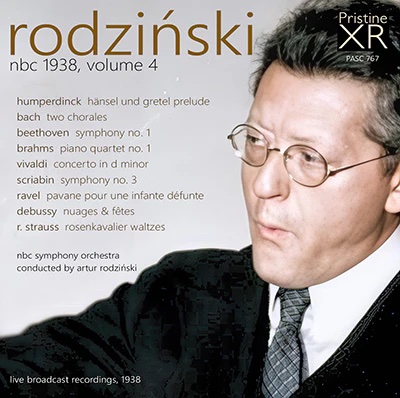
Rodziński Conducts the NBC Symphony Orchestra, 1938 Vol. 4 – Bach, Beethoven, Brahms, Strauss… – Pristine Audio
From Pristine – Volume 4, of their revival of the NBC Symphony concerts led by Artur Rodzinski.