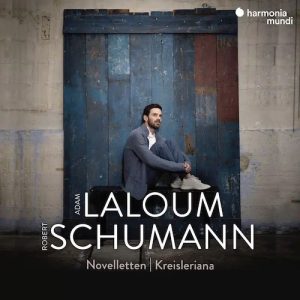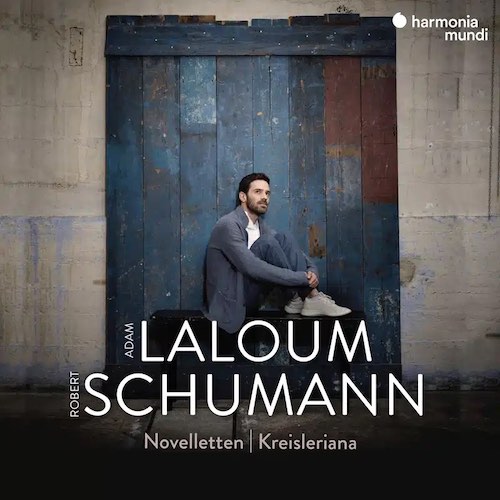
SCHUMANN: Novelletten, Op. 21; Kreisleriana, Op. 16 – Adam Laloum, piano – Harmonia mundi HMM 902748 (81:08) (7/3/26) [Distr. by PIAS] ****:
French pianist Adam Laloum (b. 1987) studied with Michel Beroff and Evgeni Koroliov, so Laloum comes to the music of Robert Schumann legitimately. Recorded in September 2024, this recital has the distinction of the full set of Schumann’s 1839 eight Novellettes, little “Clara Wieck stories” or maerchen, imaginative settings meant to console the ardent Schumann, who impatiently sought to wed Clara in spite of her father’s opposition. Besides the justly noted complete survey of Schumann’s piano oeuvre by Jorg Demus, the Dover recording by American pianist Beveridge Webster (1908-1999) set a fine example for Schumann interpretation. Interconnected as the eight pieces reveal themselves, their true character lies in poetry, in the assertive and reflective polarities in Schumann’s nature, typically characterized by aesthetic alter-egos, Florestan and Eusebius. Beethoven and Goethe assert their influence, sharing the quest for liberation and spiritual conquest, celebratory (five of them) in the D major mode, with only the massive No. 8 in F# minor.
Florestan asserts the march rhythm of No.1 in F major, revealing Schumann’s penchant for two trio sections. The sweetly consoling second tune allows Laloum’s tender legato to flourish, the rhythm now subject to tempo rubato. No. 2 pays tribute to Laloum’s ability to execute thunderous, relentless arpeggios in the manner of an étude, the piece’s having been divided into two sections, “Zuleika” and “Saracen,” after Goethe. Galloping spiration and beguiled reverie compete for dominance of expression, even claiming an allusion to Clara Schuman’s “Notturno” from Soirées musicales, Op. 6. No. 3 enjoys the spirit of E.T.A. Hoffmann, cast in delicate staccato figures that soon erupt into potent octaves. A ballroom scene emerges at No. 4, heavy in the bass part but light footed above. The music becomes mysteriously subdued, the syncopations a bit more jarring as they continue. Fervent runs and broken chord patterns intrude upon the dance, whose stormy elements may have dispersed the mirth.
A natural break for No. 5 in D major, to be played in a “loud” and “festive manner” in the right hand. This music, too, becomes darkly subdued for the second subject, a mix of march and chorale. Another double trio appears, imbuing the broad agitation a “symphonic” girth. The second trio rivals Beethoven for resolute sense of purpose, then it breaks into playful, even ornamental, scherzino jests. No. 6 in A major boasts two trios, its main idea a mix of skittish, dance figures and improvisatory staccato and leaping gestures. A folk dance or Austrian village air emerges, easily anticipatory of Grieg. Then the Schumann penchant for witty polyphony imbues a “mock-learned” aspect to the piece. Near the end, a fiddle appears with its open strings to confirm the village-scene sensibility.
No. 7 in E major begins as an extended round dance or canon, even approaching the Bach model. The secondary idea comes from Eusebius, a dreamy waltz composed of pure, upper atmosphere. No. 8 in F# minor raises the level of inspiration to a higher complexity, fusing elements of ballade, fugue, dance étude, and intimate reminiscence. Clara’s “Notturno” returns by quotation, while march figures from Kreisleriana cavort in canon. The range of chromatic colors in the piece seems daunting upon reflection: F# minor, D-flat major, D major and B minor, and then an emphatic D major. Laloum negotiates Schumann’s story-telling with crisp aplomb, and he brings a fine nuance to his colors. Maintaining Schumann’s episodic detours in dramatic tension poses no easy task, and No. 8 tests his narrative stamina at every measure. If the piece represents a compressed “mosaic” of the whole, then Laloum has met the challenge with a dexterity parallel to the art of Diego Rivera.
Schumann’s intense desire to express “a really wild kind of love” for Clara Wieck in music resulted, in 1838, in the eight-part Kreisleriana, after the character created by E.T.A. Hoffmann. The fictional zany conductor of Hoffmann’s imagination embodies the fantastico in Berlioz: the whimsical, inventive, and often unpredictable Romantic genius who sports with duty and opportunity, who enjoys his own, enigmatic personality. Schumann conceives Kreisleriana as a grand, Romantic etude of fevered, contrasting, emotional currents. Even the kapellmeister’s cat offers her opinions! The essential instability of motion finds Schumann’s Florestan and Eusebius willing participants in the dualism that centers around D minor, B-flat major, and G minor, with one digression into C minor. Violent fugato episodes collide with marches (maerchen) and polyphonic études, along with poignant moments of melancholy, beguiled reflection. Vladimir Horowitz in 1969 set a standard of recorded performance that still exerts a potent influence.
Lin’s opening D minor torrent of digital activity, especially in the left hand, finds some solace mid-section, but the effect remains a swirling nightmare of sorts. The second movement in B-flat major, the most extensive of the set, contains remarkable contrasts. Played “inwardly, not too quickly,” the piece exudes quiet passion and then, excited, quirky motion in Baroque style. A new gesture evolves, agitated and ominous in its bass harmonies, the texture now thick with agogic ambiguities. Perhaps a sense of loss permeates the music, from which the opening melodic line cannot quite recover.
In G minor, the third movement perhaps beckons a quote from Hoffmann’s feline character, a rather mincing, galloped motto tune, to be countered with an extraordinarily lyrical middle section in arioso canons. A bit of syncopated madness ensues for the coda, the “cat rather out of the bag,” so to speak. Very slowly, movement four reverts to B-flat major, the music becomes almost static in its poised intimacy. Lin manages to create an aura, an expectant atmosphere, in this movement, quite compelling. The fulcrum movement five, quite lively in G minor, presents a staggered motto impulse that suddenly erupts with mischievous force in curlicues. The bass motive climbs and then dissipates.
The intensely “interior” movement in B-flat major again moves “very slowly.” Deep bass chords announce some tragic impulse, but the “improvisational” mystery continues. We remain always aware, in Schumann, that his emotional center fixates on “nostalgia for the dream.” This movement confirms how elusively that desire persists. Suddenly, the seventh movement, very fast in C minor, bursts forth in volatile, bravura fashion. The swirl of 16th notes assumes a polyphonic format, then descends precipitously downward. Schumann indicates Noch Schneller, even faster, for Kreisler’s wizardry to be invoked; but it too, comes to a sudden halt, and we are left in an emotional no-man’s-land awaiting musical resolution. At last, a curious rondo concludes the set, “Quick and Playful” in G minor. Schumann, aware of the need for heroism, will eventually ask his performer to realize a motive “with all your power,” but the mincing, carefree opening dance rather intimidates the noble, martial intention. Passing dissonances only contribute to the tangible angst of this ending, which leaves us bemused, concerned, and perhaps abandoned.
Maestro Laloum gives us a sensitive, noble account of Schumann that should grace our library of the composer’s fine acolytes.
–Gary Lemco