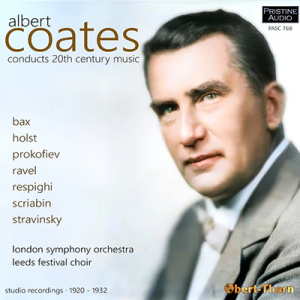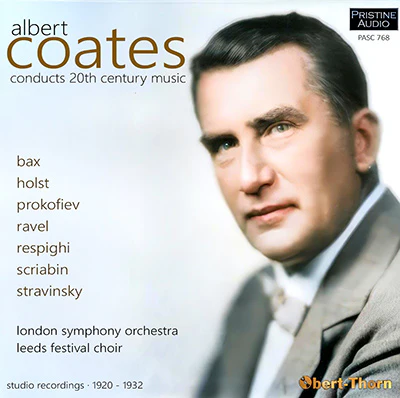
Albert Coates conducts 20th Century Nusic – Scriabin, Stravinsky, Holst, Ravel, Bax –Pristine Audi PASC 768 (2 CDs – 2 hr 1:42, complete listing and credits below) [www.pristineclassical.com] ****
My first encounter with Russian-British conductor Albert Coates (1882-1953) derived from a set, “Historical Anthology of Orchestral Music (from 78s), Volume One,” from esteemed collector Thomas L. Clear, a four-record compilation that included an especially frenzied account of Mozart’s Jupiter Symphony. In spite of the manic pace set by Coates, I had to admire the tenacity and discipline of his ensemble, which I can liken only to what Yevgeny Mravinsky achieved with his intimidated Leningrad Philharmonic. Aside from his mastery of the Russian repertory, Coates won fame for his Wagner interpretations, which could easily rival documents set down by Siegfried Wagner and Leo Blech. A man of girth and physical substance, Coates once, in a fit of temper, threatened recalcitrant players with what possibilities might be imminent if only he were “that diminutive Italian!”
Producer and Audo Restoration Engineer Mark Obert-Thorn has assembled Coates’s recorded contribution to 20th Century music, 1920-1932, here eschewing the usual Romantic legacy. `The extensive program opens with Scriabin’s 1905-08The Poem of Ecstasy (27 April and 7 May 1920), the one-movement composition which the composer considered his Fourth Symphony. Despite my aversion to acoustic recordings and their desiccation of orchestral colors, the Coates reading indulges Scriabin’s persistent demand for lanquid effects, a result of Wagner’s Tristan formula of withholding any tonal resolution, especially via whole-tone scales and competing chromatic harmonies. Thus, Coates manages an erotic elasticity to the evolution of the three-part structure, as “the joy of cosmic liberation” assaults our senses. Trumpet fanfares compete with birds’ extreme, twittering trills to accomplish an apotheosis. The “Soul in an orgy of (self) love” seems appropriate to this mastery of solipsistic energies, the illumined effects of which Coates negotiates with easy finesse. If only Coates had had more modern technology at his service, but Obert-Thorn has done much to revivify this moment of dazzlingly cryptic musical expression into a meaningful whole.
The Coates excerpts from Stravinsky’s 1910 ballet The Firebird (rec. 15 February 1928) immediately benefit from the electronic recording process, given the clear, articulate voicings from winds and strings. The glistening textures pass by in fleeting colors borrowed from the palette of Stravinsky’s teacher Rimsky-Korsakov, complemented by modern dissonances. The orchestral discipline feels less secure in the layered throes of the Infernal Dance, but at no loss of visceral excitement. The lure of the exotic continues in the selected pieces (rec. 14 October 1930) from the 1917 tone-poem The Song of the Nightingale, adapted from the 1914 opera. The delicacy of the scoring, including celesta, harp, cymbals, and glissando strings often set in pentatonic, dissonant scalar patterns, contributes to a startling array of vibrant colors. The Funeral March resonates in an eerie pageant, brief but mysterious.
The brief suite from Prokofiev’s 1921 satirical opera The Love for Three Oranges has survived mainly due to the acerbic “March.” The level of the opening foray by tongued trumpets never fails to arrest our attention, and Coates (rec. 6 January 1927) injects a mighty marcato pace shimmering with martial vitriol. The “Scherzo” imbibes all of the Coates capacity for spirited momentum, interrupted by dainty pulsations. The 1925 Exhibition of Modern Industrial and Decorative Arts in Paris inspired impresario Diaghilev to commission Prokofiev for his 1926 ballet score The Steel Step, consisting of eleven dances. Coates recorded Le Pas d’acier on 18 February 1932. An often ungainly blend of diatonic harmony and chromaticism, the music bears a militantly hectic color scheme that relies on Stravinsky’s Le Sacre du printemps cross-fertilized – as in “The Hammers” – by Mosolov’s Iron Foundry, given its recorded debut by Vittorio de Sabata. A degree of gentle sarcasm permeates the score, as in “The Commisars,” “The Little Street Vendors,” and “The Sailor with bracelets and the Working Girl.” Obert-Thorn notes that Coates recorded the complete suite, but HMV never issued movements seven through nine. The Coates performance of this imposing music competes with an equally compelling – and more complete – version by Igor Markevitch.
As Obert-Thorn points out, we collectors of classic performances most commonly associate Holst’s 1914-17 The Planets with Sir Adrian Boult. But the Coates set of four movements (rec. 20 September 1926) reminds us of the power and intensity this conductor wrought in scores he well knew and admired. A swift sense of cosmic justice informs “Mars,” rife with compelling menace. Coates had given the first public performance of the complete astrological suite in 1920. The second movement, “Mercury, the Winged Messenger,” captures the fleeting and diaphanous colors of him who servs no less as the cosmic trickster. “Jupiter, the Bringer of Jollity” projects a noble swagger borne of interstellar confidence, and the middle section becomes an orison of broad persuasion that basks in British solidarity of spirit and consummate humanity. “Uranus, the Magician” concludes the suite with dire fanfare and mischievous, urgent ambiguities befitting the “riddle of the universe.” The unnamed Symphony Orchestra demonstrates fertile instrumental accomplishment, especially in their brass and battery sections.
There exists a natural “alchemy” to the ballet music preceding Gustav Holst’s 1922 opera The Perfect Fool, since the music has dancers representing Earth, Wind, Fire, and Water. Coates offers the energetic “Introduction – Dance of the Spirits of the Earth” from the same session that produced The Planets excerpts. The restoration proves vivid, indeed. On the 28th October 1925, Coates led an a cappella choir in Arnold Bax’s 1921 Mater ora Filium for unaccompanied double chorus. The Mother of God bears her Divine Son upon her arm. May He grant us all the joys of the blessed. This recording suffers a degree of surface noise, but the innate piety and ecstasy of the occasion swells in resonant devotion.
Albert Coates claims the first recording of any of Respighi‘s “Roman Trilogy,” and The Fountains of Rome (1918), recorded over the course of a year (4 January 1927 – 5 January 1928) depicts selected Roman fountains as seen at various times of day. The first of the series, “The Fountain of Valle Giulia at Dawn,” presents a bucolic scene occupied by passing cattle at dawn. Respighi’s woodwinds and muted strings bear the hazy and ripe colors realized by the LSO. A luxurious eruption of sound announces “The Triton Fountain in the Morning,” a kind of mythical pageant wherein Neptune’s chariot enjoys a vivid retinue of sea personages. The movement, “The Trevi Fountain at Noon,” at first casts an umbra that soon evolves torrentially, a martial, brass pageant of potent force. A suggestion of melancholy nostalgia informs the last section, “The Villa Medici Fountain at Sunset,” rather a wistful recollection of a bygone era of Italian cultural eminence. Twittering birds with harp riffs, tolling bells, and the shimmer of falling leaves mark the occasion, a transparency of effect well realized by Coates and ensemble.
Finally, from 2 March 1926, we have the premiere recording of Ravel’s La Valse, Coates’s athletic rendering of Ravel’s perception of the age of Vienna and the Strauss waltz kings. Once more, a hazy opening sequence of subdued power and impulse flourishes, both of which will inevitably explode at the climax. As Obert-Thorn appropriately comments, the performance belies its hundred-year-old existence, given the throbbing, hurtling energies that appear in exquisite, instrumental detail. Touches of rubato and portamento tint the interpretation with Romantic hues, but the élan vital never wanes.
—Gary Lemco
ALBERT COATES conducts 20th Century Music
1SCRIABIN: The Poem of Ecstasy, Op. 54;
1STRAVINSKY: The Firebird (1910): The Princesses’ Games with the Golden Apples; Infernal Dance of All Kashchei’s Subjects; The Song of the Nightingale: Celebration at the Palace of the Emperor of China; Chinese March; Funeral March;
1PROKOFIEV: The Love for Three Oranges, Op. 33: Infernal Scene; March; Scherzo; Le pas d’acier, Op. 41: 8 Scenes;
2HOLST: The Planets, Op. 32: Mars; Mercury; Jupiter; Uranus; The Perfect Fool – Ballet Music, Op. 39;
3BAX: Mater ora Filium;
RESPIGHI: The Fountains of Rome;
2RAVEL: La Valse –
1London Symphony Orchestra/
2Symphony Orchestra/
3Leeds Festival Choir/