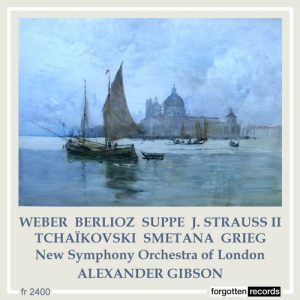
ALEXANDER GIBSON conducts = WEBER: Invitation to the Dance; BERLIOZ: La Damnation de Faust; SUPPE: Dichter und Bauer; J. STRAUSS II: Unter Donner und Blitz; TCHAIKOVSKY: Capriccio italien; SMETANA: The Moldau; GRIEG: Norwegian Dance – New Symphony Orchestra of London/ Alexander Gibson – Forgotten Records FR 2400 (79:59 complete contents listed below) [www.forgottenrecords.com] ****:
Despite his having distinguished himself with the Scottish National Orchestra, the Sadler’s Wells Company, and the Scottish Opera, conductor (Sir) Alexander Gibson (1926-1995) still suffers a general lack of recognition among record collectors, who rather appreciate him for his work in an accompanying capacity, as in his noted Paganini Violin Concerto No. 3 with Henryk Szeryng. But many operatic collaborations testify to a master of the medium, and his assorted surveys of the music of Jean Sibelius have always warranted attention.
Forgotten Records assembles a group of orchestral display pieces culled from the RCA Reader’s Digest series of 1960. At one point in time in early CD formats, the Chesky label reissued some of these performances, also in fine sound. Gibson opens with a vivid reading of Carl Maria von Weber’s 1819 Invitation to the Dance, which made an indelible impression in the 1980 movie Nijinsky, when at the Allegro vivace George de la Pena leapt through a window. For beauty and transparency of orchestral texture, the three popular excepts from Hector Berlioz’ 1846 “Dramatic Legend” La Damnation of Faust find the New Symphony Orchestra woodwinds in aerial form, while the strings lull with reveries. Gibson’s last entry here, the rousing Hungarian March, has the intensity and penetrating conviction some collectors recall from Pierre Monteux in San Francisco. The other spirited confection from 1846, Franz von Suppé’s Poet and Peasant Overture, begins with its lovely cello/harp duo and soon floats via the horns and winds to the stormy sequence first immortalized for this reviewer by Sir Thomas Beecham and Willem Mengelberg. The waltz sequence that ensues unfolds in pure charm, soon to segue into a churning fanfare that invites the low strings to comment before the waltz repeats, only to hurtle into the marvelous bombast that concludes this merry showpiece.
Gibson extends his capacity to inject hauteur and charming pomposity into music with two Johann Strauss items often featured in the Vienna Philharmonic’s New Year concerts: the 1868 Thunder and Lightning Polka and a second polka, the 1858 Tristsch-Tratsch (Chit-Chat or Gossip), famous for its crescendos and glissandos in the course of witty syncopations in the Hungarian flavor.
The music of Peter Tchsaikovsky provides two relatively large scores, his 1880 Capriccio italien, whose bugle call and intermix of Tuscan folk tunes and tarantella rhythms guarantees an orchestral display piece that awaits a sure hand for dramatics to raise the level of familiar impact, and whose classic interpretation by Paul van Kempen has a repute all its own. Gibson’s version, relatively swift, projects affection and plastic virtuosity in the various parts, especially in the strings, winds, and horns.
The more explosive potboiler from 1880, the Overture-Solennelle in E-flat Major, 1812, commemorating the Russian victory over Napoleon’s invaders, proceeds by the usual substitution of the chamber string choir for the full-blooded human chorus whose invocation for God’s intercession has its ultimate realization in the 1968 RCA recording by Igor Buketoff and the New Philharmonia Orchestra and Chorus. Despite Tchaikovsky’s virtual denial of historical accuracy in his selections of tunes befitting the 1812 victory, the clash of French and Russian patriotisms still manages a forceful performance from Gibson, the cannon, church bells, and cymbals in full, bombastic regalia. Remember Marlene Dietrich’s look of erotic triumph to this music in Scarlett Empress?
Bedrich Smetana’s immortal 1874 tribute to his homeland, The Moldau – the second of his six-part, Czech national cycle Ma Vlast – emerges from two, rippling mountain streams to sing the glorious, pantheistic hymn to Bohemian life. Gibson takes a leisurely approach, ardent and resonantly intoned, if not voluptuously colossal, a la Vaclav Talich and Rafael Kubelik. The moonlit scene, mythically inhabited by water nymphs, does invoke an erotic luster to the episode, which soon escalates in tempo and dynamics into both the hymnal and the glorious tumult of St. John’s Rapids. The fervent energies mount to Prague, where the hymn virtually collides with the bardic motif that defines castle Vyšehrad, established house of Bohemian royalty. The music sweeps into the horizon, where eternity greets the river with two sumptuous cadences.
Finally, Gibson proffers Edvard Grieg’s disarmingly simply Norwegian Dance in A Major, Op. 35, No. 2, an old Beecham “lollipop” staple. Its ternary form and directness of expression well capture Alexander Gibson lifelong intent to bring colorful and engaging music to the masses.
—Gary Lemco
ALEXANDER GIBSON conducts =
WEBER (arr. Berlioz): Invitation to the Dance, Op. 65;
BERLIOZ: La Damnation de Faust, Op. 24: Menuet des Follets; Danse des Sylphes; Marche hongroise;
SUPPE: Dichter und Bauer, Overture;
J. STRAUSS II: Unter Donner und Blitz, Op. 324; Tritsch-Tratsch Polka, Op. 214;
TCHAIKOVSKY: Capriccio italien, Op. 45; Overture solennelle, “1812,” Op. 49;
SMETANA: Vltava (The Moldau);
GRIEG: Norwegian Dance in A Major, Op. 35/2