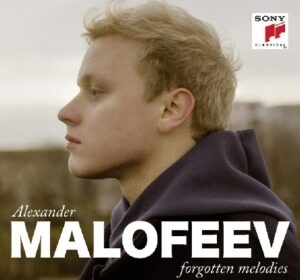
FORGOTEN MELODIES = GLINKA: The Lark; Mazurka in C Major; Mazurka in C Minor; Polka in D Minor; Farewell Waltz; MEDTNER: Forgotten Melodies; Fairy Tale; RACHMANINOFF: Prelude in C# Minor; Fragments; Piano Sonata No. 2; Lilas; Elegie; 3 Études-Tableaux; GLAZUNOV: La Nuit; Song of the Volga Boatmen; Idylle; Valse – Alexander Malofeev, piano – SONY 198029369229 (2/27/26) (2 CDs = 55:20; 68:50, complete details below) *****:
Recorded in Berlin, February 20-22 and March 3-4, 2025, this recital by Alexander Malofeev (b. 2001) pays homage to four Russian composers – Mikhail Glinka (1804-1852), Nikolai Medtner (1880-1951), Alexander Glazunov (1865-1935) and Sergei Rachmaninoff (1873-1943) – all emigrés who died far from home. Malofeev himself lives in self-imposed exile, having objected to the morality issues of the invasion of Ukraine. Malofeev explains the conceptual thread connecting these composers: “They all share a similar feeling of nostalgia. But you cannot really figure out which moment in time they are actually nostalgic for. It’s almost as if they are nostalgic for a very similar setting which never really existed in history. It’s like it is totally made up, almost a dream world—and you can find it everywhere on this album.”
Malofeev opens with music by the “Founder” of the Russian classical music tradition, Mikhail Glinka. “The Lark,” a familiar, popular tune, became, under the hand of Mily Balakirev, an imposing, B-flat minor, bravura showpiece in the Liszt manner. Both recitative and arioso, the piece wafts serene under Malofeev’s diaphanous realization of scalar runs and trills: the piece means to say farewell to Saint Petersburg. Three wistful, salon pieces follow: the two waltzes, in C major and minor, respectively, certainly bear the imprint of Chopin in their cautious melancholy. The “Polka in D minor” has the earmark of Schubert’s Third Moment musicaux. The “Farewell Waltz” in G major passes us so quickly we must rehear it to savor its metric ambiguity, an arioso close to an Italian, miniature bel canto lyric.
Malofeev considers the music of Nikolai Medtner to occupy the heart of the album, and the 1919 one-movement “Sonata Reminscenza” from his collection, rather a cycle, of 19 Forgotten Melodies instantiates the dominant sensibility of nostalgia. Those familiar with the music of the “Russian Brahms” recall the Rachmaninoff championed his work, as did a favorite pianist, Benno Moiseiwitsch. About to depart from his homeland, still in turmoil of revolution, Medtner here reflects on his emotional life and imminent, 1921 departure for Paris and Great Britain. A simple, pure, chime-like melody opens the work, followed by a theme whose development reveals a dramatic power suggestive of both Rachmaninoff and Beethoven.
Melofeev includes seven other pieces from Op. 38, miniatures that Medtner had noted down over a period of twenty years but lying outside any specific opus. Malofeev’s performance of the Sonata captures its lyric poetry and epic scale, qualities some will identify with another Russian advocate, Emil Gilels. Melofeev considers the ensuing pieces as “explorations.” Hints of Chopin and Grieg flit across the screen of imagination, while the rhythmic variables often suggest stride or bluesy jazz.
Bell tones announce the thrilling Danza Festiva, a mercurial, brilliant (Presto) étude of some length. Brisk runs and softly pedaled syncopations intertwine with knotty, polyphonic episodes. The shape of the piece becomes somewhat amorphous as the breathless, “improvisational” aspect becomes mor pronounced. More in the reflective spirit of Rachmaninoff, Canzona Fluviala proffers a liquid Allegretto con spirito whose intricate tapestry achieves some passionate filigree. Danza Rustica enjoys a swaying but anxious, habanera rhythm that seems intent to express some heroic impulse. The last measures consist of flowing arpeggios.
Canzona Serenata recalls the earlier Sonata, though the swirling barcarolle, dance motion becomes increasingly frenetic, Con moto, quasi Cadenza. Serenity does return, to round off the ternary form. Danza Silvestre (Allegro) offers a Lisztian flair for flirtatious mischief, vehement passion, and willful exuberance. Liquidly mercurial, the music passes through disparate rhythms and harmonies to arouse the envy of any jazz improviser, while its passionate outbursts rival moments from Rachmaninoff or Mussorgsky. The Op. 38 cycle finds closure in Alla Reminiscenza, the diaphanous recollection of the Sonata, with chords laden with bell tones and arpeggios from Debussy.
Medtner’s Fairy Tale (Skazka), No. 2 from Two Tales, Op. 48 is a G minor score in the Schumann manner wrought in chiaroscuro coloring and arioso flights of fancy. The use of trills and musical curlicues aligns the piece with Rachmaninoff or even the less radical side of Scriabin, but the gloss remains peculiar to Medtner.
Malofeev initiates his Rachmaninoff sequence with the composer’s familiar (and accursed) Prelude in C# Minor from 1892, whose three-note motif became known as “the bells of Moscow.” Malofeev takes the Agitato chromatic triplets on one gulp, assuming an epic grandeur for the fortissimo climax that soon dissolves into the seven measure, subdued coda. Malofeev favors Rachmaninoff’s revised, 1931 edition of the B-flat Minor Sonata, its tighter, more economical construction akin to the Medtner notion of musical architecture by incremental phrases. A favorite of Vladimir Horowitz, the work benefited from that artist’s own arrangement. The opening Allegro agitato receives a voluptuous patina from Malofeev, much as if a painter were conceiving – with clarion authority – a canvas of chromatic bells and intimate dreamscape before our eyes.
Via G major, we find ourselves in the second movement Non Allegro – Lento in E minor. A searching scale pattern of falling thirds emerges, almost reminiscent of the Brahms Fourth Symphony. Once more, bells and chime-like sonorities arise, a delicate fabric whose use of first movement impulses unifies the progress of the sonata. A sudden, forceful thrust into the third movement, and we sit in thrall to a demonic, militant passion, in which movement one’s motifs find a new companion in D major. Jerky, mercurial, inflamed, the transition to Allegro molto seems inevitable and of Herculean difficulty. Rather than nostalgia, the gathering up of former motifs reaches a point of assertion and spiritual triumph, the cycle of loss transmogrified into a bold B-flat major coda.
Along with an early “Fragment” in A major, Malofeev performs the composer’s own arrangement (1913) of his 1902 song, “Lilacs,” Op. 21/5, in which transparent keyboard filigree captures the elusive scent of the flowers described by poet Ekaterina Beketova. The gorgeous Élégie in E-flat Minor, Op. 3/1 belongs to the same 1892 set of pieces that claims the C# Minor Prelude. A sustained aria in the Chopin style, it asserts a deep appreciation of song and the piano’s soaring, vocal capacities. Malofeev then proceeds to a set of three Études-Tableaux from Op. 33 (1914): the first “study-picture” in C minor, is marked “Grave,” and it seems steeped in dark, turbulent Byronism. Here, the sense of nostalgia feels palpable in chords that prove hymnal and painfully introspective.
Malofeev’s bass harmonies exert a power rife with Russian, pietist orthodoxy. The No. 7 in G minor shimmers in hazy ambiguity, the tenor line’s reaching skyward while the bass seeks gloomy depths. The music appears to owe debts to Schumann, Debussy, and Medtner, at once. A poignant run seals its fate. No. 9 in C# minor (Grave) would likely be claimed by Edgar Allan Poe, dear to Rachmaninoff’s gloomy heart. The grim runs belong to a Bach toccata, but the unnerving repetitions and passing dissonances likely bear the imprint of both Medtner and teacher Taneyev. Close in spirit to the last of the Chopin Préludes, the piece asserts a fiery, unquenchable passion.
The music of Alexander Glazunov, as a whole, avoids the tragic muse. Optimistic, life-affirming, Glazunov revels in ballet scores and symphonies that evoke – somewhat anachronistically – aspects of Nature, much like Dvorak. His piano music remains relatively obscure. Malofeev opens with a liquid sound, “La Nuit” from 3 Études, Op. 33, this set in E major. The carillon, leggierissimo sonority enjoys a sweet melody in the midst of Debussy raindrops. “Song of the Vola Boatmen” I recall from a 78 rpm shellac by Paul Robeson. Glazunov’s Op. 97 plays the song as an A minor Andante, with an aggressive, “symphonic,” middle section pesante. “Idylle,” Op. 103 moves, Andantino sostenuto, as a chromatic lyric in F# major, tenderly and amorously rich in arpeggios. If his music proves “nostalgic,” it looks fondly back to a gentler time. Last, “Valse in D Major” from 3 Miniatures, Op. 42, a musette or music-box evocation that easily asks for ballet dancers. The structure comes directly from Chopin, but the dainty sensibility, the delicate threads of persuasive melody, claim an element perhaps lacking in the more passionate actors in this recital: charm.
–Gary Lemco
FORGOTEN MELODIES =
GLINKA:
The Lark;
Mazurka in C Major;
Mazurka in C Minor;
Polka in D Minor;
Farewell Waltz;
MEDTNER:
Forgotten Melodies;
Fairy Tale, Op. 48/2;
RACHMANINOFF:
Prelude in C# Minor;
Fragments;
Piano Sonata No. 2, Op. 36;
Lilas, Op. 21/5;
Elegie, Op. 3/1; 3
Études-Tableaux, Op. 33;
GLAZUNOV:
La Nuit, Op. 31/3;
Song of the Volga Boatmen, Op. 97;
Idylle, Op. 103;
Valse, Op. 42/3