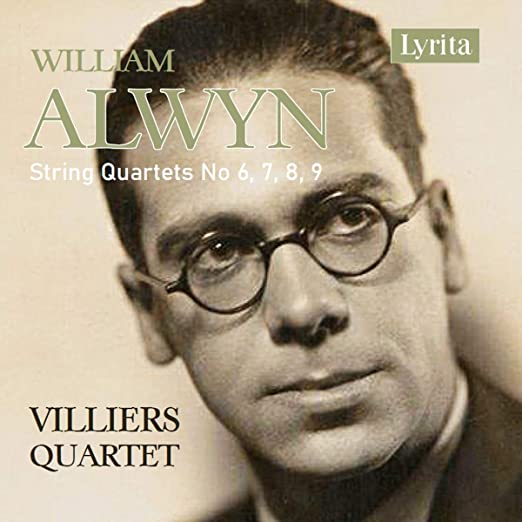
ALWYN: String Quartet No. 7 in A; String Quartet No. 6 in E minor; String Quartet No. 8 in D minor; Seven Irish Tunes for String Quartet; String Quartet No. 9 in One Movement – Villiers Quartet – Lyrita SRCD 386, 75:11 (3/20) [Distr. by Naxos] ****:
William Alwyn (1905-1985), besides having made a fine reputation for his excellent film scores – I recall the music for Odd Man Out and The Rocking Horse Winner with fond respect – maintained a deep reverence for the string quartet medium, which he called “the most intimate of ensembles.” The Villiers Quartet – James Dickenson and Tamaki Higashi, violin; Carmen Flores, viola; Nick String fellow, cello – has recorded those relatively early efforts in the medium in which Alwyn composed between the ages of eighteen and twenty-five, along with the last three of his quartet opera, composed between 1953 and 1984. En masse, Alwyn created sixteen string quartets – as had Beethoven – which embrace a Romantic ethos colored by incursions into modal dissonance and experiments with musical for, when he feels the necessity. Alwyn completed thirteen of his quartets between 1920 – 1936.
The through-composed Quartet No. 7 in A (1929) begins, Prelude: Allegro with a viola theme that traverses all four instruments, forte, and the movement disappears after only two minutes. The melodic tissue will appear later, in the third movement, Rondo: Allegro ma non troppo, as played by viola and cello. Twice as long as the first movement, the Passacaglia: Moderato second movement opens pp in the two violins, then cedes melody to the lower instruments. The interplay seems to benefit from lessons on Beethoven as well as Bach, with long notes in the cello. The dynamics dwindle into a soft pianissimo. The third movement, opening as a canon that evolves as a Rondo, featuring the second violin in dialogue with the cello. In the development section as such, the sonorities could easily be attributed to Shostakovich in their audacious dissonance as startling sound-clusters. The extensive, final movement Alwyn designates Retrospect: Adagio e tranquillo, which begins with a sense of musical stasis, passing modally – with recollections from prior movements – into brief, askew, melodic kernels that eventually coalesce in a fortissimo. The atmosphere of hovering uncertainty returns, an extended meditative coda that concludes with the intensity that silence manages to impose.]
The String Quartet No. 6 in E minor (1927) bears a dedication to John B. McEwen, Alwyn’s composition teacher at the Royal Academy of Music. This work begins Moderato, with ff chords in a dark mood that the cello extends urgently, to pass the material onward to the other strings. Viola and cello engage in some lyrical but dark mediations. The counter theme has a brighter color, set in B Major, allowing the first violin to sing. Some high tessitura marks the development section, angular and lyrical but fraught with tension. The cello and violin carry the melodic tissue forward. Music in canon and in unison proceeds. The romance of the second theme send the last pages into calm waters.
The Interlude, quite brief, suggests a subdued salon waltz over tremolo and pizzicatos, with a small, animate trio. The third movement, Scherzo: Allegro proceeds, attacca, with a rustic, country flavor, close in spirit to Percy Grainger. Some counterpoint fills the space to the martial, rustic da capo, where a dynamic quietude settles over the music to end pianissimo. The last movement Alwyn marks Theme, Variations, and Finale, Allegretto. The easy-going theme has five variants, one of which breaks into a pulse-pounding Allegro molto. A subsequent variation sounds like a meditation from Bach’s Der Kunst die Fuge. The cello takes up the fifth variation, where a sense of serenity preceded the stormy coda. The pace gains a sense of urgency up to the coda, ending in three, resolute chords.
The 1931 String Quartet No. 8 in D minor presents us a six-movement, concentrated work that looks back to Beethoven and shares some chromatic kinship with Bartok. Opening Adagio molto e tranquillo, with a sustained chord on the second violin, viola and cello, the first violin plays the main theme that infiltrates the entire quartet. The next series of movements – Adagio ma non troppo; Poco piu mosso; Andantino (quasi Allegretto) – Allegro moderato – Andante con moto – extend the main idea as a series of variations. The lengthy seventh movement, Allegro, reminisces (romantically) on the former impulses, including the first measures of the work, quickening the tempo and increasing the dynamics until the coda, which shifts the tonality to the tonic major, D.
Early in his musical development, Alwyn cherished Irish folk tunes, even including such material in his opera The Fairy Fiddler (1925) and films like Odd Man Out (1946) and Captain Boycott (1947). The Seven Irish Tunes for String Quartet (1923) derive from the Petrie Collection of Irish Music and embrace a diverse range of emotions. The easy sway of the music within the quartet medium may remind auditors of Dvorak’s similar deftness in transcription. The Villiers play the seven in groups: The Little Red Lark, Air; and The Maiden Ray; The Ewe with the Crooked Horn, The Gentle Maiden, and Who’ll buy my Besoms; and Jig. Those with the reel (the Ewe) sensibility fly through the air or chug with rustic vigor, in a spirit (Jig) close to Grieg or Grainger.
The Villiers conclude with the 1931 String Quartet No. 9 in One Movement, which takes its cue from the eponymous Romeo of Shakespeare’s play, Act V, Scene 3: “O here/Will I set up my everlasting rest,/ And shake the yoke of inauspicious stars/From this world-wearied flesh. . .” Romantic and passionate, the piece creates a tone-poem for string quartet, frequently altering its tempos and dynamics, mostly set in C minor, but moving to a serene C Major that dissipates into the spacious aether.
The Villiers made a point of performing the String Quartets No 8 and 9 at the William Alwyn Festival in Suffolk, October 2018. Their contribution to the enrichment of the Alwyn legacy we well note.
—Gary Lemco