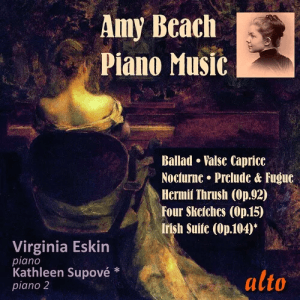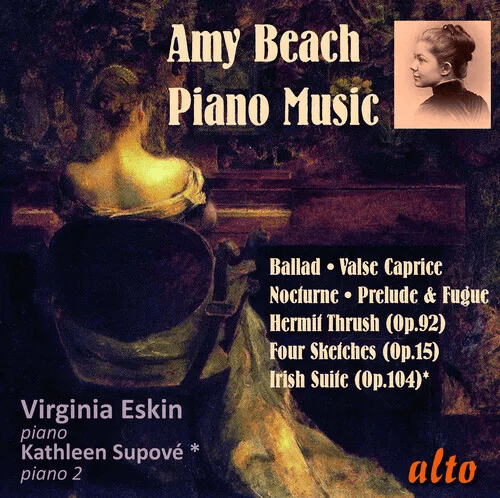
AMY BEACH: Piano Music = Ballad in D-flat Major; Valse Caprice; Nocturne; Prelude and Fugue; Four Sketches; Hermit Thrush; Irish Suite – Virginia Eskin, Kathleen Supové (2nd piano) – Alto ALC 1481 (68:00, complete contents detailed below) [www.altocd.com] *****:
American composer Amy Beach 1867-1944) enjoys a renaissance that begins to compensate for the relative neglect she and her music suffered for most of the 20th century. Having performed as a piano soloist with the Boston Symphony in 1885, she matured into a composer whose 1896 Gaelic Symphony marked a significant debut for women in professional music circles. While her musical syntax remained conservative, an offshoot of the language of Chopin, Liszt, and Schumann, her New England sensibility, with its pantheistic impulses, provided a distinct color for her inter-disciplinary vision, quick to unite music and poetry, in the manner of Mendelssohn and fellow Americans MacDowell and Coleridge-Taylor. This 2024 Alto issue remasters an original Koch release recorded in March 1994 made at the Music Room, Cambridge, MA.
Some exotic harmonic syntax opens the expansive, virtuosic Ballade in D-flat, a key whose innate romance likewise appealed to Schumann, Chopin, and Debussy. The trilling effects easily suggest the bird calls that inhabit her later Hermit Thrush pieces. The middle and late sections of this Ballad ring with alternately declamatory and dreamy hints of opera, notably Wagner. The imposing Valse-Caprice playfully combines the dervish wit of both Liszt and Chabrier, although its skittish texture more than hints at the influence of Moszkowski.
The Nocturne conveys a heavy, perfumed sensibility, close to the ethos of Gabriel Fauré. The extended melodic line appropriates some modal syntax, echo effects, and syncopation. The most expansive of the initial quartet of pieces, Prelude and Fugue (1919) indulges in organ sonorities that resound with Franck’s transposition of J.S. Bach, and its almost sullen gravitas impressed the epitome of Romantic-era virtuosos, Josef Hofmann. The scalar passages unite Franck and Chopin, with lyrico-dramatic effect. The thick Fugue, chromatic and exploratory in tonal breadth, might be attributed to Reger as well as to Franck, if the former would indulge more in transparency.
The Four Sketches of 1892 – In Autumn, Phantoms, Dreaming, Fireflies – indulge in impressions that hint at Grieg and Debussy, though more conservative than the latter. The In Autumn suggests, as it chromatically gravitates between F# minor and A major, a rural excursion in broken metrics. Phantoms enjoys a dreamy-waltz contour, quite transient. Dreaming simply extends the arpeggiated reverie, with pulsating bass chords. Fireflies demands a solid command in thirds, a la Chopin. The darting, staccato accents of the piece elevate its interest beyond a mere copy of Chopin’s study.
Pianist Eskin calls the two Hermit pieces “mimetic,” and their introspective passages point to the influence of Schumann, even while the MacDowell Colony in Peterborough, New Hampshire provided the aural model. An inscription in the score of The Thrush at Eve testifies to the innate pantheism – in the manner of the poet Gerard Manley Hopkins – of the locale: Holy, holy in the hush Hearken to the hermit thrush; All in the air. . .is in prayer.
Those familiar with Amy Beach scores may easily associate the concluding selection, the 1924 Irish Suite for Two Pianos, with her popular Scottish Legend. Beach indulged her penchant for portraying landscapes in music, likely a derivative of her knowledge of Mendelssohn’s opera, certainly that of Edward MacDowell. At intense moments, the suite resembles an orchestral exercise in two-piano sonority that rivals Rachmaninoff, as exhibited early in the opening “Prelude.” A haunted sense of melody treads cautiously through an octave bombardment and daring harmonic shifts that claim a chord’s middle third for a modal shift. An askew rhythm sets off the “Old-time Peasant Dance,” one whose eccentricity Grieg could well appreciate. The busy chromatic shifts, especially in the bass harmonies, the Beach notion of chiaroscuro, seems Liszt-inspired.
The most extended section, “Ancient Cabin,” combines chromatic harmony and scalar filigree in an introspective landscape. Is Beach paying homage to Mussorgsky’s “The Old Castle” from the Hartmann suite? The melodic contour, a gentle parlando, assumes all kinds of doubling effects and chordal grandeur. The dynamic alters significantly mid-stream, becoming evanescent in arpeggios and soft trills, soon rising into a personal, exalted orison. The “Finale” resorts to some shanty impulses, quite percussive and martial in spirit, unafraid of counterpoint. The two keyboards seem to indulge in some clever (clan) competition, happily finding thunder in their reconciliation. A witty, polyphonic gig ends the suite, deft and resolute.
—Gary Lemco
Amy Beach Piano Music
1. Ballad in D flat, Op.6 7.39
2. Valse Caprice, Op.4 4.54
3. Nocturne, Op.107 3:32
4. Prelude and Fugue, Op.81 9:00
Four Sketches, Op.15
5. In Autumn 2:16
6. Phantoms 2:07
7. Dreaming 3:27
8. Fireflies 2:48
9. Hermit Thrush at Eve, Op.92 No.1 4:15
10. Hermit Thrush at Morn, Op.92 No.2 3:47
Suite for Two Pianos on Irish Melodies, Op.104*
11. Prelude 6:53
12. Old-time Peasant Dance 4:35
13. Ancient Cabin 8:18
14. Finale 4:23
Kathleen Supové, 2nd piano