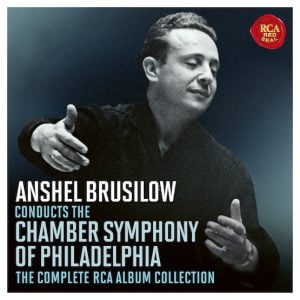
Anshel Brusilow conducts the Chamber Symphony of Philadelphia = Complete RCA Album Collection CDs (279:17) [Distr. by Sony] *****:
(Performing artists annotated below)
Collectors and music enthusiasts may recall violinist Anshel Brusilow (1928-2018) as the enterprising concertmaster of the Philadelphia Orchestra under Eugene Ormandy, who initiated an independent ensemble in 1961, The Chamber Symphony of Philadelphia, drawn from 35 members of the regular symphony orchestra. Brusilow, a violin student of Efrem Zimbalist at Curtis and a conducting student of Pierre Monteux, had served in New Orleans and Cleveland before his tenure in Philadelphia, and the new ensemble’s early days proved auspicious, and Brusilow mounted five concerts per season between 1961 and 1965.
Eugene Ormandy, however, manifested his capacity for dictatorship by instituting in 1964 a “moonlighting clause” that prevented any group of Philadelphia musicians – beyond five participants – from appearing outside of Symphony venues. When Armenian composer Richard Yardumian (1917-1985) collaborated with Brusilow for a recording of the Mass, Come Creator Spirit in 1967, Ormandy vented his jealousy by having Yardumian’s name erased from the Philadelphia Orchestra commemorative booklet, despite the fact that Yardumian had served as virtual composer-in-residence for the Orchestra, which had premiered and recorded a significant number of his works for CBS. Despite such restrictions, Brusilow obtained an exclusive recording contract with RCA, even before its official debut on 2 October 1966. The ambitious programming of large works, like Mendelssohn’s Italian Symphony and Beethoven C Minor Piano Concerto further alienated Ormandy, who resented unwanted competition. The Chamber Symphony of Philadelphia cut six records between 3 March 1967 and 10 January 1968, not to mention the 240 public concerts Brusilow led. Low pay and lack of funds reduced the ensemble by 16 members by 23 March 1968, the season having been reduced to twelve concerts instead of twenty-one. On 29 December 1968 the ensemble disbanded, and these six records remain as Brusilow’s “real comfort and lasting legacy.” The original LPs went out of print by 1972, and so this CD incarnation retrieves the group’s work after an absence of 50 years.
CD 1: Brahms: Serenade No. 1 in D Major, Op. 11. The 1857 Serenade in D by Brahms intends to imitate the divertimentos and cassations of Haydn and Mozart, apt models for this and the Op. 16 Serenade No. 2 in A, these first orchestral exercises by Brahms. The recording by The Chamber Symphony of Philadelphia (3 March 1967) enjoys a frothy energy from the first measures of the sonata-form Allegro molto first movement, certainly competitive with the two Decca interpretations of the earlier era, those by Thomas Scherman and Leopold Stokowski. The wind sound in Philadelphia resonates in woodsy colors, and the string sound proves warmly lush. The French horn, flute, and bassoon work stands out with their individual relish and infectious verve.
The second movement, a gentle Scherzo in G, ¾, remains “soft and sweet,” as indicated, though the elongated middle section achieves a resolute, martial spaciousness. The fifth movement, a second, brief Scherzo in G Minor, projects rustic energy, especially for the horn part over a busy accompaniment in the low strings. That the music “alludes” to the Beethoven C Major Symphony seems no accident. The heart of this grand work lies in the third movement, Adagio non troppo in B-flat Major, with its radiantly harmonized melody that transcends the “Classical” models that inspired it. Its middle section features a brief canon Brusilow etches with resonant care. The Minuetto movement four provides a duet for two clarinets, joined by a solo flute and a rustic bassoon. The music sojourns into the minor mode with intense colors from flute, violin, and viola. When the strings assume the melodic responsibility, the effect basks im romantic glamour. The Brahms capacity for rhythmic magic occurs in the brilliant combination of themes in the Rondo: Allegro finale, where asymmetrical phrases merge with sonorous flair in meters that alternately bounce and canter with robust authority in this impressive reading.
CD 2: Yardumian: Come, Creator Spirit: A New Mass in English1. In 1963, the Ecumenical Council in Rome decided that the traditionally Latin Mass could be expressed in the vernacular, particularly English, and Fordham University commissioned Yardumian’s “New Mass in English” for the University’s 125th anniversary, the first such piece by an American composer. Yardumian chose to set the Catholic hymn associated with feast at Pentecost, invoking the Holy Spirit to illumine the hearts of the faithful. The Brusilow performance, recorded 1 April 1967, engages Armenian-American mezzo-soprano Lili Chookasian (1921-2012), who had collaborated with Eugene Ormandy and the Philadelphia Orchestra in Mahler’s Das Lied von der Erde.
Yardumian’s Mass utilizes a number of Gregorian chants as the basis for its polyphonic, modal textures. Yardumian, though not a Roman Catholic, chose a 10th Century, Armenian, liturgical Sanctus for his own use. The work allows the congregation to participate, so the writing remains “polymodal” while insisting on textual clarity. We feel the composer’s sincere expression of spirituality, his sense of the occasion’s majesty, as he employs the ecumenical Church modes in a modern context. The scale of the orchestral writing easily suggests an imposing ensemble that would normally intimidate the ambitions of a traditional chamber orchestra. The heart of the work, the third movement, Credo, will “confess one baptism for the forgiveness of sins,” the fundamental admission of universal compassion into the world.
CD 3: Tchaikovsky: Suite No. 4 in G Major, Op. 61 “Mozartiana”3; Andante cantabile from String Quartet No. 1 in D, Op. 11; Arensky: Variations on a Theme of Tchaikovsky, Op. 35a. Brusilow and ensemble recorded the two Tchaikovsky entries, respectively, on 3 March 1967 and 13 October 1967. The Arensky dates from 8 January 1968. Tchaikovsky, who had always admired Mozart, conceived the 1887 Mozartiana as a tribute to the centennial of the premiere of Don Giovanni, an opera Tchaikovsky venerated. He had originally conceived his 1880 Serenade for Strings as homage to Mozart, especially its opening “Elegie.” For the suite of four movements, Op. 61, Tchaikovsky orchestrated less familiar Mozart keyboard works. The deft, contrapuntal facility of composer and performers marks the opening Gigue in C, K. 576. Stately and elegant, the Minuet in D, K. 355 allows Brusilow’s winds and strings their luxuries and passing dissonances. Tchaikovsky took Franz Liszt’s transcription of Mozart’s motet Ave verum corpus, K. 618 as the basis of his Preghiera. Marked Andante non tanto, the music achieves a balletic, even Wagnerian, sonority, especially given the notable harp part. The expansive last movement derives its materials from Mozart’s Theme and 10 Variations, K. 455 from Gluck’s opera The Pilgrimage to Mecca. A martial tune, set by winds and strings, proceeds in pellucid, dramatic procession, each choir of the Chamber Symphony allowed its especial, often blazing, virtuosity. Stuart Canin’s accomplished violin solo in Variation IX, Adagio, bears multiple hearings.
The popular Andante cantabile of 1871 exudes a radiant warmth of expression, the expanded, string orchestra movement from his First String Quartet having been arranged by the composer himself. Speculation states that the melody line derives from a peasant folk song, and that the eminent author Leo Tolstoy wept at the music in concert that Tchaikovsky attended.
Between the two Tchaikovsky compositions, Brusilow and ensemble perform the 1894 Variations on a Theme of Tchaikovsky by Anton Arensky (1861-1906), who had been a friend and colleague of Tchaikovsky. Written as part of collective tribute to Tchaikovsky a year after his death, the piece adopts a song, “Legend,” the No. 5 from Tchaikovsky’s group of Sixteen Children’s Songs, Op. 54. Arensky originally included his work as the second movement of his String Quartet No. 2 in A Minor, Op. 35. The theme, eight variations, and coda predominantly occupy the elegiac key of E Minor, though Variation III moves to the tonic major. Again, the Philadelphia Chamber Symphony strings exude a tender affection for the work, a reading easily comparable to those by Sir John Barbirolli and Evgeny Svetlanov.
CD 4: Cherubini: Symphony in D Major; Haydn: Symphony No. 60 in Major, “Il Distratto”. Haydn’s Symphony 60 receives a performance from Brusilow and his ensemble from 13 October 1967. Among Haydn’s most inventive and amusing scores, his 1774 six-movement symphony “Il Distratto” derives from incidental music he composed for a German language performance of a 1697 French comic farce, Le Distrait, by playwright Jean-François Regnard, about an absent-minded gentleman who forgets his wedding day. The diverse musical styles Haydn employs, from stately Baroque processionals to “a medley of Balkan folk tunes” (H.C. Robbins Landon), ensured the hilarious situations dramatic success. The Symphony contains the overture, four entr’actes, and the finale from music that accompanies the five-act play. From the leisurely opening chords of the Adagio, Brusilow establishes a firm pulse, immediately translating into a buoyant Allegro di molto. The pungent, staggered accents and suddenly explosive, rocket figures enjoy a dynamic nuance that combines verve and salon intimacy. The G Major Andante, 2/4, projects a somber, somewhat swaggering confidence featuring a fanfare between oboe and horn. The Menuetto revives the sense of reckless impulse, with a mockingly dark C Minor Trio in ¾. The tune resembles that of the opening movement of Mozart’s Piano Concerto No. 24, K. 491. The hectic fourth movement, Presto, extends the C Minor hue of the Menuetto, here in 2/4 and then modulating to the major mode. Brusilow’s strings hustle with deft accuracy. Movement 5, Adagio (di Lamentatione) in F Major, inserts music for trumpets and timpani, ever so briefly, in the course of a soaring, romantic melody. The music suddenly speeds up in the coda, a true symptom of forgetfulness. The neurosis continues into the 2/4 Finale; Prestissimo, marked by out-of-tune instruments. The o surreal style of writing marks the work as Haydn’s most Dadaist composition, a musical joke for the ages.
The 1815 Cherubini Symphony in D (recorded 3 March 1967), written for the Paris audience, warmly opens, Largo, with a lovely galant combination of strings and winds prior to its vivacious Allegro main theme and development. Cherubini, much admired by Beethoven, establishes a neat balance of lyric and muscular, rocket motifs in a style that lies between Mozart and Mendelssohn, often in unobtrusive counterpoint. Brusilow’s rendition makes Cherubini sound pre-Schubert, with a gently galloping penchant for brass and drums. The coda rings a bit false, a tacked-on affair. The second movement, Larghetto cantabile, proceeds in lyrically gracious sonata-form, celebrating the woodwinds. The more agitated development indicates Sturm und Drang impulses, later developed in the last movement. The latter two movements –Minuetto and Finale – certainly anticipate Beethoven while reveling in bustling techniques Haydn would admire. Brusilow gives the Trio section of the rustic Minuet its chugging, flighty due, much in the manner of a buffo aria for flute. Dynamic rhythms mark the last movement, another study in sonata-form, capitalizing on Cherubini’s polyphony and blended colors. This (temporarily polyphonic) Finale exerts more of the Sturm und Drang sensibility than prior movements, but still executed with a light hand. The style of counterpoint could easily have influenced Samuel Barber.
CD 5: Ravel: Le Tombeau de Couperin2; Françaix: Sérénade, for Small Orchestra; Ibert: Paris; Capriccio. Brusilow addresses French music in three sessions, 13 October 1967 (Ravel), 10 January 1968 (Françaix; Ibert Capriccio), and 8 January 1968 (Ibert Paris). Ravel’s Le Tombeau de Couperin, written 1914-1917, simultaneously revives the Baroque suite and pays tribute to fallen friends and heroes of WW I. Lightly etched and finely articulated, the Ravel suite emerges in clearly diaphanous resonance, dominated by the ensemble winds. The antique Forlane second movement alternates between sentiment and a touch of irony. James Caldwell’s sweet oboe illumines the Menuet, whose bittersweet – sometimes veiled with harp tones – stateliness warrants the price of admission. The brassy and energetic Rigaudon, marked Assez vif, hustles with the brass dominant, supported by once more by a serpentine oboe line in the trio. Pizzicato strings underlie fine hues by companion woodwinds, The initial brass motif returns with a resolute firmness to conclude the suite.
Jean Françaix (1912-1997) became part of a French movement away from German seriousness and heaviness of purpose. His 1934 Sérénade embodies all of his virtues for wit and sonorous fluency in small forms. In four movements that barely occupy ten minutes of music, he demonstrates a fleet, nonchalant grace rife with rhythmic and color diversity. The Vivace last movement has a dance-hall irony about it that slickly evades easy comparison except in the drawings of Lautrec.
Jacques Ibert (1890-1962), rather like Poulenc, exhibits the sensibility of the boulevardier, the man-about-town. Like Françaix, Ibert bears the imprint of Ravel’s taste for clarity and chiseled architecture, albeit playful and acrobatic. Ibert’s 1930 Symphonic Suite “Paris” is the result of incidental music written for a play by Jules Romains, Donogoo, and is set in six scenes. “Le Metro” begins at 8:00 A.M., when a trumpet announces our departure. The jazzy, irreverent brass scoring, deftly executed, keeps our ears and feet moving, while the bass strings mock our sobriety as the train moves below ground. “Faubourgs,” the suburbs, immediately clashes with our daily chores, the diurnal drudgery of making a living. The battery section, in tandem with the flute and solo violin, mock and lament the routine of working life, in rather Chaplinesque colors. “La Mosquée de Paris” offers an exotic moment, an Arabian lilt and Moorish drumbeat in the midst of the City of Light. “Restaurant au Bois de Boulogne” might well parody Ravel’s La Valse, with couples embracing in the glow of a soft keyboard, snare drum and cymbals, the seductive strings swirling. The brass and piano cheapen the whole affair, a dance-hall energy now a bit out of control. “Le Paquebot ‘Ȋle de France’” depicts a steamship that symbolizes escape into a better, idealized world. The misty atmosphere, the hazy modulations, the piano undercurrent, might suggest that such dreams are not all they seem. “Parade foraine” blasts whistles, trumpets, and circus or shooting gallery gestures at us in parody, perhaps the Paris equivalent of Cecil B. DeMille. Gaudy and irreverent, Ibert’s music seems to celebrate bad taste.
Ibert’s Capriccio for 10 Instruments (1938) is scored for winds, harp, and strings. A busy piece, it asks the winds to chirp, fly in the air, and buzz in mock conversation. The music soon divides the winds, brass and strings so each has its sonorous moment. For a moment the harp becomes a concertante instrument, while a bluesy tune arises from the ensemble. When harp and flute combine, at a slow tempo, a haunting color emerges, in debt to Debussy and Ravel. The texture reduces to chamber music momentarily, but then the initial, scampering energy returns, the clarinet and flute quite prominent. Pungent brass jabs announce the restiveness that permeates the last two minutes, the harp once more engaged in a series of glossy arpeggios that end on notes from a solo violin. The last measures bustle despite the Lento indication, a final poke in the ribs.
CD 6 R. Strauss: Der Bürger als Edelmann, Op. 60; Wolf: Italienische Serenade.
Brusilow turns to the German tradition, recording the Wolf Italian Serenade on 13 October 1967 and the Strauss treatment of Molière’s 1670 comic-ballet Le bourgeois gentilhomme on 8 January1968. The Strauss nine-movement suite, composed between 1911 and 1917, results from the composer’s collaboration with librettist Hugo von Hofmannsthal (1874-1929), who along with Max Reinhardt, founded the Salzburg Festival in 1920. Originally intended to fuse the Molière play with another operatic production, Ariadne auf Naxos, the enterprise became too costly unwieldy to mount, so in 1916 Strauss created an independent orchestral suite requiring no stage theatrics.
The Overture bristles with light steps, depicting Monsieur Jourdain, the upstart parvenu, pretending to aristocratic virtues. In the two ensuing sequences, Menuett and Der Fechtsmeister, Jourdain proves himself inept in manners and fencing. The parody of his efforts, realized by the trumpet and piano, enjoy a keyboard bravura in the manner of the Strauss D Minor Burleske. An obvious allusion to Wagner, the “Entrance and Dance of the Tailors” parodies manners and aristocratic graces, featuring an alluring violin solo in Viennese style, here we assume played by Stuart Canin, much in competition with the effects Willi Boskovsky would realize for Clemens Krauss. The ensuing Menuett, Courante, and Entrance of Cléonte take their cue from the composer Lully, who provided music for the original Molière play. Strauss captures the mood of the Louis XIV court with a touch of nostalgia. The Prelude to Act II anticipates the lavish Dinner scene, as honored guests will repast not merely on an “omelette surprise” from the Kitchen Boy, but an elaborate pastiche of Strauss and Wagner allusions, including references – bird calls, bleating sheep, and swirling watzes – from Das Rheingold, Don Quixote, and Der Rosenkavalier. Brusilow exults in Strauss at his pompous, flamboyant best here in the Tafelmusik, demonstrating the gifts that Stravinsky claimed belonged to “a great connoisseur” of orchestral sound. The solo cello and harp intone what may be a swansong to a by-gone, self-indulgent, luxuriant age.
Hugo Wolf’s Italian Serenade is a product of three days’ inspiration in early May 1887. Wolf meant to publish the lyric as a Serenade in G Major, but by 1890 he changed the name to its present title and then orchestrated the piece in 1892. Akin to the spirit of Chopin and his piano, Wolf conceived the orchestra as a vocal instrument, and the viola that rises in song becomes his chosen alto. Marked Molto vivo, the music receives from Brusilow the aerial transparency of texture and fluid motion that his well-groomed ensemble delivers with its patented, refreshed capacity for color nuance: a delightful finale for a collection of talented instrumentalists whose contribution to music ended all too soon.
—Gary Lemco
Anshel Brusilow conducts the Chamber Symphony of Philadelphia = Complete RCA Album Collection
Performing Artists:
Lili Chookasian, mezzo-soprano1
Chamber Symphony of Philadelphia Chorale1
Fordham University Glee Club1
Thomas More College Women’s Chorus1
James Caldwell, oboe2
Nathan Brusilow, clarinet3
Stuart Canin, violin3
More information available through Sony Classical