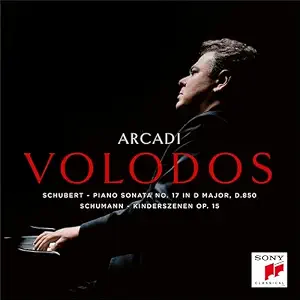
SCHUBERT: Piano Sonata No. 17 in D Major, D. 850; SCHUMANN: Kinderszenen, Op. 15 – Arcadi Volodos, piano – SONY 96588 79292 (3/24/26) (64:50)****:
Pianist Arcadi Volodos recorded these works live in Paris on 22 June 2022, avoiding the studio since he sees that venue as “a trap” that stifles “the risks and imperfections” that mark music “in the fullest sense” with its burden of truth. Schubert’s 1825 Piano Sonata in D, dedicated to Czech pianist Carl Maria von Bocklet, enjoys that same exuberant bravura we find in the Wanderer Fantasy. Two recordings among many stand out in my pantheon: those by Artur Schnabel and Eugene Istomin. Each captures the unbuttoned, happy grandeur of the work, its often punishing triplets, circuitous harmonic routes, and subtle, shifting metrics all subsumed into a fertile, assertive vision, an aerial demonstration of Schubert’s musical virtuosity.
The first movement, Allegro vivace, may invite too energetic a realization of its fanfare effects, soon followed by a series of brittle, yodeling figurations that miraculously do not diminish the cumulative motion of the musical progress. But Volodos maintains the easy tensions of the competing motives with a silken grace, attentive to the pregnant silences between the notes. At moments, the chordal annunciations assume the power of a mountain chorale, girded by torrents of scalar energies. The constant juxtaposition of major and minor versions of his themes, insistent and then mincing, allots Schubert a panoply of nervously balanced colors for Volodos’ refinement.
I must confess that Schnabel hypnotized me with his playing of the monumental A major Con moto second movement, particularly the music’s secondary section (in D major) in striking syncopations. What begins as a direct, simple song opens into a paean to the love for music itself. Volodos breathes a natural life into the progress of this sculpted hymn, forming an extended rondo form, which implies the structure of a palindrome. The flexibility of Volodos’ tempos add a sense of improvisation to an already liquidly dramatic context. Individual chords, recitiatives, and tone clusters ring with delicacy and intimate communion. For those who extract from Schubert a “religious” sense of musical experience, this moment of “absolute” music invokes many layers of the ineffable.
The jaunty, robust Scherzo: Allegro vivace – Trio cannot make up its metrical mind whether it prefers 3/2 or ¾, just so the contest extends into a soft laendler or waltz tune that emerges amidst the syncopations. B-flat major, D major, and G major vie for predominance, but the emotional affect remains courteous despite the vigor. The juxtaposition of thick chords against delicate strings of scalar tracery seem to play with our sense of whimsy, how quickly a dire sense of tragedy may modulate to mirth: here, the final impression approaches a musical box.
The last movement, a modified Rondo: Allegro moderato, has Volodos returning to the alla musette sensibility, offering a dainty march that Haydn might have invented. The balanced cadences soon subdivide and digress into flurries of quick, scalar movement and minor harmonies. The martial air becomes decisive and serious, only to relent into studied, staccato études. A new theme emerges in the best Schubertian lyric style, a possible remembrance from a Moment musical. We experience some serious, even polyphonic thoughts, assertive but eminently nostalgic. Schubert builds to a final repetition of the march theme in variation, the kind of lyrical animation that characterizes the many sets of German dances. The motion slows down in a kind of dramatic entropy, dissolved, a fond reminiscence.
Robert Schumann’s 1838 collection of 13 “easy pieces,” Kinderszenen, first came to me by way of Artur Schnabel. The idea of capturing in music “childlike wonder” encapsulates much of Romanticism, not only Wiliam Wordworth and Charles Dickens. As Volodos points out in his commentary, Schumann “is made up of contrasts, of sudden break and moments of blinding intensity.” We may equate the stark emotional contrast with Schumann’s Florestan and Eusebius, his alter egos of assertion and restraint.
Little of “the child” lies in the technique asked of the pianist. Despite their brevity, the pieces require consummate fluidity of style and a poised sense of time. “Of Foreign Lands and Peoples” rocks us with a sense of exoticism born of the interval of the sixth, B-G. “Curious Story” presents a maerchen, a fairy-tale, dotted-rhythm narrative. “Pleading” alternates scales but ends with an unresolved dissonance with G atop an A major chord. Robust in temper, “Important Event” sems to round off the initial six (of twelves) as a unit, with six more and an epilogue to complete the cycle.
“Träumerei” remains the most famous episode, its dreaming in F major dependent on the rising 4th, made eternal by any number of Horowitz realizations. Volodos allows the piece the same breadth and affective courtesy he might grant Debussy’s Clair de Lune. Florestan returns to us in “The Knight of the Hobbyhorse,” a piece that might have inspired D.H. Lawrence’s “The Rocking Horse Winner,” along with Schubert’s “Erl-King.” Volodos gives the ride a brittleness that soon erupts into a more threatening gesture.
Gentle counterpoint marks “Almost Too Serous,” syncopated and modulating into G# minor. “Frightening” vacillates between a simple arioso and an impulsive collision of both hands. “Child Falling Asleep” offers a tender, rocking, syncopated chorale in E minor. The sensibility proceeds into the recitative of “The Poet Speaks,” in which Schumann’s rich harmonization and poignant pauses reflect moments in Beethoven for seriousness of purpose. Spiritual intensity need not be loud, but merely authentic.
—Gary Lemco