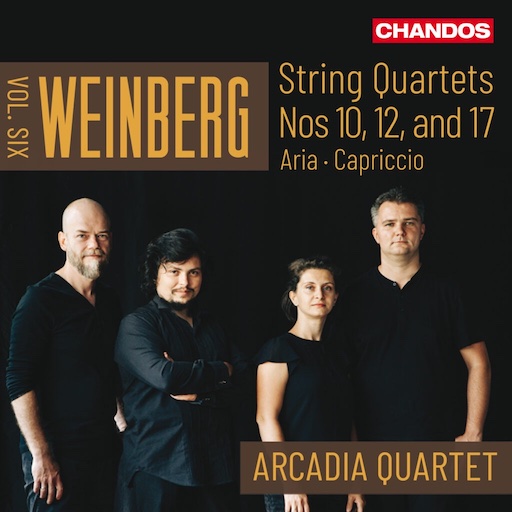
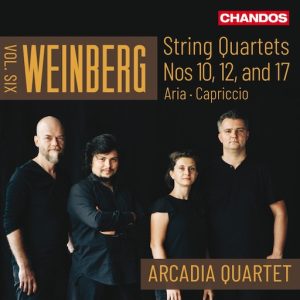
WEINBERG: String Quartet No. 10 in A Minor, Op. 85; String Quartet No. 12, Op. 103; String Quartet No. 17 in D Major, OP. 146; Aria in D Minor, Op. 9; Capriccio in A-flat Major, Op .11 – Arcadia Quartet – CHANDOS CHAN 20363 (85:15) [Distr. by Naxos] *****:
This Volume 6 (rec. 3-5 April 2025) by the Arcadia Quartet, dedicated to the complete quartet oeuvre of Mieczyslaw Weinberg (1919-1996), completes the cycle, especially welcome given the Arcadia Quartet’s ethos, to shed light on Weinberg’s legacy, “this wide-ranging, profound phenomenon, which has been overlooked for so long.” Often, the music of Weinberg must submit to analyses of the political situations that influenced and often constrained his work. Of equal note, Weinberg’s friendship – and creative competition – with his great contemporary, Dmitri Shostakovich, invites comparisons and contrasts. But Weinberg forged a path of musical distinction independent of direct imitation; and rather Weinberg exploited his nationalist Polish, Jewish, and Slavonic roots to master his idiosyncratic means of expression.
Arcadia opens with Weinberg’s String Quartet No. 10 in A Minor (1964), music dedicated to his future second wife, Olga Rakhalskaya. In four movements, the structure follows the old Baroque pattern of slow-fast-slow-fast format that Shostakovich likewise employed in his own Tenth Quartet. Weinberg’s music moves seamlessly through the four movements, drawing upon the long-line, chromatic impulses of his first movement, Adagio, for expressive possibilities. The moody procession while remaining fixed in A minor tonality, exudes a nervous, haunted melancholy.
From amidst a murmuring, eerie sonority a dance-like Allegro second movement emerges, conflicted, rather tussling between the parts. A buzzing in the first violin competes with pizzicatos and high register tessitura, while the cello toys with a plaintive lament. The writing becomes more virtuosic in character, but the mood remains elusive, a frustrated, resentful dance lyric. Violin and cello share the honors of the striking Adagio, the melody set over dissonant, raucous harmonies that suggest a strident call to ams. The anguish of the moment belongs to the first violin; but at a held D-flat pedal point, the music mutes to a somber echo of the former pain that fades away.
With the cello’s move to the enharmonic C#, the music of the last movement, Allegretto – Adagio, assumes a mincing, hesitant motion, eerie as in movement one, but initiating an ungainly waltz rhythm. The music devolves into segments of melody over a drone-like bass in waltz time, lyrical in spite of itself. A pizzicato sequence counters the modal harmonies and open chords, especially in the viola. Some high harmonics enter the moody tapestry, all the while the drone has extended, moving into a nervous, final space.
Weinberg’s String Quartet No. 12 (1969-1970) is dedicated to a Shostakovich pupil, Veniamin Basner and follows Shostakovich’s own model Twelfth String Quartet. No less influential, Bartok’s Third Quartet serves as an expressive icon. The knotty first movement, Largo, presents a concertante first violin part of extreme expressive range, occasionally eruptive in an otherwise sustained, somber atmosphere. At moments, the syncopated evolution of the music becomes static, with its energy drawn from the intervallic interweaving of instruments using12 notes of the chromatic scale without resorting to pure serialism.
The second movement Allegretto – Largo, proceeds like an experiment after the spirit of Bartok, pairing instrumental colors and brief melodic kernels and nervous rhythmic pulses. High whistles against pizzicato chords, glissandos, col legno, sudden interjections, and moody pedal points – until the solo cello in upper register asserts an arioso of an anguished kind to a quiet coda. A violent Presto ensures: A robustly intense march, it takes the Bartok gambit of separating and then combining the instrumental voices, often in vivid, motor rhythms. The dissonances take an ungainly, circuitous route to resolve themselves, indulging in quiet, intimate moments of modal harmony. Weinberg seems to parody Bartok’s notion of “night music.” The music becomes even more vigorous and intense, confronting harsh pizzicatos against an anguished first violin part that screeches the music to a sudden halt.
Annotator David Fanning calls the last, expansive movement Moderato “the strangest movement of all.” Metrically complex and texturally complex, including a contrapuntal section, having moved from 5/4 to 7/8, a blend of canon and double fugue. Melancholy in tone, the effect – for want of a better term – feels Kafka-esque in its sustained, almost mewling, angst. We feel kinships both with Bartok and Shostakovich, though the repetition of a chord repeated 32 times may call us back to the quick second movement of Beethoven’s Op. 135 F Major Quartet. The duets between first violin and cello, the persistent staccatos, collectively feel like calls from some personal abyss.
Weinberg’s String Quartet No. 17 (1986) returns to a defined tonal center, D major. This brief, relatively optimistic score has the Borodin String Quartet for its dedicatee, in honor of the ensemble’s 40th anniversary. Though performed attacca, the quartet has four defined sections. The aggressive, opening Allegro-Adagio tune bears an echo of the String Quartet Op. 11 of Samuel Barber. The music moves quicky to the dominant A major for a chorale tune, a busy enterprise for the four players. The cello enjoys a virtuoso cadenza, which functions as a transition to movement two, Andantino – Adagio.
A duet between violin and viola, after individual solos, segue into the Lento section. David Fanning claims the arioso theme bears resemblance to a “birthday aria” from Weinberg’s operatic treatment of Dostoievsky’s The Idiot. The notion of “original innocence” and its concomitant dangers (as in Melville’s Billy Budd) may account for whatever “confessional” aspects attach to this last of Weinberg’s quartets. Once more, the cello part proves most communicative, even as the violin offers an agitated, contrapuntal foil. The final movement, Allegro, whose relationship to movement one seems clear, but the allusions to previous motifs from other movements confound the process with rather stunning virtuosity, much in the manner of Bartok. The presto coda sings and stings our attention, suddenly harmonized into a resolute, tonal conclusion.
Two 1942 short works by Weinberg complement the later quartets: the Aria in D Minor
may owe debts to Borodin, though commentator Fanning cites Fauré. This work appeared simultaneously with Weinberg’s Symphony No. 1, Op. 10 (another Shostakovich “coincidence”). The piece enjoys a throbbing lyricism for all of its exactly four minutes. Timed at almost 86 minutes. I wondered if the final track, Weinberg’s 1942 Capriccio in A-flat Major, would play on my CD equipment. It did not.
—Gary Lemco
.
.