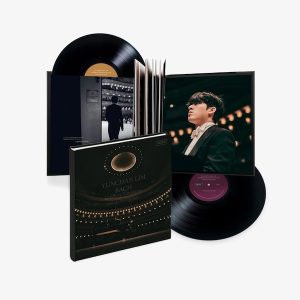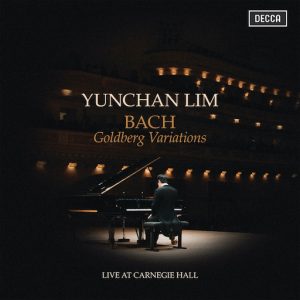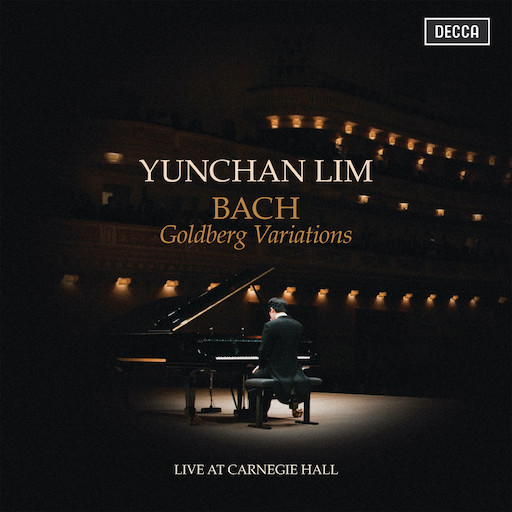
BACH: Goldberg Variations, BWV 988 – Yunchan Lim, piano – Decca 487 1515 (17/12/25) (77:22) [Distr. by Universal] *****:
Pianist Yunchan Lim presented J.S. Bach’s Goldberg Variations for his Carnegie Hall concert of 25 April 2025, a feat that, via recordings, has become synonymous with comparisons: Glenn Gould in 1956, and various interpreters of international stature, like Maria Tipo, Rosalyn Tureck, Jorg Demus, and Daniel Barenboim. Bach himself may have originally contemplated the 1742 piece “Aria and Diverse Variations” as a didactic vehicle – not merely as a “soporific” for Count Hermann Carl von Kaiserling of Dresden – but as the culmination to his Clavier-Übung, a comprehensive study-guide of keyboard practice at the time, a collection of klavier and organ works demanding virtually every technical and expressive skill in a performer’s repertory.
As a musical and arithmetic concept, the Goldberg Variations awe us in their “fearful symmetry,” to cite William Blake, given the progression of every third variant as a canon at a larger interval, and the recurrence of 16 and 32 as numbers for musical measures. All kinds of hyperbolic conceits abound to find transcendent praise for Bach’s achievement, but the “unity-in-variety” idea is not new, nor the integrity of the “Aria” itself, which remains “pure” at both ends of the musical odyssey. Commentators have pointed out the direct similarity of the sarabande “Aria” theme of 14 bars to Handel’s Chaconne and 62 Variations in their initial eight measures. What the individual interpreter must achieve lies in maintaining a seamless continuity while imparting unique character to the short – depending on a performer’s realization of repeats – episodes that constitute the entire necklace. Finally, despite the academic severity of the work, the player must permit a sense of gamesmanship and humorous delight in the astounding, aerial acrobatics of the filigree, whose humor asserts itself overtly in the quodlibet conclusion.
Lim establishes his approach from the outset, his piano tone confident in a modern, even romantic suasion of the “Aria,” with no attempt to make the piano sound like a harpsichord. Tempo and architecture early fused into a lyrical and yet bold evocation of Bach’s musical evolution. The contoured beauty of the “Aria” immediately calls forth the vehement first variation, in bold strokes. But Lim’s stunning legato, too, demands attention, as in Variation XXI, Canone alla Settima, a studied, gorgeous duet in liquid tones. The ensuing Alla breve dances with light feet and an exhilarated trill, while XXII indulges in quick, slickly galloping runs, the filigree indicative of some Brahms gambits in his Handel Variations.
Lim’s execution, both bravura and arioso, reveal themselves as early as Variation V, though for expressive tension and sustained lyricism, we await the epic Variation XXV, whose slow tempo and affective, legato inwardness elicit a special poetry. Barenboim lingers here for over 10 minutes, while Lim’s delicate tracery and dramatically restrained anguish extend for 8.5 minutes. Landowska called this variant her Black Pearl, and the piece requires its own sense of intimate depth. Lim’s fermata lasts forever, until the swirling motions of Variation XXVI catch us in a feverish eddy of pulsating, ornamental filigree. The Canone alla Nona quite dances with polyphonic deftness, its momentum aided by some wicked trills into the festooned antics of Variation XXVIII, without Lim’s succumbing to the temptation of pesante chords in the left hand. Variation XXX serves as an elaborate fanfare, and Lim does not hold back his trumpets and urgent cascades.
Lim’s Quodlibet, a bit marcato to my taste, sounds out two popular songs, a timely moment before the timeless “Aria” reasserts its placid hegemony. There have been many moments of note, as in the strong continuity from Variation V to Variation VII, and the exquisite Andante Variation XV, whose immediate contrast to the startlingly liberated leaps of Variation XIV could hardly be greater, for Canone alla Quinta presents solemn depths that might have inspired Franz Liszt.
In sum, Lim’s account of the Goldberg Variations contains both highly sensitive and breathtaking elements, the work wrought in well considered periods of evolution, with wide lacunae as the Bach experience gains girth and a voluptuous sense of structure. If Lim lacks Glenn Gould’s impetuosity and iconoclastic bravura, he brings an exquisite sense of articulation to the whole. Recording producer David Frost and his technical team deserve honorable mention for their fine document, to be accorded distinction among the annals of fine Bach playing.
—Gary Lemco
Also available on Vinyl