A highly individual reading of works that defy a single interpretation.
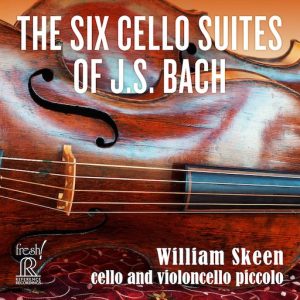
BACH: The Six Cello Suites – William Skeen, cello & violoncello piccolo – Reference Recordings FR-758 (2 CDs), 150:21 ****:
Any recording of Bach’s famous cello suites presents the performer with a host of issues, none easily resolved. Perhaps the decision to render these works on so-called “historical” instruments only adds to the problems. Since the advent of “historically informed performance” (HIP) practices, many, many assumptions have been made about the realities of what music sounded like in the good old days. Tempos are generally faster—why? We don’t really know as there are no concrete indications in the scores. Vibrato in string instruments has generally been jettisoned (though there are some exceptions—why? We don’t really know as there are no concrete indications in the scores or contemporary documents. And even as to what instrument the pieces were intended for remains a mystery in many cases. So, interestingly enough, the cause of many period instrument conductors and performers that tend to devalue the idea of “interpretation” actually lowers the bar enough to allow an extreme amount of interpretative finesse, surpassing that needed for performance on modern instruments! All Pablo Casals had to do was pick up his cello and play.
And play how? There is no indication in the copies we have of the cello suites (the most authentic maybe being the Anna Magdalena Bach manuscript—the original does not exist, unlike that of Bach’s violin partitas and sonatas) as to what these are for. It could be that they are simply exercises in the form of suites, as they are all very consistent in their structure, unlike the master’s other collections. If so, should they be played like that, with little interpretive nuance? Tough but necessary questions all.
As these are played on a period instrument, and by a well-worn and experienced practitioner of the instrument familiar with current baroque performing dogma, William Skeen (currently principle cellist of the Philharmonia Baroque Orchestra, among others), we know what to expect in terms of vibrato usage—none. The pitch is lower than on a modern instrument, a baroque bow is used, and the “Giovanni Grancino, Milan, 1725” cello, which has a beautifully dark tone in the first five suites, while the last, which calls for a five-stringed violonpiccolo 1685 instrument is on a reconstructed instrument that was saved from Nazi Germany, and reestablished in its five-string guise.
It is almost impossible to make comparisons with modern instrument readings as the two are so different, so perhaps an adequate evaluation will prove illuminating when looking at this recording (done carefully managed in Skywalker Sound Studios in California by Lolly Lewis) with two other personal favorites that also use a five string for the final suite. Matt Haimovitz on Pentatone is by far the most “interpreted” of any baroque recording I have heard of these works. Lots of pulling around tempos, pauses, radical dynamic shifts all mark his recording as one to reckon with, though it will set some period performers’ teeth on edge as too much hearkening to a romantic ethos not in current favor among HIP practitioners. His tempos are also extremely quick, the first three suites clocking in a rapid 58:46. One cannot ever talk about these suites without mentioning the incredible Pieter Wispelwey, who has visited these on recordings at least three times, one quite recently. The gold standard remains his 1998 readings on Channel Classics, gorgeously recorded, more interpretatively mellow, yet strikingly “right” in their overall impression. William Skeen falls at the other end of the speed spectrum, the slowest of the recordings I know (Wispelwey’s first three suites are at 61:35, a little slower than Haimovitz) managing a noticeable 72:11 for the three suites, significant enough to assume a major departure from the vision of the other two cellists.
You hear this in every movement—it’s as if Skeen has decided to present these pieces in a manner that reflects the importance of each note Bach writes. They are careful renderings, structural integrity being a primary focus of the artist. Indeed, he says in the notes that “Listeners are certainly able to appreciate the Suites, but to me, they are written for the performer.” Aside from the interesting philosophical issues inherent in this comment (remember Milton Babbitt’s Who Cares if you Listen?), one does indeed perceive this as a very personal utterance from Skeen, and several times in repeated hearings I felt as if I was intruding by listening outside a practice room door!
This is however, all to the good, for we have here a very different baroque performance that steers in many ways away from established mainstream period practice and much more towards a manifesto of an individual artist who perhaps is unsure himself of the “right” way to perform these pieces and so offers a very individualized and unique exhibition of timeless music, done as he sees fit, not for all time, but as the artist discerns in this present moment. The sound is very close (as are all solo cello recordings), warm, and resonant.
—Steven Ritter