BEETHOVEN: “Human Misery – Human Love” = Symphony No. 9 in d, Op. 125 – Erin Wall, sop./ Mihoko Fujimura, mezzo-sop./ Simon O’Neill, tenor/ Mikhail Petrenko, bass/ OSM Chorus/ Tafelmusik Chamber Choir/ Montreal Sym. Orch./ Kent Nagano – Sony 88691919442, 66:58 ***1/2:
Sony continues its series of the Beethoven symphonies with Nagano/Montreal with this rendition of the Ninth Symphony, done live at a 2011 concert opening their new home at the Maison symphonique de Montreal. It is not an especially glowing recording, the perspective being mezzanine with a relatively constricted soundstage. The sound itself is soft and easy, mimicking to an extreme degree the sound of a fine analog recording—lots of clarity but without a lot of presence. I found myself constantly upping the volume. It’s not even close to the old Montreal recordings that Decca did for Dutoit many years ago.
Interpretatively Nagano is up to his old tricks, surrounding the work with a lot of philosophical esoteric jargon that offers little illumination into this vast work. What Beethoven would have thought of this is only speculative, but I am sure prefacing the piece with a poem “Where have you gone, my revolutionary friend?” and ending it with the same poem in French would have forced him into quite a rage—what else can you say after Schiller’s poem in the piece itself? So this needless addition to this recording only causes some extra effort on the part of the listener to hit the “next” button.
There is nothing new to this Ninth. While newcomers to the work can approach with confidence in that they get a mainstream decent interpretation that is played beautifully, veterans will find nothing here that offers enlightenment—maybe that is simply something we can’t ask for anymore at this juncture. Nagano did surprise me with vibrato-free strings in the mysterious opening that was very effective. His speeds are quick indeed, an obvious period-instrument influence, though the rush to the finish at the end of the forth movement feels contrived, as if he is playing to the crowd. He wouldn’t be the first.
So this is a confident, sophisticated, no surprises Ninth that fits the bill as a standard interpretation, though there are a host of others that will take you to the depths—Furtwangler/Lucerne, Karajan 1963, and Bernstein/Vienna to name just three.
—Steven Ritter
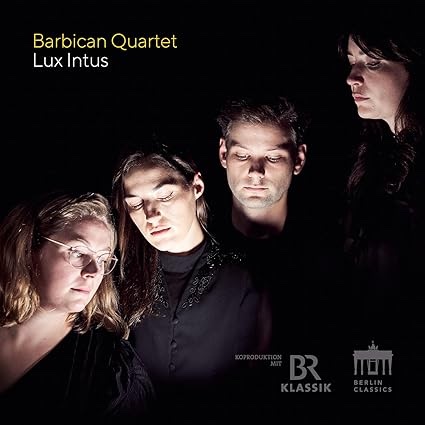
Barbican Quartet – Lux Intus – BR Klassik
“Internal Light”… illuminating the inner voices of the quartet