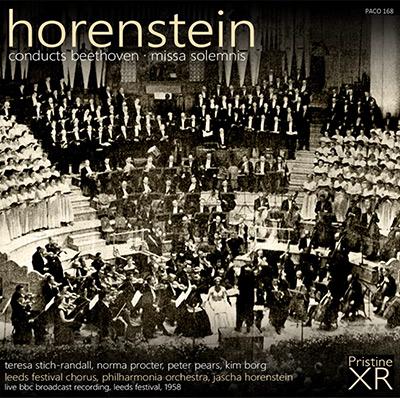
BEETHOVEN: Missa Solemnis in D Major, Op. 123 – Teresa Stich-Randall, soprano/ Norma Proctor, alto/ Perter Pears, tenor/ Kim Borg, bass/ Leeds Festival Chorus/ Philharmonia Orchestra/ Jascha Horenstein – Pristine Audio PACO 168, 77:00 [www.pristineclassical.com] ****:
On the first page of the Missa Solemnis (1819-1823), Beethoven inscribes the words, “From the heart – may it go again – to the heart.” The extraordinarily complex work has a dual allegiance to supporters of Beethoven, Prince Nikolai Galitzin and Archduke Rudolf, each of whom Beethoven admired and sought to impress with his late compositions, meant to “reconstruct his life” to a great extent, given the severity of his social and spiritual isolation. Beethoven had been engrossed in polyphonic studies, ranging from the music of the Ancients, like the Flemish Obrecht and Ockeghem, to the works of Handel; and we can hear some of the collective influence in the Overture to the Consecration of the House.
Horenstein came to lead the Leeds Festival on 11 October 1958 as a result of Otto Klemperer’s misfortunes, first with bronchitis and then with a near-death experience of having fallen asleep with a lighted cigarette. Despite confronting an actual performance of the Missa Solemnis for the first time, Horenstein solves many of the structural challenges – even anomalies – of its style, demanding of the vocal choir that they serve as woodwind instruments, as well as the huge dynamic shifts and alterations in the orchestral tissue. Perhaps the most unique sound in the composition occurs in the Praeludium to the Benedictus, an orchestral transposition of organ music, a kind of improvisation utilizing flute, bassoon, contrabassoon, diviso violas and cellos, organ and basses. Concertmaster Hugh Bean plays the lovely violin solo that serves as a transition between the Sanctus and Agnus Dei.
Horenstein opens with a massive D Major chord that yields to a softer response from the strings, engendering a series of invocations, of which the “Kyrie” at crucial moments adds dramatic weight. Horenstein instills in the ensuing Gloria, Allegro vivace a frenzy concomitant with Beethoven’s remark that “No bar is inexpressive.” The dynamic range proves enormous, exploiting what the composer deemed “inward” and “outward” music. Marked larghetto, the Qui tollis slows for the vocal quartet to dwell in a sense of tragic meditation. Theresa Stich-Randall, the “white soprano,” has always held a special place in my pantheon of sound, especially for the innocence she conveys in the Mahler Fourth. Beethoven moves to a grand fugue on “In Gloria Dei Patris” that, for sheer volume competes with the trumpet work from the Philharmonia brass, along with an active timpani part. The polyphony itself resonates with antiquity, sounding modally by way of Handel or even earlier, Palestrina. Rapturous rising scales and quick, passing notes add a decidedly virtuosic dimension to an already anguished sense of bliss in multiple, Herculean contours on “Amen.”
The expansive Credo forms the literal “crux” of the composition, forcing its “system” of belief into complex rhythmic patterns and layered, stratified choral sound, often in the Dorian mode. The words, et vitam venturi saeculi, amen, strives, Allegro con moto, for a moment of ineffable transcendence. The biographer Schindler once described Beethoven in the throes of composing the massive fugue of the Credo, the composer wrought in a paroxysm of spiritual conflict. Thee Holy Spirit appears in the Philharmonia flute, having risen above the chorus. Beethoven text-paints the passion of Christ, the Crucifixus, in pungent syncopations, punctuated by potent, painful sforzandos. The thick bass lines carry a cantus firmus sense of inevitability amidst a texture in which Horenstein has instilled a martial, crusaders’ intent, a victory over the doubt only the truly faithful can know.

Ludwig van Beethoven,
by Hornemann
Beethoven marks his Sanctus as an Adagio, in which opening horns and timpani capture the human heart. Passionate and meditative, Beethoven divides the music among cellos and violas, into which the vocal quartet quite literally hurls confessions of faith. The solo violin of Hugh Bean conveys the presence of the Holy Spirit here upon the earth, lighting up the vocal quartet in an unreal aura. Kim Borg’s resonant bass, combined with its vocal opposite, Stich-Randall’s soprano seem to extend the sheer power of contrary states of the soul.
In terms of harmonic modulation, the Agnus Dei will move from a dark, agonized B minor to a sunny D Major of optimism. Kim Borg intones the pity, the Miserere for the “Lamb of God,” taken up by Norma Proctor and Peter Pears and glorified by the full vocal quartet. Beethoven then reverts to a pastorale in a Baroque fashion, 6/8, asking in his score for both inner and outer peace, but inner peace above all, the dona nobis pacem. Beethoven treats the moment fugally, but interrupts with trumpet sounds of war, cutting off the pacem, pacem solicitations for peace. Drumbeats will persist, even in the midst of renewed hope, the constant juxtaposition of Man’s own dualism, though the music will finally acknowledge a fanfare to celebrate the ite missa est that Horenstein surrounds in glowing naivete to conclude in the simplicity of six measures what has been a towering struggle to find God on a planet often swept with confused alarms of struggle and flight.
—Gary Lemco