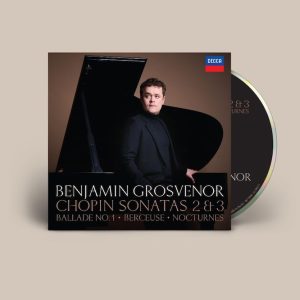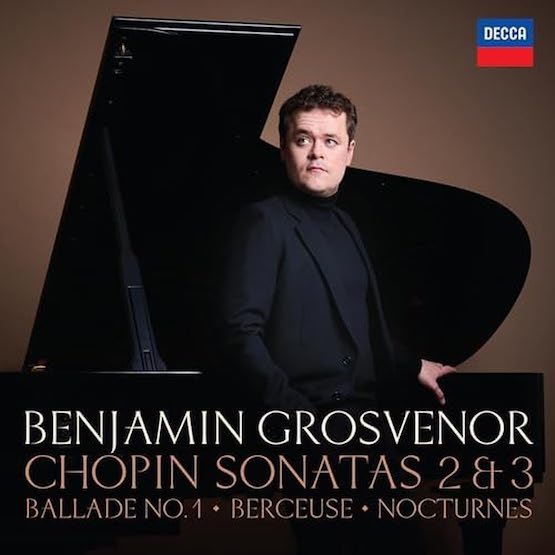
CHOPIN: Piano Sonata No. 2 in B-flat Minor, Op. 35 “Funeral March”; Berceuse in D-flat Major, Op. 57; Ballade No. 1 in G Minor, Op. 23; Two Nocturnes, Op. 55; Piano Sonata No. 3 in B Minor, Op. 58 – Benjamin Grosvenor, piano – Decca 487 0958 (75:46) (3/23/25) [Distr. by Universal] *****:
British pianist Benjamin Grosvenor (b. 1992) has held a dominant position in Chopin interpretation, having been invited to contribute to the Chopin and His Europe Festival, besides his several, much revered albums devoted to the Polish master. The present recital from 23-26 September 2024, was recorded at the Lady Stringer Studio, Garsington Opera, Buckinghamshire and produced by John Fraser. The two mature piano sonatas by Chopin as well as selected solo works extend Grosvenor’s repute for thoughtful, digitally sterling performances that rely less on power bravura than upon a desire to preserve Chopin’s conception of the piano as a singing instrument.
Grosvenor’s Chopin Sonata in B-flat Minor (1835-37) proves sturdy and nuanced, at once. Having taken the first movement repeat at the Doppio movimento, he paces the progression to a tender realization of the D-flat theme. Grosvenor takes a long view of the movement’s structure, delineating in his tempo and chordal adjustments the transition from the aggressive, almost breathless agitato to an etched, loving sostenuto. The passing dissonances and counterpoints emerge clearly, even pungently, but without histrionic antics. He quieter sections enjoy the pulse and intimacy of a nocturne that had inadvertently wandered in among the conflicting forces. The final twelve measures, the stratified coda, resounds with dramatic closure.
I would venture Allegro vivace as the chosen tempo for the ensuing ¾ Scherzo in E-flat minor. Grosvenor treats the bel canto, counter theme of the G-flat Trio, Più lento, as a modified waltz or mazurka, intimately and nostalgically ornate. The da capo resumes the potent vitality of the opening section with a fury and grim determination that seem, inevitably, to lead into the famed Funeral March. The fatal bell chords in B-flat and G-flat ring out, marcato, in solemn authority. After repetitions of its potent message, the D-flat major Trio section arises like a trilled aria, a tearful, parlando recollection of Paradise Lost. The last movement Presto, 2/2, never ceases to stun us with its eerie chromaticism and relentless momentum, its sensibility here, from Grosvenor, laden with bitter eternity, as the last, sullen B-flat chords shatter our complacency once more.
A true contrast in temperament emerges with the 1843 Berceuse, Op. 57, a study both in improvisation and the intricacies of harmonic-rhythm. This might be Chopin’s answer to the great Bach passacaglias and chaconnes, in admirably compressed form. The ostinato rhythm, unvaried, supports a top line in effervescent and nuanced fluctuation. Solomon remains my chosen interpretation for that mythical “desert island,” though Grosvenor offers a woven, delicately hewn, tapestry singularly his own.
Enter what some may deem the most fiery of the four Chopin Ballades, that in G minor (1835), conceived in reaction to the national poet Adam Mickiewicz, here set in a modified sonata-form that maintains a strong sense of “narrative” improvisation. Grosvenor instills a sense of tragic fate in the opening Lento, and he then proceeds via Neapolitan -– similar to Beethoven’s Appassionata Sonata -– harmony to the salon waltz that will succor us in each of its three appearances. The grandiose chromatics that ensue testify to Grosvenor’s control of vast sonority in restraint. The liquid variants of the tender melody contain the seeds for explosive emotional conflict, and Grosvenor ascends to the occasion with decisive force, declaiming the various runs, turns, and ornamental filigree with deft articulation. By the time Grosvenor traverses the final Allegro con fuoco, we become convinced that, despite Chopin’s often unflattering comments about Beethoven, that master’s Op. 57 had a decisive influence on this especially potent moment in the Chopin oeuvre.
Shura Cherkassky for many years held sway over the Nocturne in F Minor, Op. 55/1 (1842-43), given its deceptively plain melodic curve and its ornamental repetitions. Grosvenor, too, provides a chaste but provocative color to this piece, whose middle section becomes adamantly declamatory. Selective pedal adds a palette of subtle hues and evocative space. The E-flat Major Nocturne, Op. 55/2, claim many connoisseurs, “belongs” to Ignaz Friedman or perhaps to Valdimir Horowitz, according to taste. Grosvenor has his own ideas of pace and gentle emphases, and he insinuates a poised eroticism into the drooping melodic line and its underlying arabesques, his passing arpeggios and trills liquid, indeed.
The 1844 Sonata No. 3 in B Minor, Op. 58 has had wonderful acolytes, in Cortot, Lipatti, Rubinstein, Casadesus, and Freire, among others. The largest of Chopin’s solo works, the piece demonstrates more control, especially contrapuntally, over the so-called “German tradition” in sonata format. The best expression of Chopin’s “idiosyncratic Classicism” comes by way of the arch-formalist pianist, Charles Rose. Despite a somewhat hard patina from his instrument, Grosvenor coaxes luxurious warmth from the lyrical second theme in the opening Allegro maestoso. Chopin’s late-style polyphony warrants a prolonged discussion all its own, but Grosvenor treats these moments as studied improvisations and explorations of competing tone colors, based almost entirely upon the first theme. The recapitulation leaves out theme in order to exploit the secondary theme’s capacities for bel canto and arioso colorations. A stratified coda declaims a firm, resolute affirmation by Grosvenor.
The second movement, a skittish ¾ Scherzo: molto vivace, sports a moody and introspective trio section in B major. The opening, part étude and part ballade, rather dazzles us in its E-flat major arpeggio runs, fleetly realized, especially in the artist’s right-hand pyrotechnics. Comes abruptly the extended Largo in B major, 4/4, a haunted nocturne whose repeated tropes reveals slight adjustments in pitch and tone color that require great finesse in touch and pedal technique. At first, the mood seems funereal, moving in a dotted rhythm in the same key as his famed second Nocturne, in E-flat major. Grosvenor is in n hurry, and he lingers over the elongated E major episode, which has become its own center of operatic gravity. The step wise figures that ensue assume a searching quality that finally finds its home in the first theme that had followed the grim, four-measure opening sequence. The coda combines the two disparate impulses, ending after just a hint of ambiguity.
The last movement, Finale: Presto non tanto, basks in tumultuous shifts of touch and texture, a hybrid rondo with sonata ambitions. Set in 6/8 B minor, it cares not for the chosen modal identity and spectacularly seeks a home elsewhere. The fervor of Grosvenor scalar and declamatory filigree finds equal bravura in his brilliant running passages. The boldness of the writing reminds us much of the foment in the G Minor Ballade. The resolution to B major requires a virtuoso digital prowess, which Grosvenor commands with no loss of his individual, color commentary. The cumulative effect warrants the epithet “heroic,” without having any recourse to a polonaise.
—Gary Lemco