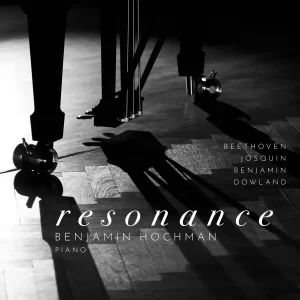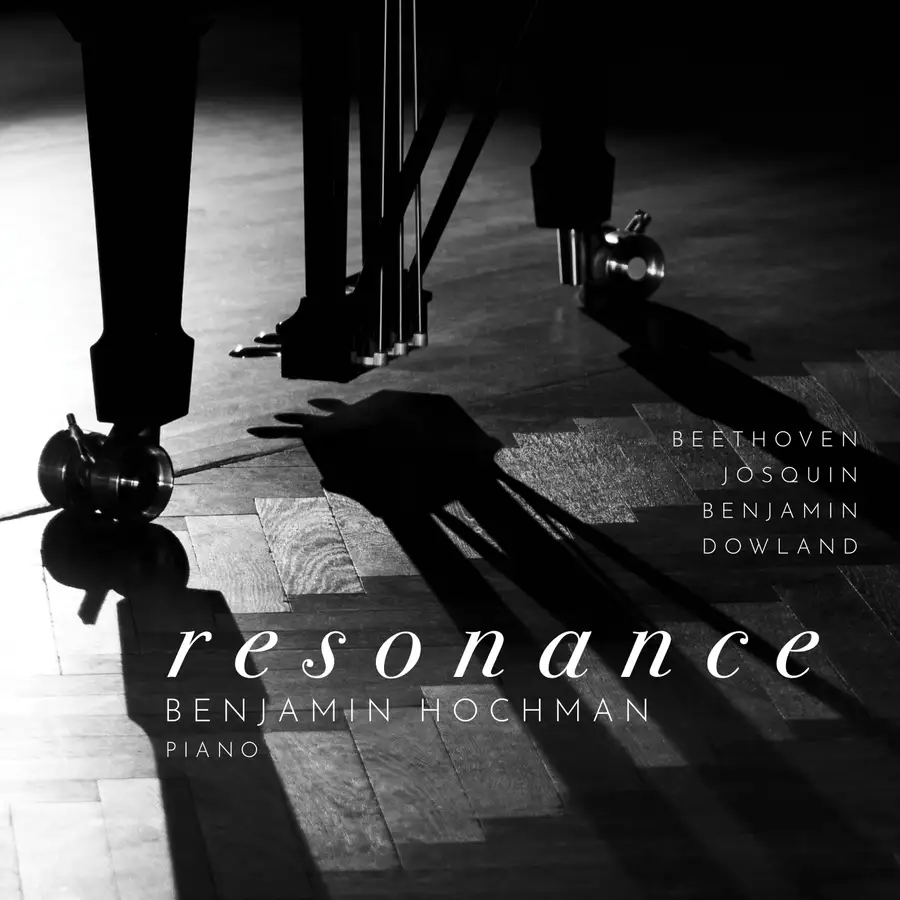
Resonance. Ludwig van BEETHOVEN: Sonatas, op. 109, op. 110; Josquin DES PREZ: Ave Christe; George BENJAMIN: Shadowlines; John DOWLAND/William BYRD: Pavana Lachrymae. Benjamin Hochman (piano) — Avie 2681 (62:32) – ****.
This program, as prescribed by the artist, was chosen to bring new light to two of Beethoven’s late sonatas by combining them with music old and new. To many, the music of George Benjamin will be as familiar as that by Dowland and Des Prez. The last two composers, of course, didn’t write for the piano, and of course Beethoven’s experience with pianos wasn’t with the modern Steinway used on this recording, captured at the Berlin Teldex studio. Presumably with streaming or downloads you can access this in Dolby Atmos. I auditioned the copy on CD. As far as liner notes go, the details contained within add value to the production, however I’m not a fan of the thin font Avie chose nor the size, which makes for difficult reading.
The sound on this recording is nicely engineered. There’s good reverb from the studio recording, and the instrument itself might not have the largest dynamic range, but when pushed harder by Hochman, it responds nicely.
The two Beethoven sonatas are sensitively rendered. While I have far more experience with Beethoven’s earlier sonatas, maybe save for the Hammerklavier, these two later sonatas are, while less familiar to me, somewhat Janus-like, looking forward and backward. It’s an apt notice that qualifies Hochman to bring in non-traditional fodder for the concert experience, or here, a recital on CD. Such an example is the ultimate movement of the A-flat major sonata, where we can imagine Beethoven building resonance on the instrument with his lack of hearing, before moving into a brief fugal passage, evoking the spirit of J.S. Bach.
Perhaps more familiar to fans are the first and second movements of the E major sonata. Marked Prestissimo, the second movement does not present non-stop fury. I auditioned a few other performances; Hochman’s timing is in alignment with several recordings. There were a few aspects of phrasing that I found interesting from András Schiff (recorded live on ECM New Series). Hochman holds his own, however, responding adeptly to the dynamics. Schiff gets a more shrill sound from the upper reaches of the keyboard, which I thought was in character with the music. The first movement opens this album, with Beethoven indulging in what I think is a clear romantic aesthetic. He explores the edges of the piano’s gamut, exploring conceivably what the latest instrument of his time could produce. Part of the racket-making that he would have experienced is far less offensive on the Steinway, but Hochman responds appropriately, I think, making pleasant sounds with all of his instrument’s possible colors.
The Josquin des Prez and Dowland/Byrd pieces are each short, acting as foils to the three larger works on the recording. I wouldn’t have recognized Josquin’s music, articulated as such, on a piano keyboard. With this instrument the piece takes on an especial modernity to it, harmonies go into unexpected directions, and there are also a lot of triadic harmonies, which kind of surprised me. I think Hochman’s treatment of the Josquin is appropriate, making it something pianistic. There are sections with repeated chords on each “beat,” which for me mimicked some of the A-flat Beethoven in flavor.
Dowland’s music is perhaps more familiar to me, and maybe to you; it’s more successful I think because is translates a bit more directly to the keyboard. Byrd’s ornaments stand out.
The third major work on the album is George Benjamin’s Shadowlines, described as six canonic preludes for piano (2001). It was written for, and debuted by the pianist Pierre-Laurent Aimard. Rendered in six movements, each has the length of an early baroque keyboard suite. The harmonic language goes into realms that are a far cry from Beethoven, not to mention the other works. The constant assault of new ideas from each movement keeps the listener’s attention sharp.
The linked page above describes the piece:
This sequence of pieces, all canons in different ways, was conceived as a continuous, cumulative structure: 1) A brief, seemingly improvisatory prologue. 2) The high register, fierce and harshly chromatic, against the lower, which is consonant and calm; a compact coda reconciles these opposites. 3) A miniature scherzo, all within the space of 11/2 octaves in the bass, leading immediately to: 4) Explosive and monolithic, the pianist’s hands perpetually rifting apart then re-uniting in rhythmical unison. 5) The most expansive and lyrical movement; at its heart a slow ground-bass, over which builds a widely contrasted procession of textures. After a short pause: 6) A simple and gentle epilogue.
Benjamin’s dynamic shifts are faster than what is called for in the Beethoven. Like Beethoven, however, Benjamin seems invested in exploring the sonic possibilities of the piano, asking for use of the extremes of the keyboard. There moments within the fourth movement, marked Tempestoso that the soft harmonic language was something not terribly removed from the Des Prez arrangement. The most expansive movement, the fifth, I think is well-interpreted by Hochman. The building of clusters of dissonance by the composer requires certain keys to be held while others get released. I can imagine this movement might be difficult to perform in person with its “shadows” of quiet, competing for audience noises (coughs and the such), but this recording allows us to appreciate, I think, the richness of the Steinway’s lower gamut without compromise.
I have to give credit to Hochman for his programming on this album. It would have been easier to record a third Beethoven sonata and be done. But instead he brought awareness to a more recent, contemporary piece, one that audiences may find difficult to enjoy. While I cannot directly appreciate the canonic forms the composer has used, the range of moods conveyed by the piece holds our attention. It’s not a piece I feel I need to go back to often. At first, I’ll be honest and say I didn’t care much for it. But upon repeated listens? Yes, it grew on me, as did the colors the pianist is able to pull from the consonance and dissonance present in this piece, depending where you “stop the needle.”
But the question then becomes, does it provide added value, when presented as such, between the pillars of Beethoven’s late sonatas?
It’s impossible to say if the effect is equally felt by everyone, but I forced myself to explore this question by jumping between the Benjamin and Beethoven. While the language between these pieces is different? Yes, there is enough consonance in the Benjamin piece to link them, and while the contrasts are obviously born out of difference in these languages, the more interesting similarities seem rhetorical in origin.
—John Hendron