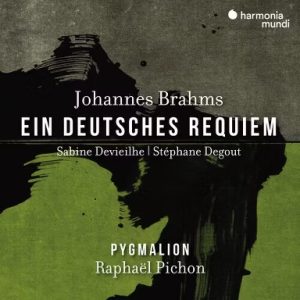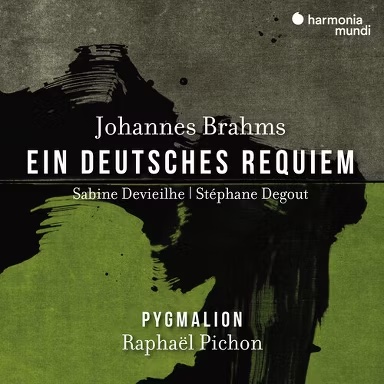
BRAHMS: Ein deutsches Requiem, Op. 45 – Sabine Devieilhe, soprano/ Stéphane Degout, baritone/ Pygmalion/ Raphaël Pichon – Harmonia mundi HMM 902772 (65:07) (10/1025) [Distr. By PIAS] ****:
Dvorak once remarked that he found in his musical idol Brahms not one ounce of genuine religious devotion; yet, between 1866 and 1869 Brahms labored arduously to expand what had been a cantata for the death of Robert Schumann into a most ambitious vocal work. Eschewing the traditional Latin mass, the missa pro defunctis, Brahms adopted the Protestant texts drawn from Martin Luther’s German translation of the Bible, freely incorporating passages from both Testaments in sympathy with the composer’s desire to mourn the dead and comfort the living, at once. Given the composer’s predilection for Classical architecture, Brahms constructs a seven-movement work that achieves remarkable symmetry and artistic closure in the form of a loose palindrome, aligning the work more with the Aesthetic Movement, in which Art vied with Religion for supremacy in celebrating an omnipotent Deity.
Raphaël Pichon (b. 1984), a countertenor and violinist, organized Pygmalion in 2006, an ensemble of 37 singers, with a mission to perform a variety of musical genres on original, period instruments. The spare application of vibrato in the case of Brahms creates a startlingly antique sound, simultaneously chaste and pungent, relishing the dramatic juxtapositions of dynamics in Brahms that move from inward quietude to an eruption of emotional vehemence. Where many conductors on period instruments favor excessively slow speeds, Pichon often impels the music with furious haste, as in the polyphony of the baritone meditation Herr, lehre doch mich. . ., with its resounding tympanic pedal on D for over 50 measures. Equally affecting, there resounds the monumental sixth movement, Denn wir haben hie Kleine bleibende Statt, a lament for the ethereal nature of existence that concludes with a resounding sense of triumph over Death. At the coda, Pichon rushes breathless into the last movement, literally a sweet transfiguration of the work’s beginning, cyclically blending the fate of mourners and the mourned in a perpetual pattern of acceptance.
The two soloists deliver fine, sensitive readings of their respective texts, given my own experiences with Elizabeth Schwarzkopf and Gundula Janowitz in the soprano part, and the likes of Hans Hotter, Tom Krause, and Dietrich Fischer-Dieskau in the bass part. The second movement, Denn alles Fleisch es its die Gras, proves especially poignant, a morbidly conceived waltz-march that Pichon invests with towering presence, gradually moving by stealth to a shattering fortissimo. The sudden shift to female voices of consolation renders the contrast with effective nuance. What endears us to this reading lies in the clarity of textures, an invasion of light a la J.W.N. Turner, where the classic performances by Karajan, Klemperer, Lehmann, and Walter opt for giant cumulus clouds to announce our pageant toward Eternity.
—Gary Lemco