Rending at Vail, Part 2
by Gary Lemco
A unique aside occurred when McDermott herself led an early-afternoon, “Immersion Experience,” a discussion and analysis, “Inside the Music,” from the keyboard at the Interfaith Chapel, of the first of Sergei Prokofiev’s War Sonatas: the No. 6 in A Major, Op. 82 (1940). McDermott champions Prokofiev’s nine piano sonatas as “the most important group of piano sonatas in the 20th Century.” In this perspective, she shares the enthusiasms of fellow pianist-scholar Barbara Nissman. The close analysis revealed the breadth of Prokofiev’s brilliant scoring for the keyboard, his deft manipulation of the key, first movement motif – a mentally stultifying intrusion, repeated 179 times! – making for a through-composed experience of taut, even manic, emotional extremes. Violence and occasional tenderness emerge in the course of the music’s long journey, marked by dissonances, modal asides, virtuoso toccatas, and thunderously martial energies that reek and rail with war cries. As if Spain’s Guernica were not enough, the music would lilt at past romance in its waltzes, then warn, tocsin-like, that if we persist in our respective aggressions, we reap the whirlwind. The complete set of nine Prokofiev sonatas was scheduled later, the 17th and 18th, than my stay allowed.
We return to the Ford Amphitheater on July 13 for a program guaranteed to win the local population: Jennifer Higdon’s brief piece from 2000, Fanfare Ritmico, and two Rachmaninoff works, his 1940 Symphonic Dances and his ubiquitous Piano Concerto No. 2 in C Minor, Op. 18 (1901). The Higdon piece, to me, emerges as manipulated cacophony: thunderous, busy, noisy, and splashy – the equivalent of musical roughage meant for the orchestra to hone their choir entries. Higdon claims the music depicts the increased mechanization of modern life, a point Charlie Chaplin made abundantly clear in the cog-in-the-wheel of-progress scene in Modern Times. The audience applauds dutifully, afraid a hiss might be interpreted as part of the score. Rachmaninoff’s three Symphonic Dances were conceived precisely for the Philadelphia Orchestra when led by Eugene Ormandy. The three extended movements capture the usual Rachmaninoff gambits of rhythmic energies softened by blatant, sentimental nostalgia. Nézet-Séguin milks the pieces with his muscular, deliberately kneaded gestures, asking for the big Philadelphia sound and lingering over the melodic phrases. Typically, Rachmaninoff brings in his eternal trump card, the Dies Irae from the Requiem Mass, to seal his rendezvous with Death. In the slower sections of the Dances, Nézet-Séguin lost the dramatic tension, so that “effects” became self-conscious, such as the xylophone’s recollection of Saint-Saens and the obvious iterations from Rachmaninoff’s own Isle of the Dead.
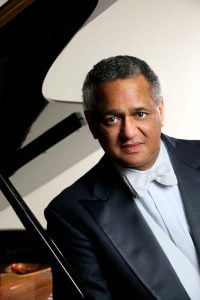
André Watts
A more healthy and invigorating experience arose with the advent of the piano soloist, Bruce Liu, for the Second Concerto. Prior to the concert’s opening, Maestro Nézet-Séguin sadly announced the death of American pianist Andre Watts, aged 77, with whom this conductor had made his debut with the Philadelphia Orchestra in this exact same concerto. The appearance of Paris-born Chinese pianist Bruce Liu meant a debut for him at Vail and my own introduction to him, winner of First Prize at the 2021 Chopin International Piano Competition. His burnished tone and suave sense of the Rachmaninoff style meshed even more beautifully in the full rehearsal I attended than at the concert proper, for spontaneity and poetry. The second movement, Adagio sostenuto, proved revelatory when, in the middle section, the bravura passages bristled of Schumann’s Kreisleriana suite. The collaboration, needless to say, brought the house to its collective feet, inspiring Liu to provide an encore – doubtless in memory of Andre Watts – the Siloti arrangement of the Bach Prelude in B Minor.
Friday July 14 brings not only Bastille Day but a meeting with British composer Anna Clyne (b. 1980), whose orchestral piece, This Moment, receives its world premiere this evening. Commissioned by the League of American Orchestras, the five-minute work finds inspiration from Vietnamese Buddhist monk Thich Nhat Hanh (d. 2022), a Zen master and peace activist. His meditation on death ironically reactivates one’s appreciation of life. Aware that she would share a program including Mozart’s Requiem in D Minor, K. 626, Clyne deliberately absorbed quotations from Mozart’s Kyrie and Lacrimosa into her otherwise percussive texture, that allowed us the Kyrie but buried the Lacrimosa.
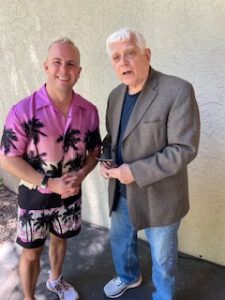
Maestro Nézet-Séguin, with
Gary Lemco
The 1791 Mozart Requiem proceeded immediately, with no intermission. The four singers: Rosa Feola, soprano; Jennifer Johnson Cano, mezzo-soprano; Issachah Savage, tenor; and Kyle Ketelsen, bass-baritone, each contributed sonorously to the occasion, the score in an edition that augmented the Suessmayr version of the incomplete original with a 1971 edition by Franz Beyer. The result had little to do with any sense of “authenticity”: large scale, with orchestral forces of some 80 players, the effect proved immense. Nézet-Séguin kneaded the opening Introit and Kyrie with tender, loving care, the Colorado Symphony Orchestra Chorus boldly resonant. The Philadelphia string section caught hellfire for the Dies Irae and in the later Confutatis. Bass-baritone Ketelsen bore the grueling tessitura of the Tuba mirum with solemn dignity. The two female singers proved alert and flexible in tone and solid in their respective range, sailing into the heights in Mozart’s ensemble pieces. Everyone awaits the liquid melody of the Lacrimosa, a section that could have served in a violin concerto. The Agnes Dei, an operatic fugato, maintained clarity and dramatic force, leading to the sighing mystery of the finale, the Communion: Lux in aeternam.
The Philadelphia Orchestra is one of several major symphony groups dedicated to Bravo!Vail, joined by the Dallas Symphony, the New York Philharmonic, and the Academy of St Martin in the Fields. The sheer diversity of chamber music groups, experimental ensembles, and visiting soloists demands that interested patrons obtain the expansive booklet that describes all of the Festival events and venues, the canny integration of established and new repertoire.
Bravo! Vail review by Gary Lemco, Part 1