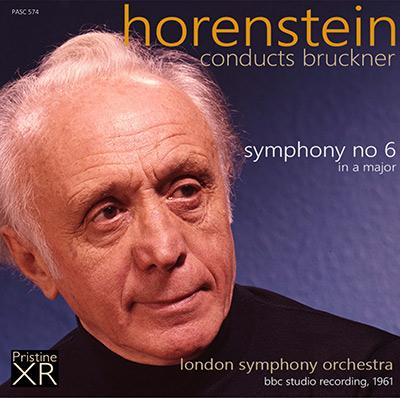
BRUCKNER: Symphony No. 6 in A Major – London Symphony Orchestra/ Jascha Horenstein – Pristine Audio PASC 574, 56:29 [www.pristineclassical.com] ****:
Perhaps the most tautly conceived of the Bruckner symphonies, the A Major (1879-1881) literally shimmers with rhythmic excitement throughout. In terms of recorded performances, the general lament arises for that live performance by Wilhelm Furtwaengler, whose document suffers the loss of the first movement. My own preference among commercial renditions has been that of Joseph Keilberth on Telarc. In the case of Jascha Horenstein (1898-1973), the A Major Symphony entered his repertory in 1936. Pristine restores the performance of 11 November 1961, marking the work’s revival for the LSO after a hiatus of 25 years, when Sir Hamilton Harty had programmed the piece in that same, fateful year, 1936.
The pungent triplets that open the first movement, Maestoso, merely hint at the level of rhythmic stratification that permeates the momentum that ensues, in which cross currents occur between two and three, and three against four. Following Brahms – even in the midst of Wagnerian urgencies – Bruckner invokes three main themes – in rather Phrygian modality – for development. Bruckner will “saucily” manipulate his harmonies so that his false recapitulation later on will have wandered into E-flat Major. Horenstein elicits clearly articulated figures from his horns and winds, so much so that Barry Tuckwell recalled in an interview with me how his section relished Horenstein’s insistence that they not subdue their interjections. Horenstein maintains the feverish instability of the whole without having lost the melodic threads that hold the complex together. The huge fortissimos that slam us back on the right harmonic course counter the intimately gradual crescendo in A Major/A Minor that will climax that last annunciation of the opening theme, here in astonishing breadth and dramatic majesty.
The slow movement, marked Adagio: Sehr feierlich, proceeds in a lachrymose F Major and its tonic minor, and it builds a literal cathedral of polyphony, in which perhaps six independent musical lines become stratified. The oboe theme itself undergoes various transformations, and Horenstein mysteriously mounts the funereal but haunted melody into a “dying declaration.” The last movement finale, too, will utilize the oboe theme for its own possibilities. The “religiosity” of the Adagio remains here, with Horenstein, in the same grand space that Furtwaengler manages in his esteemed Berlin reading.
Feverish and somewhat grotesque in emotive content, the Scherzo swaggers in relatively slow tempo, cantering in uneasy grace with cross rhythms. Horenstein elicits a brilliant clarity of line here, the texture, for all of its layering, transparent. The Trio section emerges both bucolic and anguished. The brass work resonates with Wagnerian allusions, likely Tannhauser. The da capo resonates with that same, quirky, nervous tension, the basses and cellos in pedal, the violas and second violins lustrous in their nagging staccato gestures. The movement cascades in a tumult of processional grandeur to conclude. The Finale: Bewegt, doch nicht zu schnell, utilizes three motifs, and the music does seem to achieve an emotional quietude the other movements lack, and this in spite of an epic storm set in the E Major, Phyrgian mode that has infiltrated this music since the opening. The titanic gestures want to re-establish the A Major key as well as the initial melodic thread; and having done so, the work can claim a cyclical unity that we might not have suspected in the course of its meandering means.
The remastering by Andrew Rose of this reading from Maida Vale Studios has been first rate.
—Gary Lemco