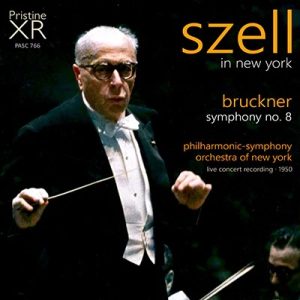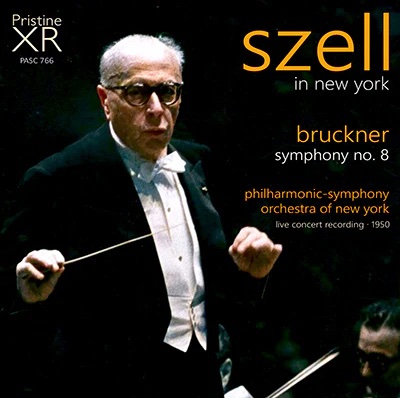
BRUCKNER: Symphony No. 8 in C Minor, WAB 108 – Philharmonic-Symphony of New York/ George Szell – Pristine Audio PASC 766 (71:24) [www.pristineclassical.com] *****:
Eminent conductor of the Cleveland Orchestra George Szell (1987-1970) delivered three subscription concerts in New York’s Carnegie Hall in mid-December 1950, the 14th, 15th, and 17th, featuring music by Casella, but more significantly, an uncut version of Bruckner’s 1882 Eighth Symphony. Here we have the Sunday broadcast, an intensely forward-driven reading of Bruckner’s most problematic symphonic work, insofar as the composer’s insecurities about form and structure led to several revisions of the piece and the emergence of competing “editions.”
My own introduction to this knotty piece arose from EMI’s awkward packaging of some disc I purchased – likely the Beethoven Triple Concerto with the Oistrakh Trio and Malcom Sargent – that tacked on an accompanying disc of the first and last movements of the Bruckner led by Herbert von Karajan from Berlin. Consternation and curiosity competed for dominance, since I wondered how I would complement the excerpted symphony with its interior movements. I never did manage to purchase the Karajan version intact, but I auditioned the work as a whole courtesy of first, Eugen Jochum and then the famed 1949 Furtwaengler rendition.
The Karajan version of the opening Allegro moderato – with its brooding and often monumental application of three themes that appear, respectively, in dotted rhythm, and then the Bruckner patented gambit: two quarter notes followed by triplet filigree – seemed interminable. The music unfolded episodically and convulsively, justifying the Brahms quip about “contorted boa constrictors.” George Szell, conversely, imposes a firmly linear, propulsive pacing of the opening movement that establishes just proportion for the work as a whole. Where Szell succeeds lies in the smooth flow of transitions, the grand modulations to G major and to E-flat minor, intermittently injecting monolithic textures that suddenly retreat into intimate chamber music. Szell saves his slowed rhetoric for the coda, in which the brass beat out the dotted-rhythm tattoo ten times in a morbid and eerie atmosphere, one that Bruckner associated with the annunciation of Death itself. As misty as the opening had been – shades of Beethoven’s Ninth, the final bars included a silence followed by the tympani’s rolling three soft utterances.
I recall how shattering I had found the Scherzo: Allegro moderato when realized by Furtwaengler in 1949 Berlin. The five-note motif resounds relentlessly, again, not far from Beethoven’s obsessive scherzo from the Ninth Symphony. George Szell’s capacities for speed and accuracy – so eminent in his Wanger performances – surge forth here, with pungent articulation from woodwinds and tympani. The whistling qualities in th winds and strings assign a rustic, Austrian mountain sensibility to the music, even while the tympanic pedal sustains the secondary-theme section. Szell’s palpable grip on his responsive forces assure the dramatic impact of a probing, intuitively wrought conception. The A-flat major Trio section just as majestically projects a noble, Handelian procession, capped by horns and harp. Brass punctuations more than suggest a diversion to some hall in Valhalla before the inevitable return to perilously exalted and ineluctable energy.
Both Beethoven and Wagner may claim credit for Bruckner’s mighty conception of his massive Adagio third movement. Reflecting on this huge and controversial movement – due to competing editions from Haas and Nowak – we note that Bruckner, while permitting degrees of passion and vehemence in his scores, betrays no sense of irony or bitterness. Set in a solemn 4/4, the music unfolds in broad periods, often with more than a hint of Wagner’s Parsifal. The Philharmonic demonstrates its capacity for sustained, legato execution from the various choirs, as though the music were presented via the organ diapason. The cellos intone a deep melody that soon sails upward, via strings and winds, a towering melodic edifice worthy of Bruckner’s cosmic cathedral. A bucolic serenity sets in, as the music hesitantly seeks an upward, tremulous path to the great, layered, chorale-inspired climax in E-flat major. The extended coda basks in a sea of relatively static harmonic motion and melodic confidence reminiscent of Schubert.
I must grant Herbert von Karajan credit for having overpowered me with the opening, “belligerent” measures of the fourth movement, Finale: Feierlich, nichl schnell that gallops monumentally upon the scene as both march and chorale. Szell’s version seems to me more reserved, more organic in its absorption of this impulse into the two other thematic groups. Bucolic motifs as well as (fugal) polyphony from the previous movements define the musical progress, halted by an ardent spiritual appeal over an ostinato period that soon erupts into a titanic convulsion led by brass and tympani. The Philharmonic brass alertly applies the chorale tune as a linear evolution to the stratified C major peroration – a brilliant variant upon the Scherzo energies – that marks the triumph over all adversities.
The Pristine transfer of the 1950 broadcast, again utilizing their cleansing XR process, has produced a fine addition to the appearance legacy of George Szell before the New York Philharmonic, You may well decide to provide the missing applause to this historic concert event.
—Gary Lemco