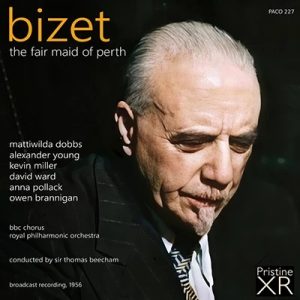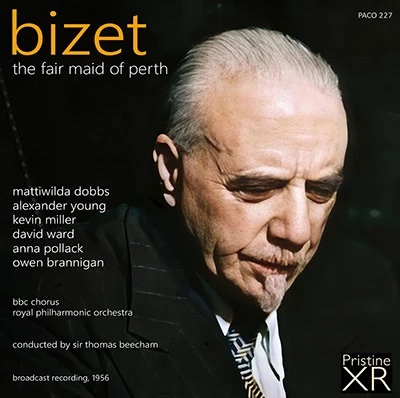
BIZET: The Fair Maid of Perth (La jolie fille de Perth, sung in English) – BBC Chorus/ Royal Philharmonic Orchestra/ Sir Thomas Beecham – Pristine Audio PACO 227 (2 CDs = 2hr 14:39) [www.pristineclassical.com] ****:
How shall I describe Georges Bizet’s 1867 opera La jolie fille de Perth: as a four-act assemblage of melodramatic, chivalric clichés mitigated by moments of exquisite, lyrical inspiration. Based on the 1828 novel by Sir Walter Scott, the true weakness of this infrequent opera lies in its inane libretto, by Jules-Henri Vernoy de Saint-Georges and Jules Adenis, rife with stock situations and improbable circumstances. At times, the opera seems to involve something of a “class struggle” between a corrupt aristocracy and a virtuous proletariat, anticipating much of Victor Hugo. Forgotten by Bizet himself – it did not resurface until 1935 – the music survived by way of the composer’s own orchestral arrangement, the 1867 orchestral suite entitled Scènes bohémiennes, featuring movements like the Prélude, Sérénade, Marche, and Danse bohémienne. Sir Thomas Beecham (1879-1961) championed both forms of the music, as did Georges Prêtre (1924-2017).
From the outset, Beecham establishes a transparent orchestral texture, the Scottish setting infiltrated by exotic notions of intrigue. The tropes of opéra-comique unfortunately subvert author Scott’s attempt to contrast the moral imperatives of civilized society versus barbarism. The alternation of comic and dramatic situations never finds an aesthetic balance in the libretto; and despite the innate lyric capacities of the vocalists, the result leaves us with a musical curio well preserved by the integrity of its interpreters. Soprano Mattewilde Dobbs (1925-2015) sings the role of Catherine Glover, daughter of a glovemaker. She must retain her moral integrity in 14th century Perth, in the face of a host of noble suitors’ advances. The challenging vocal lines, many in the high coloratura range, certify the strain on her fidelity.
Alexander Young (1920-2000) sings the role of Henry Smith, the working class blacksmith whose love for Catherine will put his life at risk in a proposed duel. Kevin Miller plays Le Duc de Rothsay, a character whose love of pleasure more than hints at the Duke from Verdi’s Rigoletto. The love-duet in Act I’s blacksmith’s shop may remind some of the sensibility from Il Trovatore. When the Duke employs the wiles of a gypsy queen Mab (mezzo Anna Pollack, 1912-1996) to lure Catherine into a tryst, the specter of Verdi rises again. Later, Catherine becomes induced to temporary madness, and we have the seeds of Lucia di Lammermoor. Despite dire, glaring suspicions, impersonations, and errors of judgment, the opera ends with the restoration of harmony in praise of honor and virtue.
What makes the production bearable derives from the deft coordination of vocalists and ensemble of artisans, maidens, and local witnesses, all of whom form the responsive chorus. Love duets, drinking songs, and the general revelry of the Act II Shrove Tuesday carnival beguile our musical curiosity for this often tuneful opera. Those moments when we recollect the infectious music distilled for the Bohemian Suite, enhance our appreciation of Beecham’s devotion to music that might have faded into obscurity. There exist moments in the rhythmic suasion of the melodies, such as “Les signeurs de la cour,” that lilt in the manner of Johann Strauss.
Act III offers a duo for mab and the Duke that combines folk elements with dramatic tension. Mattewilde Dobbs had been the first Black American vocalist to earn a place at the MET, and Alexander Young had shone in Handel operas as well as in Beecham’s reading of Liszt’s Faust-Symphonie. David Ward, who portrays the apprentice Ralph, had distinguished himself in Pierre Monteux’s rendition of the Berlioz Romeo and Juliet Symphony. Beecham arouses every musical instinct in us with his Act IV “Le jour de St Valentin” wedding march that integrates all the forces we note in grand opera.
Despite almost any vestige of dramatic realism, La jolie fille de Perth exudes a hearty vitality, by virtue of the enthusiasm of all participants. The choral and dance episodes bear the stamp of Beecham’s grand sense of swift, melodic line and rhythmical buoyancy. If any other composer fits into Bizet’s category at this early stage of his development, it might be Donizetti. The light, comic elements in this piece will not maintain critical or popular support after the intensities of Carmen established Bizet as a consummate master of his medium. The 1933 Glyndebourne Festival introduced The Fair Maid of Perth in English so that British audiences might savor those charms that transcend its narrative, preposterous nonsenses.
Beecham’s restored performance from the BBC Third Programme, 5 October 1956, enjoys the ministrations of Andrew Rose and his patented XR process, imparting a sonic sheen on a rarity in the operatic repertory that Beecham considered unjustly neglected.
—Gary Lemco
Sir Thomas Beecham – Bizet, The Fair Maid of Perth – Pristine Audio
Catherine Glover – Mattiwilda Dobbs
Henry Smith – Alexander YoungLe Duc de Rothsay – Kevin Miller
Ralph – David Ward
Mab – Anna Pollack
Simon Glover – Owen Brannigan