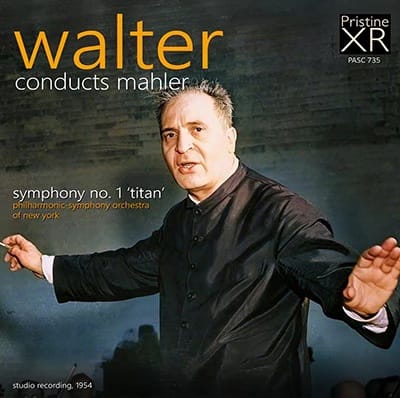
MAHLER: Symphony No. 1 in D Major “Titan” – New York Philharmonic Orchestra/ Bruno Walter – Pristine Audio PASC 735 (48:48) [www.pristineclassical.com] *****:
Indeed a labor of love, this revival of Bruno Walter’s 25 January 1954 reading of the 1888 Mahler First Symphony, which appeared in monaural sound on Columbia Records (ML 4958) has special significance for many of us audiophiles. The familiar score, recipient of innumerable recorded performances, marks the first of the composer’s symphony iterations of his song-cycle impetus, namely Des Knaben Wonderhorn, as well as direct quotations from his paean to unrequited love in his 1885 Lieder eines fahrenden gesellen. The first commercial recording, by Dimitri Mitropoulos and the Minneapolis Symphony Orchestra, made in 1940, bore the conductor’s patented trademarks for potent rhythmic drive, uncompromised, clashing harmonies, and a sense of irony pervades even the most tender expressions of feeling. Bruno Walter brought his intimate knowledge of the composer’s style in concert with the Viennese tradition in which Mahler’s music received its nurture. Although Walter made a second version of the score in 1961 in Los Angeles, I have always favored this, his initial document, for its piercing drive, unhomogenized sound, and the sheer brilliance of his New York ensemble, especially in the versatile wind and brass sections.
I pause to interject my irked curiosity at Columbia Records, which neither continued to contract Mitropoulos to establish a complete Mahler cycle nor Bruno Walter, who seemed perhaps the more the natural torch-bearer. While Leonard Bernstein would become the 20th Century’s primary interpreter of Mahler, his approach remains one step removed from those historical contemporaries of the composer who shared his direct lineage and confidences.
Producer Andrew Rose has subjected the CBS recording to his XR process that adds ambient stereo to the remastering of this studio taping from Carnegie Hall. The resultant impression of acoustical space seems to me most palatable in the final movement, when the cellos and distant horns sound a lament of unrelieved regret. The warmth that Walter elicits throughout the performance invests the score’s bucolic moments, its “forest scenes” and its third movement, klezmer elements, with a pungent nostalgia. Walter’s pacing of the divergent motives in this sprawling canvas feels perpetually right, his sense of adjusted tempo seamless. The wind choir in both the first and last movements – John Wummer, flute; Harold Gomberg, oboe; Robert McGinnis, clarinet; Stanley Drucker, E-flat clarinet; and William Vacchiano, trumpet – color Mahler’s score in affectionate, often ghostly, hues. Walter has often been accused of having “softened” the Mahler sensibility, to make his music more domestically accessible; but here, the driven sense of pantheism and terror and the simultaneous, startling projection of the Romantic ego suffer no compromise. Mahler sings in his chains like the sea. As a youthful listener and advocate of Mahler, this Bruno Walter reading served as my template, and it still rings with an eternal authority.
—Gary Lemco