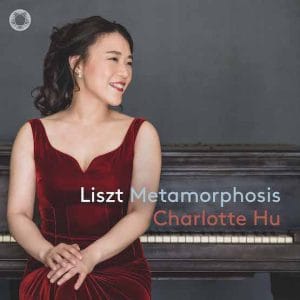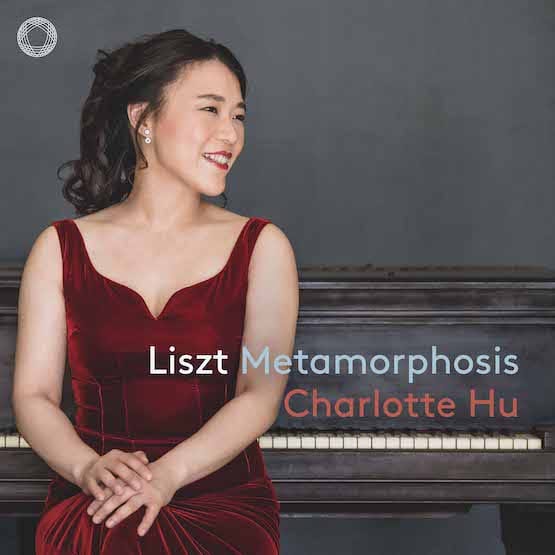
LISZT METAMORPHOSIS = Les jeux d’eau a la Villa d’Este; Rhapsodie espagnole; Concert Etudes; Adaptations of Lieder by Schubert, Schumann – Charlott Hu, piano – Pentatone PTC 5187 259 (74:44, full contents detailed below) (7/24) [Distr. By Naxos] *****:
If any “Metamorphosis” occurs here, it lies more in the transformation of the former Ching-Yun Hu, now Charlotte Hu, into a musician whose Steinway instrument no longer sounds percussive but sings most intensely the selected Liszt compositions, 1845-1877. Recorded 3-5 January 2023 at Abeshouse Production Studio in New York, the recital enjoys a glamorous keyboard sonority in which the music of Franz Liszt emerges with resonant power and stylistic intelligence.
Hu opens with Liszt’s classic template for the future Impressionism in music of later Ravel and Debussy: Les jeux d’eaux à la Villa d’Este of 1877, from his third Year of Pilgrimage: Italy. The shimmering arpeggios Hu creates soon emanate a radiant energy in D major, and the music assumes a more transcendental significance bearing an inscription from St. John: Sed aqua quam ego dabo ei, fiet in eo fons aquae salientis in vitam aeternam (But the water that I shall give him shall become in him a well of water springing up into eternal life). Much in the virtuoso tradition of performance established by Arrau and Cziffra, Hu affectionately realizes this music with a sustained ardor and articulation of the chorale line. The ringing upper registers, in tandem with the huge block, bass chords, produce an organ sonority well worth the eminence of the Abbé Liszt.
The ubiquitous Schubert Lied Ständchen from the posthumous cycle Schwanengesaeng, D. 957 follows, espressivo il canto, as directed, lacking only the voice of Fritz Wunderlich to complete the lush effect. The “shimmer of mirroring waves” continues with the Liszt transcription of Schubert’s 1823 Auf dem Wasser zu singen, the undulating 6/8 meter conveying a radiant barcarolle sensibility throughout and becoming in Liszt ecstatically passionate. Its transformation from A-flat minor to an irradiated A-flat major no less compels our pantheistic ardor. We too easily forget the context of Schubert’s famous 1825 Lied Ave Maria, D. 839, which derives not from any Christmas sensibility but from Walter Scott’s Lady of the Lake. It stands as Ellens Gesang III, set by Liszt in 1838 and revisein 1876. Hu establishes a firm, moving bass line over which the ardent melody may sail and later enjoy enhanced, virtuoso filigree. The transcription of the Goethe classic “Erlkönig” thoroughly indulges Hu in dramatic coloration, as the wild horseback ride involves a distraught father, a feverish child, and the fatally malevolent Erl-King, intent on the boy’s destruction. It might be relevant to point out that D.H. Lawrence exploits the same, seductive motif in his tale, “The Rocking Horse Winner.” Hu delivers the multi-layered keyboard texture with astonishing, directed gravitas.
Robert Schumann’s 1840 Lied for his beloved Clara, Widmung, Op.25/1 has had cinematic realization by Henry Daniell and Katherine Hepburn, respectively; but for pure keyboard artistry, my own idol has remained Ruth Slenczynska in her Jubilee recital on American Decca. Hu plays the first of the Myrthen cycle transcriptions with a resonant force that rather de-sensitizes its delicate aspects. For beauty of piano tone, however, the rendition emphasizes the clarity of Hu’s interior lines.
The last four items reflect the Liszt bravura tradition, the concert staples of the likes of Arrau, Berman, and Cziffra, rife with dynamic coloration and digital finesse. Composed 1845-1849, the Three Concert Études resemble Chopin in style and poetic expression. The first of the triptych, Il lamento in A-flat major, traverses a number of key changes as it describes a deep, pulsating meditation on loss and mortality, inspired by the artwork of Michelangelo. The “trick” for the second of the études, La leggierezza, lies in respecting the tempo designation, Quasi allegretto, while realizing delicately and irregularly spaced 16th notes and chromatic runs. In several respects, Hu reminds us of how much this study resembles the Trois Nouvelles etudes. On occasion, Hu’s tempo becomes a tad more manic and volcanic than required, but the sense of style remains unmarred. The art of crossed-hand technique has few exemplars as melodious and captivating as Un sospiro, the étude in the ever-lyric key of D-flat major. The sheer flow of the uninterrupted melodic line make us forget the discipline required in the execution of exchanged leading motifs. The last page seems to invoke the “Ave Maria” theme, even as the bass line sighs voluptuously in the course of its fluid, poignant progress.
Hu concludes with Liszt’s 1858 recollection of Spain and Portugal, his Spanish Rhapsody, which exploits the traditional La Folia variants that Corelli, Glinka, and Rachmaninoff, each in his turn, turned to colorful advantage. The boldness of Hu’s delivery more than once invokes Lazar Berman and Gina Bachauer as possible models of keyboard excellence. Once the Jota Aragonesa sets in, Hu manages the required fast chords, thirds, and octaves with unbridled aplomb, no less attentive to Liszt’s ardent capacity to sing the glories of the Iberian experience. Her high-flown upper register trills reverberate with a whistled sense of aerial virtuosity. The last few pages bristle with keyboard excitement of the first order, unbuttoned and vehemently convinced of the mission to translate pianistic technique into a statement of the assertive, artistic ego.
—Gary Lemco
Charlotte Hu – Liszt Metamorphosis
Les jeux d’eau a la Villa d’Este, S. 163;
Rhapsodie espagnole, S. 254
Schwanengesang, S. 560 after Schubert, D. 957;
Liebeslied, S. 556 after Schumann, Op. 25/1;
3 Concert Études, S. 144:
Il lamento;
La leggierezza;
Un suspiro;
3 Lieder von Franz Schubert, S. 558:
No. 2 “Auf dem Wasser zu singen”;
No. 12 “Ave Maria”;
No. 4 “Erlkoenig”;