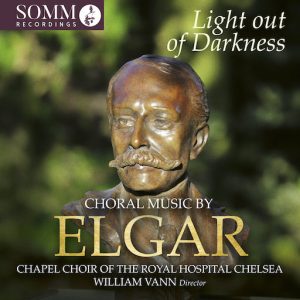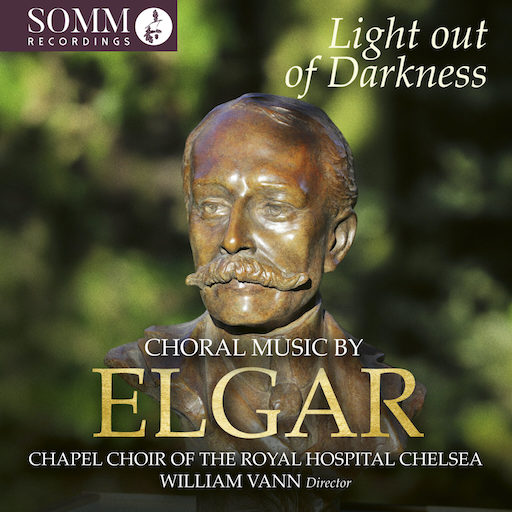
Light out of Darkness: CHORAL MUSIC by ELGAr – Chapel Choir of the Royal Hosptial Chelsea/ Callum Knox, organ / William Vann Director – SOMMCD 0714 (77:29, Complete contents detailed below) (1/16/26) [Distr. by Naxos] ****:
This collection of selected vocal works (rec. 16-18 February 2025) by Sir Edward Elgar (1857-1934) reveals the degree of religious piety expressed by the autodidact composer, who studied Catel’s Treatise on Harmony and refined his organ playing for church music in both Worcester’s Anglican Cathedral and with the choir of St George’s Roman Catholic Church, to which Edward Elgar found appointment as organist, 1885-1889. These self-styled “universities” ingrained in Elgar a lasting ecumenical sensibility which, when combined with the repertory he absorbed from 1877 violin lessons with Adolph Pollitzer in London – with its invasion of Italian and German operatic productions – created a composite, eclectic range of musical alternatives in the young composer.
A significant, organ-based dissonance announces the opening selection, the Chorus “Light out of darkness,” from the cantata (or oratorio, as Elgar preferred) The Light of Life, signifying the divine Mercy wrought by the Crucifixion, herein offered as “remedy” for human frailty. Later on the disc, we have the chorus “Light of the World, we know Thy praise.” The Word has gained ascendancy in all matters of the spirit. Elgar invokes huge, soothing harmonies to invoke that Light that “shines unto the Perfect Day.”
The Apostles (1903), despite its standing as his most expansive composition, Elgar meant to be much larger, but only his 1906 supplement, The Kingdom, came to fruition. “The Prologue” (chorus) claiming “The spirit of the Lord is upon me,” accumulates by degrees a massive dynamic to assert a Gospel of rebirth girded by plangent organ harmonies. The contrast between soprano/alto and tenor/bass antiphons proves effective. Psalm 51 (in a world premiere recording) proffers an extended confession of weakness and sin, a plaint for forgiveness for a life conceived in Calvinist terms, praying for ultimate absolution. The assumption here is that King David regrets his lust for Bathsheba and his destruction of Uriah. The antique atmosphere Elgar creates, an agonized monody, seems a modern setting of a Gregorian chant.
“Praise ye the Lord” could grace any Sunday service, regardless of denomination. Set three strophes of eight lines, the music follows a direct course, intoning a pantheistic reconciliation of all in Nature. Great is the Lord (1910-1912), the longest of the compositions collected, substantially addresses Psalm 48, in order to celebrate the 250th anniversary of the Royal Society. The massive 6-part choir intones motifs one may recall the finale from the Violin Concerto. While beginning D major, the piece modulates to a jarring F# minor, then A-flat major (andante) before the return to the home key.
Elgar insisted the anthem for baritone and SATB chorus be “gigantic,” proclaiming God’s glory even unto the towers and bulwarks of the earth.
The Four Part Songs, Op. 53 date from 1907-1908, composed during a sojourn to Rome. Dedicated to Elgar’s American friend Julia Worthington, the second of the songs, taken from Lord Byron’s The Corsair may hint resonantly at emotional depths beyond the literary. “Deep in my soul” opens in E-flat but soon proclaims a kind of bitonality with A major and then E major. Ms. Worthingtom may claim the identity of “the soul” alluded to in the Violin Concerto. “O Wild West Wind” energetically celebrates the ode by John Keats, a declaration the poetic power to embrace (Nobilemente) the opposite ends of creation, at once. Elgar intends that this music be performed “with the greatest animation but without hurry.” Two Choral Songs (1914) take their texts from the poems of Apollon Nikolayevich Maykov (1821-1897), “Love’s Tempest” and “Serenade.” The first poem allies Nature’s fury with an awakened passion, starting softly then erupting Allegro con fuoco. “Serenade” employs a repeated refrain, “Dreams all too brief, Dreams without grief, Once they are broken, come not again.” The emphasis on unrequited dreams in nervous harmony has echoes in Mahler though the technique may recall Elgar’s familiarity with the part-song style in Brahms.
Go Song of Mine (1909) ranks as Elgar’s finest part-song, based on a text by Cavalcanti (c. 1255-1300) in a translation by Dante Gabriel Rossetti (1828-1882). Its existential theme bespeaks the grim spirit of the times, moving in modes of B, fitting for the original context “A Dispute with Death.” This music may serve as the equivalent of a pungent scene from director Igmar Bergman. Of the eight remaining entries, The recording of Elgar’s setting of the Stabat Mater is another of the premieres on the disc. Scholarly speculation posits that the setting of the hymn by Pergolesi (1736) may have supplied the “enigma” for his most famous orchestral work. The austere Ecce sacerdos magnus (Behold the Great Priest) enjoys the organ’s lush accompaniment as the upper range of voices exalts his heavenly mission.
The mighty organ sets off Elgar’s arrangement of God Save the King (1902), arranged at the invitation of the publisher Novello. A soprano invokes the lines of the first verse, soon joined in unison, and the whole bears a true Handelian majesty: a fitting conclusion to a rare, thoughtful assemblage of inspired music by Elgar.
—Gary Lemco
Light out of Darkness – Choral Music by Elgar
The Light of Life, Op. 29:
Chorus: Light out of darkness;
Chorus: Light of the World, we know
Thy praise;
The Apostles, Op. 49:
Prologue;
Psalm 51;
Praise ye the Lord;
Great is the Lord, Op. 67;
4 Part Songs, Op. 53: Nos. 2-3;
2 Choral Songs, Op. 73;
How calmly the evening;
Stabat Mater;
Ecce sacerdos magnus;
O Salutaris Hostia in G;
O Salutaris No. 1 in E-flat;
O Salutaris Hostia No. 2 in E-flat;
God Save the King (arr. Elgar)