CLEMENTI: 12 Monferrinas, Op. 49; Sonata in G Minor, Op. 50, No. 1 “Didone abbandonata: Scena tragica”; Sonata in D Major, Op. 25, No. 6 – Byron Schenkman, piano
– Centaur CRC 3078, 57:29 [Distr. by Naxos] ****:
The music of Muzio Clementi (1752-1832) survives in the many piano students who read through his numerous exercises and sonatinas; but Clementi posed a powerful influence in his time, both as an excellent pianist–competitive with Mozart and Beethoven–and as an entrepreneur who ran a successful publishing company. Two generations ago, Vladimir Horowitz and Robert Goldsand maintained a tradition in this composer. Byron Schenkman, who seems a Boston-based musician with several strings in his harp, credits his interest in Clementi to Rebecca Allan, Head of Education at the Bard Graduate Center.
Clementi entitled his Op. 49 pieces “Monferrinas,” meaning to invoke a Northern Italian dance–from the state of Monferrato–that occasionally flitters like a Beethoven bagatelle (No. 3 in E) or Schubert waltz (No. 2 in C). The angular No. 4 A Minor seems more modal in character, its light right-hand filigree reminiscent of both Beethoven and Schubert. The curious metrics of No. 5 in A anticipate Schumann. The D Minor/D Major diptych that follows reveals intricacies we associate with Chopin and his forerunner Scarlatti. The E-flat Major takes the 6/8 dance form and turns it into a stamping folk tune with a light trio. The Piedmont sensibility gushes forth in the gentle No. 9 in G Major, almost a Schubert laendler. The No. 10 in C and No. 11 in F might have been marked “alla musette,” since their delicate high range of ornamented notes and ostinato bass invoke a music-box. The last of the set gilds the lily in a series of ringing arpeggios, setting a pattern Schumann could borrow for his butterflies. More virtuosity in the manner of three-hand effects gives us the impression of a restrained and elegant bravura.
The pathos-laden G Minor Sonata “Didone Abbandonata” is Clementi’s last published work, a dramatic scene inspired by the death of the Queen of Carthage at her own hand after her abandonment by her lover Aeneas. Clementi enters the empfindsamkeit world of emotional text-painting, the chromatic lines tracing the twisted love and emotional dissolution of the Queen’s mental state. After a relatively short Introduzione, the main movement, Allegro con espressione, follows, built as a series of emotionally disparate episodes fraught with runs and jabbing sforzati. The harmonies become quite advanced in their dissonance and stretti, almost an adumbration of Liszt. A late Beethoven influence for the Adagio dolente? The sudden moments of anguish suggest an instrumental Gesualdo in broken style. A suggestion of fugato dissipates but leaves obsessive repeats, the chromatic line all but invoking the Liszt B Minor Sonata. The last movement literally captures Dido’s emotional desperation, the runs and choppy bass line appropriate for a silent film melodrama until more of a virtuosic Beethoven ethos sets in. The last page finds Dido’s fury self-consuming, a resounding finale.
For sheer contrast the D Major Sonata fills the Classical bill par excellence, rife with every kind of formula that marks the Haydn/Mozart style. Light, elegant, bubbly in its Alberti bass, the music moves with a frothy energy in the opening Presto. A sweet da capo movement, Un poco andante, follows, unassuming in means and melodic tissue. Haydn meets his match for long strings of runs and brisk fioritura in the Rondo finale. The piano sound–courtesy of Frank Cunningham at WGBH Boston (2009)–enjoys a bright presence without becoming intrusive.
— Gary Lemco
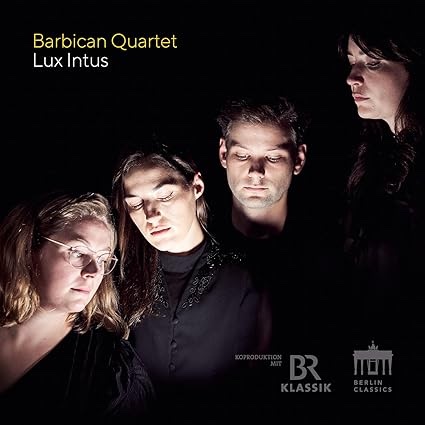
Barbican Quartet – Lux Intus – BR Klassik
“Internal Light”… illuminating the inner voices of the quartet