Jazz with an unexpected source.
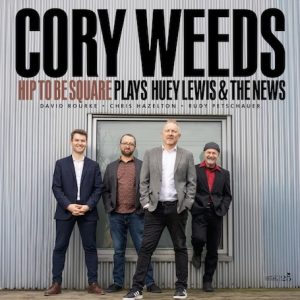
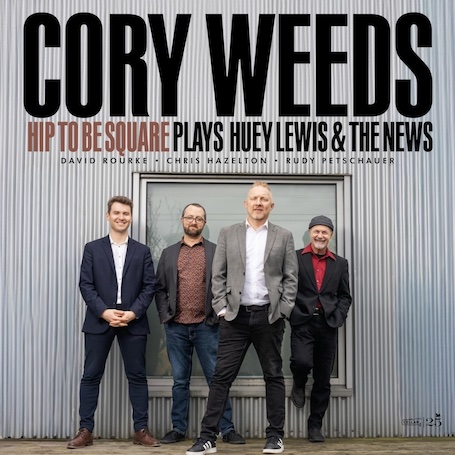
Cory Weeds – Hip to Be Square – Plays Huey Lewis & The News (Boop Bop Bing Bash!) – [TrackList follows] – Cellar Music Group CMV111725; 60:14 [10/16/26] ****:
(Cory Weeds – tenor saxophone, producer; Chris Hazelton – Hammond B3 organ, arranger, producer; David Rourke – guitar; Rudy Petschauer – drums)
Jazz musicians find inspiration wherever and everywhere. Broadway show tunes; alternative rock; classical music; anything can seemingly be turned into jazz.
So, maybe it shouldn’t be a surprise Canadian saxophonist and Cellar Music Group founder Cory Weeds has refashioned six songs by Huey Lewis & the News into organ jazz quartet arrangements. Another seven tracks include like-minded originals and a few well-chosen jazz adaptations. Hip to Be Square — Plays Huey Lewis & The News (Boop Bop Bing Bash!) has a somewhat unwieldy title but that’s because one half is Lewis (Plays Huey Lewis & The News) and the other half has jazz covers and originals (Boop Bop Bing Bash!). The album features Weeds on tenor saxophone with Hammond B3 organist Chris Hazelton, guitarist David Rourke and drummer Rudy Petschauer.
Hip to Be Square is available as a CD in a deluxe six-panel gatefold card case; as a 12-inch, two-sided, gatefold limited edition 180g black vinyl LP; and as a digital download.
The project’s initial conception was due to a specific album stuck in a van’s CD player. In 2013 Hazelton and Weeds were on a four-hour drive from Kansas City to St. Louis for a gig. The CD stuck in the van’s player was Huey Lewis & the News’ Greatest Hits. While listening over and over to Lewis’ songs Weeds thought the music could be modified into a classic organ quartet setup. Hazelton agreed. Hazelton put together some arrangements for some Lewis tunes but the project was delayed a few times. Flash forward to 2024. While on tour, Weeds and Hazelton visited a Portland, Oregon record store. At one point they noticed a sales clerk holding 25 LPs of Lewis’ best-selling 1983 record Sports. Voila. “That was it,” Weeds says, “The universe had spoken.” Arrangements were codified; Weeds band toured the material to sharpen their performance; and in late 2025 they headed into a Vancouver, British Columbia studio.
Legal issues also affected the album. The Cellar Music Group is partially funded by FACTOR Canada, a private non-profit organization which provides support to Canadian recording artists. One of their rules is no contemporary pop. In order to get around that restriction, Weeds split his record in half. The Lewis material forms the LP’s Side A (Plays Huey Lewis & The News) while non-pop jazz is on Side B (Boop Bop Bing Bash!).
The quartet open with “The Power of Love” from the 1985 Back to the Future movie soundtrack. Lewis’ original has a strong backbeat, lots of AM-radio friendly drive, and a repetitious, earworm arrangement. Weeds’ quartet gives the tune a different rhythmic shift, a soulful impetus and some tasty sax, guitar and organ soloing. It’s a nice way to start Plays Huey Lewis & The News.
Up next is “Bad Is Bad,” arguably the most obscure title from Lewis’ Sports (1983), since it was overshadowed by other, massive singles. “Bad Is Bad” has a bit of history. Lewis wrote it in the late 1970s when he was in Clover, during a short stint when Lewis was working with Thin Lizzy’s Phil Lynott. Evidently it was never taped until Lewis resurrected it for Sports. Lewis & the News offer a bluesy treatment fronted by Lewis’ Chicago-styled harmonica. Weeds and his group supply a soulful rendition which retains a blues-tinted foundation but centers on an iridescent soul-jazz arrangement highlighted by sax, organ and guitar improvisations.
Weeds and his band have fun with “I Want a New Drug,” also from Sports. Weeds asserts, “The groove, the swagger, the humor, the unmistakable energy – it already had the DNA of great soul jazz hidden inside it. Instead of trying to recreate the original, we wanted to re-imagine it through the lens of organ jazz and hard bop.” Weeds explains, “What surprised me most is how naturally the song transformed. Strip away the ’80s production and you uncover a well-written composition with a deep groove and room for improvisation. The result feels both nostalgic and brand new at the same time – like Huey Lewis wandered into a late-night jazz club.” Indeed, the upbeat and swinging translation has the hallmarks of a future soul-jazz standard. Certainly, it must be a real crowd pleaser.
“Hip to Be Square” is from 1986’s Fore! Lewis’ original has a lively deportment and often misunderstood lyrics which made it rife for satire by “Weird Al” Yankovic and the Sesame Street children’s TV program; the tune was also in a violent scene in the 2000 dark comedy/horror flick American Psycho. The foursome sustain the head-nodding main motif and extemporize around the melody to provide another cut steeped in 1960s soul jazz. One can imagine Richard ‘Groove’ Holmes or Brother Jack McDuff tackling this if it had been around in a prior era.
Not all the material associated with Huey Lewis & the News was penned by Lewis. “Do You Believe in Love,” from 1982’s Picture This, was written by songwriter/producer Robert John ‘Mutt’ Lange. Lewis crafted it into a mid-tempo RnB-infused chart-topper. Weeds alters “Do You Believe in Love” into a sultry, starry-night ballad percolating with amour and heightened passion. Over the course of eight minutes Weeds and Hazelton stretch out with some engaging solos.
The ‘Lewis’ half concludes with Lewis’ somewhat generic-sounding “If This Is It,” also from Sports. Weeds proves again if 1980s slick production quality is deleted, the result is another soulful organ jazz success with abundant aplomb and assuredness. Rourke is a standout during his solo guitar moment.
Heading into the second half, the quartet commences with “There Arno Answers,” a Hazelton/Weeds co-composition. Weeds states, “It’s a title with a double meaning. Arno is someone in my life who has helped guide me through some very deep waters over the years, but the tune also reflects a period where I found myself carrying more questions than answers.” He further elucidates, “Musically, I wanted to channel that tension into something earthy and direct – a serious organ-boogaloo groove with attitude.” The five minute piece is, as Weeks describes, “Greasy, funky, simple and catchy.”
The only other band original is Rourke’s five-minute “Meezy’s Back in Town.” It is likable and affable and evokes jazzy sitcom or movie themes, with hints or reminders of Mike Post (L.A. Law), Patrick Williams (see Lou Grant) or Jack Elliott (Night Court). The number could make a listener ask, “Who’s Meezy and why is he back in town?”
Those who like to dig deeper into jazz history will appreciate the rest of this CD.
The group creates a slight bossa nova spin and a lighter tone to Harold Ousley’s funky “The People’s Choice,” which is on saxophonists’ Gene Ammons & Sonny Stitt’s You Talk That Talk! (1972). For a time Ousley was a sideman for Ammons. “The People’s Choice” is a hidden gem which soul jazz aficionados should search for to hear if possible.
American jazz organist/pianist Billy Gardner’s 1963 “Boop Bop Bing Bash!” was the secondary idea for the album title. Gardner was a mainstay of soul jazz mostly as a sideman. He wrote this for saxophonist George Braith’s 1963 LP Soulstream. Braith’s version kicks along with a bop-ish orientation and Weeds and his group bring some of the same vigor to the cut, although they also slow down some of the sections, thus giving “Boop Bop Bing Bash!” a bop/soul assemblage that can’t be beat.
Weeds and the quartet get back to blues on Jimmy Owens’ chugging “Get the Money Bluze,” also known as “Get That Money Blues,” composed for Dizzy Gillespie. Its the closing track on Gillespie’s 1966 record The Melody Lingers On. Gillespie’s was a large ensemble presentation, whereas the quartet simplifies and shortens the arrangement and dispenses with some of Gillespie’s outdated musical details.
There are two tracks connected to Canadian jazz.
“Up in Gavin’s Flat” comes from Vancouver-based saxophonist Mike Taylor’s Brute Force (1973). Weeds’ interpretation keeps things straightforward. One difference is adding guitar, which furnishes a three-way conversation missing from Taylor’s hard-to-find original.
Vancouver multi-instrumentalist John Lee (who is on Weeds’ label) contributes the easygoing and lilting “At Long Last,” which has luminous sax, guitar and organ.
The concept of covering Huey Lewis alongside some obscure jazz music may not be the first thing jazz buyers may go looking for, but on Hip to Be Square — Plays Huey Lewis & The News (Boop Bop Bing Bash!) the outcome is something unpredictably enjoyable, refreshing and definitely soulful.
TrackList:
The Power of Love
Bad Is Bad
I Want a New Drug
Hip to Be Square
Do You Believe in Love
If This Is It
There Arno Answers
Meezy’s Back in Town
The People’s Choice
Up in Gavin’s Flat
Boop Bop Bing Bash
At Long Last
Get the Money Bluze
—Doug Simpson