Daniel Barenboim plays CHOPIN – The Warsaw Recital = Fantasy in F Minor, Op. 49; Nocturne in D-flat Major, Op. 27, No. 2; Sonata No. 2 in B-flat Minor, Op. 35 “Funeral March”; Barcarolle in F-sharp Major, Op. 60; 4 Waltzes; Berceuse in D-flat Major, Op. 57; Polonaise No. 6 in A-flat Major, Op. 53 “Heroic” – Daniel Barenboim, piano
DGG B0015384-02, 77:51 [Distr. By Universal] ****:
Argentine pianist Daniel Barenboim (b. 1942) has now performed before an admiring public for over sixty years–having first appeared at age seven–and his live all-Chopin recital (28 February 2010) from National Philharmonic Concert Hall, Warsaw betrays no letdown in the quality of his musicianship; in fact, if “mellow” must serve as a one-word epithet, it well describes Barenboim’s approach even to Chopin’s most daunting keyboard works.
If “mellow” might be construed as slack or without tension, be advised that Barenboim’s power in the opening Fantasy in F Minor belies any such notion. Rather, his grasp of the work’s architecture – given his digital prowess that consumes metric and dynamic challenges–embraces its mood shifts and rhythmic adjustments with a singular unity of effect. The girth of Chopin’s compositions Barenboim restores by the broad symmetries of phrase and the unhurried vocal lines he fashions without mannerism. The D-flat Nocturne–a miracle of chromatic harmony and nuanced timbres–achieves a sensuous patina that spins an elaborate improvisatory thread. The sensuous wash of sound is not so chastely detached as that of Michelangeli, nor as intellectually distilled as that of Moravec, but it flows much in the same spirit as Artur Rubinstein’s immaculate combination of strength and supple grace.
Both drama and bravura play their parts in the dark B-flat Minor Sonata, whose March funebre defines its grimly heroic character. The first movement’s “Doppio movimento” fusion of speed and gravitas receives its full due without the sacrifice of the poetic instinct that infuses the piece with tragic restraint. No less epic sweep invests the Scherzo whose trio section finds a singing repose in the midst of spiritual calamity. That same capacity to find a calmly lyric exquisitely poised emotion in the eye of a mortal storm informs the D-flat Major episode of the Funeral March proper. The last movement’s “howlings among the gravestones” (Artur Rubinstein) flies at a banshee’s pace, a dizzying rush to judgment. The last chord unleashes its own sea of appreciation from the audience.
Barenboim’s expansive realization of Chopin’s 1846 Barcarolle in F-sharp Major reminds us of how much Debussy could glean from Chopin’s fertile pen, the piece a miracle of unity-in-diversity. Part nocturne, part gondolier’s rocking boat song, the song no less develops in the rhetorical style of a ballade, while thirds, double notes, and pearly roulades describe a Venetian sojourn of rapturous and even stormy intensity. Barenboim’s careful attention to the intricate chromatic harmony thickens the tapestry until it reaches the keynote F-sharp in the low bass as a kind of safe harbor, the tonic-dominant final chords concluding a true voyage of the spirit.
Barenboim manages to personalize his group of waltzes, the bravura F Major, Op. 34, No. 3 here as flirtatious as was Zsa Zsa Gabor in John Huston’s Moulin Rouge. The 1831 A Minor Waltz (marked Lento)–with its slow tragic trill–alternately expands and contracts with hope and wistful regret. The tenderness with which the sultry modulations pass by offers a litany of Romantic conceits to parting as sweet sorrow. The familiar triple meter of the C-sharp Minor Waltz gains by Barenboim’s subtle accents on the second beat and the restraint of the increasing runs that end in a flicker of light. Shall we add Barenboim’s performance of the 1843 D-flat Major Berceuse to the short list of immaculate inscriptions? Another miracle of Chopin’s capacity for compression, its static harmony must have inspired Ravel’s Bolero. Through a four-bar theme and ostinato bass line, Chopin via Barenboim dazzles the ear with water effects–among the 16 variants–that would lull children of all ages to idyllic dreams.
Almost mandatory programming for the Warsaw audience comes the 1842 A-flat “Heroic” Polonaise whose maestoso marking Barenboim invests with both rigor and consummate flexibility, heft and lyricism. Here Barenboim cannot help but relish his own bravura accomplishments, given the scale of the work, its huge range of the keyboard in runs and scales, its demand for difficult trills in the weak fingers. Yet the piece escapes the usual formulas of “polonaise” writing in order to become a testament to a liberated homeland, a song to the free sprit of the people. So, as a final tribute, Barenboim proffers the so-called “Minute” Waltz in D-flat Major, no longer “tiny” or “miniature,” but a compression of the will to life and particularly one lived in the majesty of love and beauty. Vissi d’arte, vissi d’amore.
–Gary Lemco
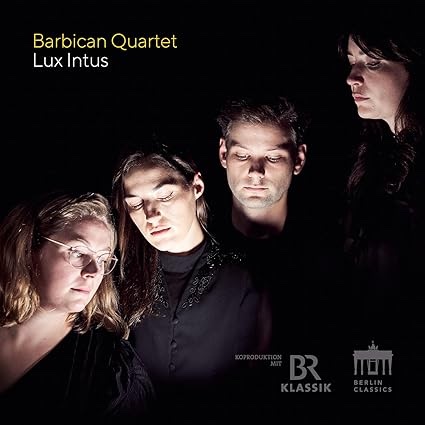
Barbican Quartet – Lux Intus – BR Klassik
“Internal Light”… illuminating the inner voices of the quartet