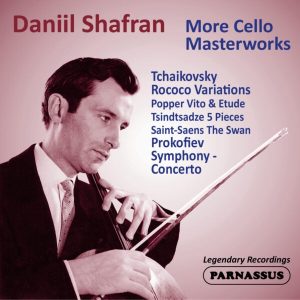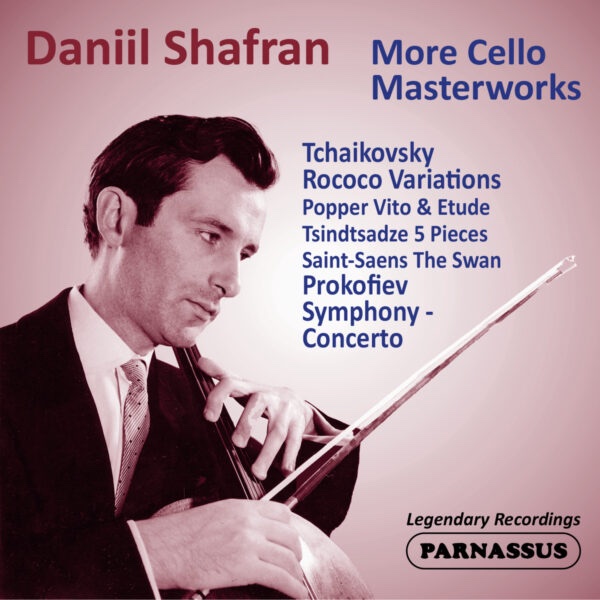
More Cello Masterworks = TCHAIKOVSKY: Variations on a Rococo Theme; POPPER: Vivo; Concert Etude; TSINTSADZE: Five Pieces on Georgian Folk Themes; SAINT-SAENS: The Swan; PROKOFIEV: Symphony-Concerto in E Minor, Op. 125 – Daniil Shafran, cello – Parnassus PACL 95016 (77:49, complete content and credit listings below) [Distr. by Alto] *****:
“A musician of “merciless iron discipline,” Russian cellist Daniil Shafran (1923-1997) and his patented 1630 Amati instrument acquired a reputation for flawlessly intoned performances of suave, poetical beauty and elegant sensitivity. The cellist Steven Isserlis summed up that “as a cellist and musician, Shafran was unlike anyone else. At a time in which, thanks to various media, musical styles are converging, Shafran’s voice remained apart. His vibrato, his phrasing, his rhythm all belonged to a unique whole; his astounding virtuosity conveyed a musical personality that retained the passion, the simplicity and the poetry of a great Russian folk singer. He was incapable of playing one note insincerely; his music spoke from the soul.”
Parnassus assembles a program 1949-1962 that demonstrates something of the range of Shafran’s fluid art, that defines the discovery of what Steven Isserlis calls “the last member of a lost tribe of cellists.” The program opens with a rendition of Tchaikovsky’s 1876 Rococo Variations, conceived as an homage to beloved Mozart by way of friend cellist Wilhelm Fitzhenagen. The structure, a theme, seven variants and coda, seems to rely on an edition now considered corrupt but still capable of showing off the versality and singing tone of the solo part, whose tessitura reaches high into violin territory. Shafran had been playing the work from the time he was 11 years old, and his seamless ease of execution blends perfectly with Kondrashin’s responsive ensemble, especially the illumined woodwinds. The sound and tone of Shafran’s Amati – especially in vibrato – varies from a full-throated ff to a whispered pp, while the elastic continuity of the variations retains its essential character. His spiccato and staccato passages blister the ear with their exactness and speed, and his potent cantilenas sing rapturously. The Variation 6 Andante section, after the long solo cadenza, proves mesmeric.
Shafran turns to the demanding studies by Bohemian virtuoso David Popper (1843-1913), which among other resources, test the cellist’s deft articulation and bowing technique, the first, “Vivo,” subtitled “Spanish Dance,” with a hearty beat that verges on that of a tarantella. The striking accents of the dance virtually fly off the bridge, while pianist Nine Musinyan (1910-1995), Shafran’s wife, demonstrates the plastic mastery of her instrument she learned from her teacher, Konstantin Igumnov. The equally pulsating Concert Etude allows Shafran and Musinyan to gallop in perfect harmony. Likely, the music of the Soviet Georgian composer Sulkan Tsintsadze (1925-1991) will be unfamiliar, but his 1950 Five Pieces of Georgian Themes exploit the indigenous, modal harmonies of the region in a manner reminiscent of Kodaly for lyricism and Khachaturian for color. The opening “Arobnaya” sets the tone with its broad, expressive melody and nuanced, exotic harmonies from the keyboard. Plucked figures mark “Chonguri,” whose percussive motion might reflect a stringed folk instrument. “Sachidao” proves hazy and oriental in a mode of light fingers, a sultry tent dance that begs for a veiled and acrobatic female. The fourth entry, “Nana,” offers a luxurious, slow berceuse in high register, much in imitation of Khachaturian. The fifth and final piece, “Plyasovaya,” injects a spiky, percussive energy into the mix, the kind of stomping dance favored by Bartok and Enescu. The middle section moves breezily, with slick glissandos and jabbing accents from Shafran that show off a nimble security with his Amati.
What to say of Saint-Saens’ “The Swan” from Carnival of the Animals, except to proclaim the broad majesty of Shafran’s voluptuous tone undergirded by a tender application of vibrato. Here, the piano part illustrates the transparent gifts of his later partner, Anton Ginsbeg, with whom Shafran would tour extensively.
At the request of Russian cello virtuoso Mstislav Rostropovich (1927-2007), composer Sergei Prokofiev decided to re-work his 1938 Op. 58 Cello Concerto in E Minor into what became in 1952 his Symphony-Concerto in three movements. In this potent reading, Shafran has the expert assistance of conductor Gennady Rozhdestvensky (1931-2018), whose capacity for colors had been honed by his father, Nikolai Anasov. Prokofiev himself exploits the woodwinds’ crystalline coloration in the opening movement, Andante, setting the solo cello against bassoons and horns, as well as the lower spectrum of stringed instruments, without having lost the sonority of his stellar instrument, whose flighty athletics testify to the influence of Rostropovich.
The expansive second movement, Allegro giusto, serves up the tour de force of the composition, lasting some sixteen minutes and serving as the heart of the work. Shafran has a punishing cadenza of two pages that emerges seamlessly from the body of the rather frenzied tissue. A whirling opening that adumbrates the last movement’s danse macabre sends us along precarious melodic runs, always threatening to careen into percussive, discordant chaos. Still, Shafran’s cantilena pleas for reconciliation, and a lyrical, even melancholy beauty rises that displays Shafran’s especial, striking tone. The valedictory tenor of the music hints at the composer’s last Symphony No. 7, Op. 131. Suddenly, the music accelerates into a demonic etude that asks the orchestra to lend various, sporadically placed colors, hinting at a bizarre, surreal march. The tempo shifts yet again, with Shafran’s adjusting his sound to reach into harmonics and whistling, pyrotechnical impulses we recall from the Violin Concerto No. 1 in D, Op. 19. This discordant, mysterious sequence becomes ever more agitated and anguished, finally sending Shafran and company into a stratospheric coda.
The last movement, Andante con moto, begins in a spirit of melancholy, buttressed by Prokofiev’s coloristic sense of counterpoint. Shafran then indulges in a scored solo part that never quite separates into a formal cadenza but demands of him any number of shifting bowings and slides. The drunken affect of an off-kilter dance erupts, with grumblings and whimsical portamento from the ensemble, including a celesta. From this morass of sound arises an earnest song from the cello that finds solace in an ostinato pacing which incites Shafran to dragonfly-quick arpeggios in tandem with horn and drum fanfares. The coda flies up into cosmic harmonics, as the drum passes a final judgment. Whew!
—Gary Lemco
Daniil Shafran: More Cello Masterworks
TCHAIKOVSKY: Variations on a Rococo Theme, Op. 33;
Moscow Philharmonic Orchestra/ Kirill Kondrashin/
POPPER: Vivo, Op. 54/5; Concert Etude, Op. 55/2;
TSINTSADZE: Five Pieces on Georgian Folk Themes;
Nina Musinyan, piano/
SAINT-SAENS: The Swan;
Anton Ginsburg, piano/
PROKOFIEV: Symphony-Concerto in E Minor, Op. 125
USSR State Symphony Orchestra/ Gennady Rozhdestvensky