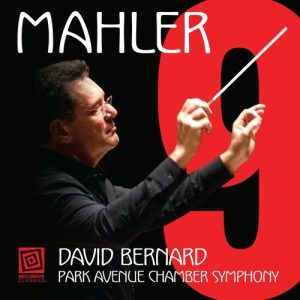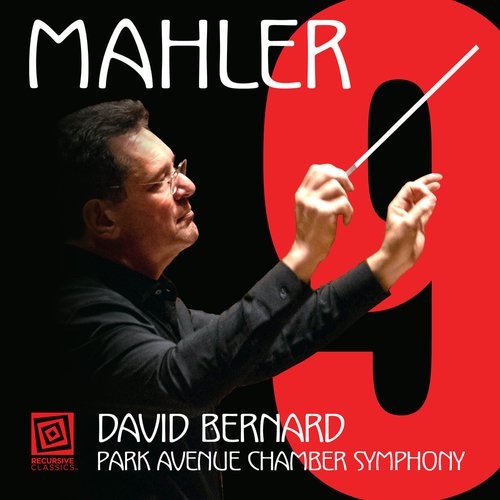
MAHLER: Symphony No. 9 in D Major – Park Avenue Chamber Symphony/ David Bernard – Recursive Classics (78:52) (6/13/25) [www.chambersymphony.com] ****:
The Park Avenue Chamber Symphony celebrates its 25 anniversary with a highly personal, even intimate, version of Gustav Mahler’s Ninth Symphony (1909-1910), recorded in November 2024 at the DiMenna Center for Classical Music in New York City. The resultant acoustic, immediately riveting, follows Mahler’s sound world, in progressive tonality from D major to D-flat major, offered as a series of brilliant, intense meditations rife with intimations of mortality.
When we recall that a parodic funeral march inhabits Mahler’s First Symphony, it comes as no surprise to note the vast appearances of death motifs in the entire symphonic oeuvre. The Ninth Symphony (1909) has come to mean “Farewell” on multiple levels: to Mahler’s own life, to the security of musical tonality, to the comforts of pre-20th Century civilization. Terribly superstitious, Mahler had felt anyone’s ninth symphony tempted fate, given the thwarted progress in Beethoven and Bruckner. Mahler attempted to circumvent fate with his Das Lied von der Erde, a “Symphony for Tenor, Alto Voice and Orchestra,” which would have made the D Major his Tenth Symphony, with yet another, a Symphony in F-sharp, on the horizon. Commentator David Patrick Steans attributes the lachrymose sensibilities of this dark opus first to Tchaikovsky (his Pathetique Symphony) and then to Richard Strauss, whom Mahler met in 1887 Leipzig, and whose symphonic poem Death and Transfiguration finds echoes early in the first movement. I incline to the influence of Franz Liszt, whose opera Mahler well knew, and who likewise indulges in extremes of Empyrean bliss and Dantesque despair.
The expansive opening movement, Allegro comodo, in an abridged sonata form, institutes the thematic and harmonic extensions of “last thoughts,” the repetitions of the Ewig (forever) impulse of Das Lied von der Erde’s farewell that is no less an existential constant. In due course, Mahler will allude to Beethoven’s “Das Lebewohl” from Piano Sonata No. 26, Op. 81a. Some conductors, like Leonard Bernstein and Jascha Horenstein, have seen the motif as one among many in a complex, contrapuntal founding structure quite capable both of lyricism – ausdrucksvoll, zart gesungen, and espressivo – or, alternately anguished, mit Wut and liedenschaftlich, as required. Bernard’s thoughtful pace captures the throbbing aspect of the unfolding narrative, intruded upon by severe moments of dissonant, affective turmoil. Much of the ensuing development moves on wie ein schwerer Kondukt (“like a grave funeral procession”), vacantly enunciated (a Pyrrhic Victory?) by muted brass and tam-tam, no less besieged by conflicted (brass) forces. While the recapitulation maintains the original order of themes from the exposition, a sense of exhaustion, in solo violin, harp, and flute and cello pianissimos, that employs the sighing figure in a softly dissolving coda.
Between the huge slow movements that frame the work, the interior movements shed an ironic, violent, and fantastical hues – in the laendler and burleske episodes – on the nature of mortality, including dance music of paradoxically intricate, learned, folkish, and banal quality. The degree to which Mahler imbibed classical counterpoint has rarely affected such contentious idioms in music. The mixture of life and death – or death-in-life – marks the impetuous and grotesque, bassoon-initiated, Austrian Ländler dance second movement, a totentanz, as it were, equally reliant on the sighing motif to claim its sense of unity. Whether Mahler’s idiosyncratic walking gait or his inefficient heart-beat might claim to be the instigator of this eccentric voyage, Bernard makes the most to capture its raucous symmetries, his scoring, like the piccolo and E-flat clarinet, often anticipating much of Krenek and Weill.
The third movement, Rondo-Burleske, allows us a cynical vision of spiritual anarchy, perhaps indicative of Mahler’s loss of faith. The aural chaos finds its counterpoint, literally, in the evolution of a double fugue worthy of the great master, Sebastian Bach. The whirling, metric velocities are kept in check by Bernard’s close attention to sonic clarity of articulation. Martial and irreverent, clownish figures pass by in kaleidoscopic fashion, a welter of emotional disparities. The Park Avenue woodwinds and brass prove their mettle in controlled tropes, a series of cruel or consoling antiphons in syntactical permutations before the strings utter their version of ascension. Commentator Stearns offers measure 347 as a particular moment of “revelation,” but he hesitates to claim its nature. Bernard delivers a kind of moto-perpetuo pandemonium, increasingly hectic as it culminates in a rousing but distorted coda.
The Park Avenue Symphony strings alone intone the hymnal opening of the final Adagio. Sehr langsam und noch zuruckhaltend, with its obvious debts to Tchaikovsky, but here no less obligated to tragedies within Mahler’s own family life. Bernard’s veneration for this solemn orison shines through, a warmly etched performance of staid, emotional power. The long, pained harmonic journey will often toy with the A-flat major, A major (of the Rondo-Burleske), and F minor tonalities, establishing at best an ambiguous aura to this sighing, valedictory procession. The melodic allusion to the fourth of the fatal 1904 cycle Kindertotenlieder could be more than the text’s insinuation of a grieved parent’s deluded attempt at consolation; it may well mark a man’s vain attempt to regain his lost faith, a la Nietzsche, in metaphysics. So, this is the way the D Major Symphony world ends, ersterbend (dying) in an elongated, anguished whisper. A conscientious, even towering, performance, this Bernard rendition.
—Gary Lemco