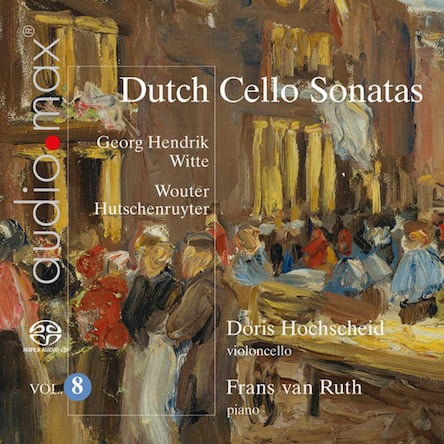
“Dutch Sonatas for Violoncello and Piano Vol. 8” = GEORG HENDRIK WITTE ‒ Sonata for Pianoforte and Violoncello, Op. 15; Three Pieces for Pianoforte and Violoncello, Op. 14; WOUTER HUTSCHENRUYTER ‒ Sonata for Pianoforte and Violoncello, Op. 4 ‒ Doris Hochscheid, cello / Frans van Ruth, piano ‒ Musikproduktion Dabringhaus und Grimm multichannel SACD MDG 903 2094-6 (2+2+2); 71:14 (12/14/2018) ****
“Too Leipzigerisch”—that’s the barb Franz Liszt lobbed when he heard a performance of Schumann’s beloved Piano Quintet at the composer’s home in June of 1848. This was a slap, of course, at Mendelssohn and the conservative musical style promulgated by the Leipzig Conservatory, which he had founded. Liszt’s criticism may have been issued half in jest since the Hungarian debuted several of Schumann’s works and was generally a staunch advocate. But neither Schumann nor his wife Clara took it as such, and for the remainder of the century, musicians in central Europe would have to declare whether they came down on the side of Mendelssohn’s Leipzig or Liszt’s and Wagner’s Weimar.
In the middle and late nineteenth century at least, Holland gravitated mostly to Leipzig and its musical aesthetic. In fact, Georg H. Witte (1843–1929) studied with, among others, Mendelssohn’s teacher Ignaz Moscheles and with Carl Reinecke, who would faithfully carry that aesthetic into the twentieth century. After working in Leipzig and his native Utrecht, Witte would finally settle in Essen, where in 1871 he was installed as director of the Essen Music Society. He became a naturalized Prussian citizen and lived the rest of his life in Essen. Given his duties as the city’s music director, which included work with the choir and orchestra plus teaching assignments, Witte found little time to compose, leaving only a small body of work. However, based on the sonata and character pieces on offer here, he was a considerable talent.
His style shows the influence of Schumann more than Mendelssohn, especially in the three character pieces, which recall the German composer’s Fantaisiestücke and Stücke im Volkston for cello and piano. However, in the minor-key music of the Sonata and the finale of Three Pieces, Witte seems to echo the special air of melancholy that sometimes haunts Mendelssohn’s often sunny chamber music. This is, of course, just to give an idea of the influences behind the music, though Witte is mostly his own man, a man who has a way with a melody that compares favorably with that of his great models.
The Sonata is a stronger vehicle than the Three Pieces, with a well-argued, dramatically eventful sonata-allegro opening and a finely poised Adagio slow movement. There are good things in the finale as well, though for me there is a bit too much Mendelssohnian note-spinning in the first thematic group, even if it is treated to a pretty inventive development. Initially, Witte seems to have considered the first two movements less successful than the third and subjected them to “extensive revisions” (though it’s not clear from his notes what those entailed). If that’s the case, he certainly got things right as far as I’m concerned and should, perhaps, have lavished the same attention on the finale. I’d be interested to know if other listeners have a similar reaction.
Unlike Georg Witte, Wouter Hutschenruyter (1859–1943) studied in his native land, at the Toonkunst Music School, with Friedrich Gernsheim, another pupil of Ignaz Moscheles, and Woldemar Bargiel, Clara Schumann’s half-brother and alumnus of the Leipzig Conservatory. Like Witte, Hutschenruyter had initial success as a composer, conducting his own works with no less a body than the Concertgebouw. But, again, like Witte, he ultimately decided that composition was not his strong suit, and in 1892 he accepted the post of principal conductor with the Utrecht Symphony, where he served for twenty-four years. His final post was as head of his alma mater, the Toonkunst School in his native Rotterdam.
There’s a part-funny, part-infuriating story attached to Hutschenruyter’s 1882 Cello Sonata. The composer entered the work in a Hamburg music contest that called for either a cello sonata or a series of three character pieces. One of the jury members wrote to the Dutchman, telling him that his composition was a strong contender but could not be considered for the prize because it began with a slow movement. Would he, perhaps, care to designate the work a set of character pieces rather than a sonata? Respectfully, no, came the answer, to which the juryman responded, “Now you will surely not win a prize!” And he didn’t, though the sonata soon, justly, appeared in print.
It is a strong work, slow first movement notwithstanding. That slow movement, by the way, begins with a march-like tread underscored by repeated chords in the piano but soon gives way to a headlong minor-key middle section that imparts a decidedly split personality to the movement. And so, too, the second movment, a nominal scherzo that saunters along in the manner of a Brahms intermezzo rather than a Mendelssohn fairy-dust scherzo. Again, the B section is closer to quicksilver, with a jumpy, near-moto-perpetuo piano part above which the cello proceeds in more linear fashion.
The finale is another story altogether. An intense C-minor melody is followed by a heroic second subject in the major, setting up a classic musical battle between the forces of darkness and light. The interplay of the two melodies in the development section is especially masterful, with the radiance of the second subject cutting through the dark tapestry here and there before its final triumph in the closing pages. In a way, I understand the juryman’s hesitation about the work. It doesn’t quite hang together in classic sonata fashion, even if one considers Beethovenian precedents like, oh, say, the Moonlight Sonata. But that last movement really is worth the price of admission, to coin a phrase.
In all, an ambitious and attractive program of forgotten pieces that don’t deserve such a fate. Doris Hochcheid and Frans van Ruth, who have featured in earlier volumes of this series, capture all the beauty and nuance this very good music has to offer. As expected, MDG’s surround sound is fully you-are-there and then some. Heartily recommended.
—Lee Passarella