An outstanding coupling in every respect.
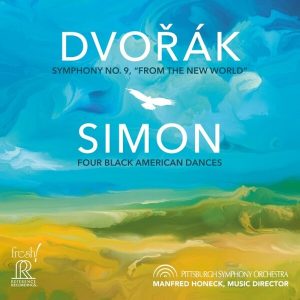
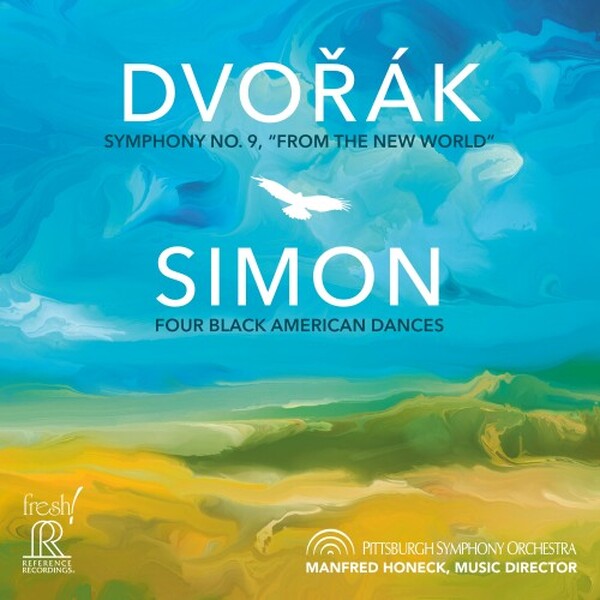
DVORAK: Symphony No. 9; SIMON: Four Black American Dances – Pittsburgh Sym. Orch./ Manfred Honeck – Reference Recordings multichannel SACD FR-7695, 58:53 *****:
One expects these days that any release from the PSO and Honeck will be superlative in sound and intriguing in interpretation, as the conductor has proven himself repeatedly to be historical, thoughtful, and willing to shine a new light on time-worn masterpieces. As a bonus, he also offers couplings that on first appearance might seem incongruous, but when heard seem to fit like a glove.
Such is the case here, where the great Czech composer meets a nascent great artist from the shores of America. But let us first examine the work from the former resident of Spillville, Iowa. If there is anyone in the world who is a classical music fan that has not heard the “New World” symphony, then that person must be living as “off grid” as you could imagine. For most of us involved in the genre as performers or listeners, this work is surely the mother’s milk of all pieces ever written; there are so many performances available on record, and truly outstanding ones at that, you could stumble through a large field of them, picking at random, and be entirely satisfied were it the only one you would ever hear.
All this is to say that any new recording is going to have to offer something tremendously exciting to awaken interest of any kind. Recently there was an offering from the Atlanta Symphony under Natalie Stutzmann, fresh on their new contract with Erato, which was good, even wonderful in certain ways, but nothing particularly illuminating. Now Manfred Honeck, who is apparently treading his way though the standard repertory while attaching new nuggets of wonder to each release, tackles the intrepid Dvorak ninth. The results—and I cannot believe that I am saying this—thrust this release not only into the top five, but straight to the top.
You heard that right—this is the best ninth I have ever heard, and like most of you reading this, I have heard many. Why is this? First, as expected from these forces and this label, the sound, especially in the SACD incarnation, is simply incredible. Not only is the audio spread vivid, cushioning, and with rich depth, the engineering that allows only hall-like reverberation in the back speakers is simply perfect. Then you must consider the masterly way that Honeck spotlights differing lines and instruments that offer a new perspective to the ears. The clarity in the recording has to be heard to be believed.
Much of the clarity comes from the almost obsessive attention paid, bar by bar, to not only Dvorak’s intentions, but the realization of them considering the orchestral playing of the time and the nature of certain instruments. For example, Honeck mentions that the timpani of the time were not always able to correspond to the melodic needs of particular passages, where in the first movement the tuned E and B in the timpani does not align with the bass line of the third trombone and cellos and basses. When compared with other performances, this subtle change in matching the lower instruments adds a more forceful and pleasing coloration to the music. In the second movement, Honeck reminds us that Dvorak intended this section to serve as a study for a cantata based on Longfellow’s Hiawatha, and when the various transitions are performed with this in mind, the adagio takes on the feeling of a warm and longing tone poem. The scherzo and finale are immensely exciting, lifting the rafters in the last bars of the symphony before fading into softness, like a wonderful dream slipping from memory.
But the memory does not fade as we move on to Carlos Simon’s Four Black American Dances, premiered by Andris Nelsens and the Boston Symphony in 2023. Now I suppose that I have to say that Simon is indeed a black American (but maybe we will one day get to the point where this is not necessary, as I am sure Simon wants to be remembered simply as a “composer”), but in this case it’s important as the music offered is specifically from his own knowledge of dance types found in the black experience. The Atlanta native has crafted a wonderful set of movements, “Ring Shout” (a religious and ecstatic offering of charismatic fervor), “Waltz” (the preferred dance of the debutante balls that appeared among more well-to-do black families in the 1930s), “Tap!” (a very popular dance that especially exploded among black performers, as its African and Irish roots merged with the jazzy propulsion offered by African/European step dance traditions), and “Holy Dance” (redolent of modern, Pentecostal expressions of exuberant and joyful worship). This suite is sure to become a favorite among audiences of all stripes, and one looks forward to what Simon might accomplish in the future. Much credit must be given to Honeck, who heard what you hear in matching the Dvorak with this piece—Dvorak knew what he was talking about when he said that the future of music in America “must be founded on what are called Negro melodies.” Though this is perhaps a bit narrow considering the vast array of influences that American music constitutes, one certainly hears echoes of Simon’s work in the prescient haunting melodies of Dvorak.
Simon is currently Composer-in-Residence with the National Symphony Orchestra in Washington, D.C. and soon takes up a one-year appointment as Composer-in-Residence with the Royal Concertgebouw Orchestra in Amsterdam.
You want this disc—you may not know it now, but when you hear it, all will become clear.
—Steven Ritter