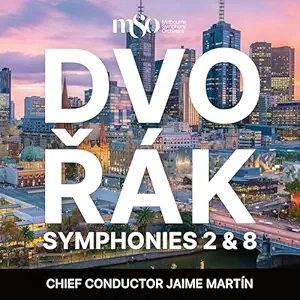
DVORÁK: Symphony No. 8 in G Major, Op. 88; Symphony No. 2 in B-flat Major, Op. 4 – Melbourne Symphony Orchestra/ Jaime Martín – MSO 0004 (2 SACD = 97:00) (11/21/25) [Distr. by Integral] ****
Dvořák’s G Major Symphony of 1889 (rec. 25-9 June 2024) has enjoyed a fulsome recorded history that includes elegant, classic readings by Vaclav Talich, Rafael Kubelik, George Szell, Antal Dorati, and Sir Thomas Beecham. Consistently melodious, the work basks in pastoral ecstasies inspired by the Bohemian countryside and a villa in Vysoká, the home of his brother and his wife. Less volatile and darkly dramatic than Symphony No. 7 in D Minor, the work abounds in bucolic lyricism, comprised in brief but tenderly hewn melodies and infectious rhythms, especially the third movement Allegro grazioso, a compelling waltz, which, depending on the interpreter, can effect a haunted nostalgia.
Conductor Jaime Martín takes a broad, even lush, approach to the sonorities of the G Major Symphony, quite basking in the cello and brass lines, while the flute solos (Sarah Beggs, principal) emerge in their youthful vigor and piercing virtuosity. To my ears, Martín and his Melbourne players wish to inflect a sound and sympathy in this work reminiscent of the great Vaclav Talich (1883-1961), in which epic outbursts found complements in intimate, etched, lyrical phraseology. While the melodic content belongs to Dvořák, the formal structure seems to borrow from Brahms and Schubert, particularly in the way the Adagio movement in E-flat major erupts with passion before resuming its search for tranquility. Even with the bristling, martial fanfares of the last movement, Allegro ma non troppo, Dvořák elicits a whirlwind of contrapuntal mastery and syncopation that sets challenges for the Melbourne players’ articulated attacks.
Dvořák felt unhappy with his 1865 edition of the epic-sized Symphony No. 2 in B-flat Major, perhaps lamenting its initial likenesses to music by Schubert and Wagner. For two decades the symphony languished, even facing possible immolation by the composer, who (happily for us) did revise the work in 1887, allowing its premiere in Prague in 1888. A youthful buoyancy infiltrates this optimistic score, which if it suffers anything structurally, the “fault” lies in its plethora of ideas. The Scherzo, however, asserts the presence of the mature master already incipient in the early movements.
Martín and the Melbourne orchestra (rec. 31 March – 5 April 2025) infuse a genial warmth into their realization, imbuing the first movement, Allegro con brio, with a robust energy that does occasionally relax for Dvořáks lyrical interludes. The expansive music gains more girth when the conductors (rarely) take the repeat. We hear a young composer’s struggle to mediate academic rigor with natural Bohemian temperamental inspiration. Martín reveals both fire and tenderness in this opening assault on otherwise German tradition.
Dvořák already excels in slow movement creativity, here a Poco adagio of inner self-confidence in tenor and melodic control. This movement, too, relishes its broad vistas, more of Smetana and Wagner than Beethoven. The open-work of violins, horns, and woodwinds proves delicately haunting, while the middle section exploits Dvořák’s contrapuntal gifts. There appear moments of relative, melodic and color stasis, with Dvořák’s lingering on large pedal points in the manner of an organ’s tonal palette. The interplay of woodwinds late in the movement might reflect the influence of Wagner’s Forest Murmurs, cross-cultivated by some Lisztian declamations.
Beginning in a bucolic haze, the Scherzo suddenly erupts into a forceful exertion of primal energies, the patented cross-rhythms in full effect. The Melbourne brass and woodwinds exult in their fanfares, while the cellos impart a silken luster to the middle section, aided by aerial flutes and an insistent tympani. The sense of an expanded Slavonic Dance never leaves the milieu, as rustically active as it remains transparent.
The last movement, Finale: Allegro con fuoco, after quirky opening bars, advances in a mixture of bucolic and martial figures, the Melbourne brass and tympani in resplendent form. We hear a certain Wagnerian temper’s thickness and counterpoint’s infiltrating the otherwise Bohemian milieu, much touched by echoes of Smetana. The warmth of viola and cello choirs invests an attractive luster to the whole, a potent forecast of what, in Dvořák’s maturity, will define his orchestral magic. The last pages turn rather a festive assertion of voluptuous energies, the likeness to Wagner’s Tannhäuser now ardently apparent.
–Gary Lemco