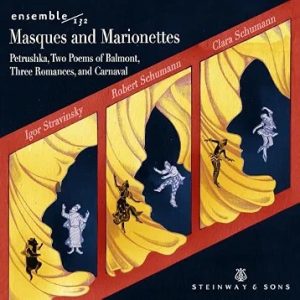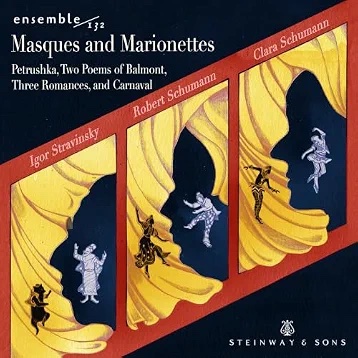
Ensemble 132: Masques and Marionettes – STRAVINSKY: Two Poems of Konstantin Balmont; Petrushka ; C. SCHUMANN: Three Romances; R. SCHUMANN: Carnaval – Maria Ioudenitch and Abi Fayette, violins/ Luther Warren, viola/ Zachary Mowitz, cello/ Sahun Hong. Piano – Steinway & Sons 30254 (75:51) (10/2/26) [Distr. by Naxos] *****:
The Boston-based Ensemble 132 (estab. 2019) follows its guiding principle, that “Great music transcends the confines of instrumentation.” Thus, a large range of interpretive freedom ensues, allowing the musicians to expand upon “official” scores and present them in settings conducive to the fluid abilities and creative whims of the performers. The prime mover of Ensemble 132, pianist Sahun Hong, means to engage the collaborators in projects that expand, even defy, the genres of the original compositions they interpret.
This program opens with a piano quintet arrangement of Igor Stravinsky’s 1911 Two Poems of Konstantin Balmont, “Forget-Me-Not Blossom” and “The Dove.” The violin and cello, respectively, serve as the main storytellers. From the shimmering, tremolo first measures the violin sings a plaint that the flower might inspire ardent devotion in the beloved. The cello intones in high register over an eerie drone bass the mournful loss of the “crimson flower” of love by the white dove once possessed it. Dark dissonances proceed to accompany the mournful tune, the piano especially sternly unsympathetic.
Pianist-arranger Hong has raised the specter of Stravinsky’s original concept for his Petrushka ballet as a quasi-concerto for piano and orchestra. Set at the Shrovetide Fair in the St. Petersburg of the 1830s, the story line involves a hand-puppet character whose roots lie in Commedia dell’arte and Russian folklore. The music relishes a bi-tonal, intervalic rubric (C major – F# major) that captures the very human struggle – here, in a character brought to life by sorcery – for love and acceptance. The immediacy of Hong’s “re-orchestration” loses little by way of kinetic energies, especially conscious of Stravinsky’ own depiction of his character’s capacity to “exasperate the patience of the orchestra with diabolical cascades of arpeggios.” The violin takes up the melancholy plaint of the puppet in “The Magic Trick,” replacing the flute, while the keyboard adds intimations of sorcery.
“The Russian Dance” we know well from the piano solo arrangement the composer created for Artur Rubinstein. Now, it assumes a more stinging character as violin and piano engage in a spirited colloquy. The scene in “Petrushka’s Room” becomes almost unbearably acerbic with violin and piano bravura passages. “The Moor’s Room” clearly establishes the bitonal, perhaps bi-polar, threatening energies in the main character’s loss of love and his resultant fury. The cello takes up the drone for “Petrushka’s Waltz,” the violin and piano adding their respective sense of irony. The four-note pattern asserts a version of a “fate” motif, gathering speed and dissonance as a source of pain and revolt. Suddenly, we are thrust into the kaleidoscope of the Fair, a deliciously raucous exhibition of colors created by Ensemble 132 from which the cello and violin elicit the main, lyrical theme over keyboard ostinatos. The motion becomes increasingly dizzy, often explosive, a paroxysm of longing and despair. The shimmer of the open motives recurs, and the melodic line becomes more strident, more punished, mostly by way of the cello’s unnaturally high register.
With an aggressive, martial assault of rhythm and color, Ensemble 132 makes us hear “The Dance of the Coachmen,” a concoction of competing melodic and metric impulses, testily layered in relentless harmony. Suddenly, the textures break off in a sense of climactic resolve, pulsating and then maestoso chordal, even pentatonic, in character. The progression, now ironic and fatal, cascades to an abrupt, unsentimental collapse.
A mighty, dramatic juxtaposition of effect follows, as cellist Mowitz and pianist Hong perform movement one, Andante molto, from Clara Schumann’s intimate 1853 in a version that deepens the harmonies and colors from the original setting for violin and piano. For the second movement Allegretto, violist Warren joins Hong in music alternately mournful and frolicsome. The third movement, marked “passionately quick,” has realization in its origjnal form by Ioudenitch and Hong. The textural fluency in Schumann’s sense of color allows the two instruments to trade the presentation of the main theme, which soars to a passionate apex in the keyboard, resolves into calm acceptance.
Recast as a piano quartet, Robert Schumann’s opening gambit for his Carnaval, “Preambule,” has all the power of a colossal fanfare, introducing his own, psychological assortment of characters that reside in his fertile imagination. The idea of creating “Little Scenes on Four Notes” attaches not only Robert and Clara’s musical anagrams, but no less invokes the economy Beethoven established in his Fifth Symphony. Again, the Comedia dell’arte enjoys plastic treatment of its various characters, especially the serious and wistfully playful sides of Schumann’s character.
According to the notes by arranger Hong, Schumann’s autobiographical solo piece has gained “a newfound humor and sparkle” by virtue of its added performers. Those who relish this more “orchestral” incarnation likely recall Arnold Schoenberg’s treatment of the Brahms G minor Piano Quartet. Hong’s coy version of “Coquette” and his addition of the oft-omitted “Sphinxes” inserts both theater and gothic drama into a score noted for its lyrical flamboyance. Clara (“Chiarina”) appears in full waltz regalia and Chopin in his especial, nocturnal grandeur. “Reconnaissance” has rarely sounded so ardent in the search for beauty, “Pantalon and Colombine” so mercurial in their treatment of each other, and “Paganini” regains his sonorous diabolism in mincing then aggressive bounds. “Aveu” assumes its rightful integrity as a piano solo. “Promenade” enjoys schwung and dazzling color. Finally, what Hong terms “the scale of intensity” merges full force in the ironical “Pause” and the fiery conclusion, “March of the Davids-Leaguers against the Philistines,” Schumann’s forceful protest against all intellectual mediocrity and self-satisfaction.
What we have here embodies a bold experiment in chamber-music programming, carried off with explosive self-assurance and technical brilliance.
—Gary Lemco
Ensemble 132: Masques and Marionettes
STRAVINSKY:
Two Poems of Konstantin Balmont (arr. Hong);
Petrushka for Piano Quintet (arr. Hong);
C. SCHUMANN:
Three Romances for Violin and Piano, Op. 22;
R. SCHUMANN:
Carnaval, Op. 9 for Piano Quartet (arr. Hong)
Maria Ioudenitch and Abi Fayette, violins/
Luther Warren, viola/ Zachary Mowitz, cello/
Sahun Hong. Piano