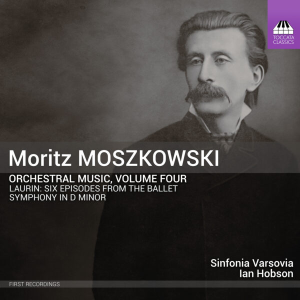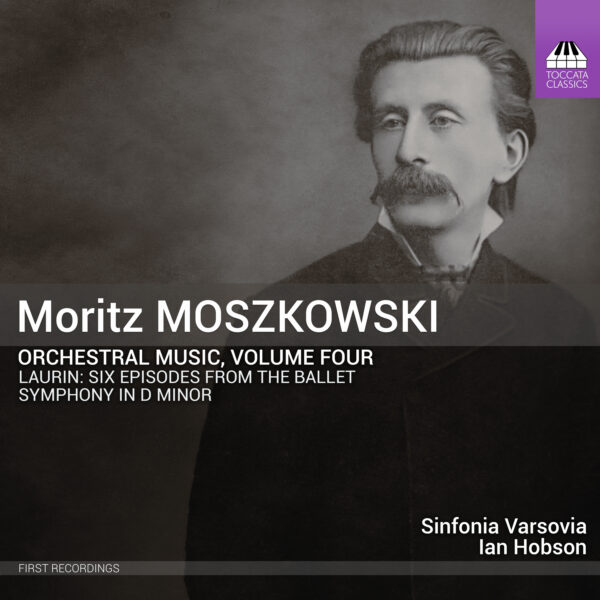
MOSZKOWSKI: Orchestral Music, Vol. IV – Symphony in D Minor; Laurin: Six Episodes from the Ballet – Sinfonia Varvosia/Ian Hobson – Toccata Classics TOCC 0615 (8/7/26) (59:01) [Distr. by Naxos]****:
Pianist-composer Mortiz Moszkowski (1854-1925) receives little note except as a creator of brilliant miniatures and salon pieces, mainly for the keyboard. The present efforts of conductor Ian Hobson and Sinfonia Varvosia to unearth and disseminate more orchestral scores by Moszkowski have provided us (rec. 14-15 February 2022 and 18 June 2025) the composer’s youthful (1873) Symphony in D Minor and his ballet Laurin (1892-93). Barely 19 years of age and a pupil at the Neue Akademie der Tonkunst in Berlin, Moszkowski produced his symphony, which he reported “received very encouraging applause” at its premiere. The score, along with various, other early works, lay as an undiscovered cache in the National Library in Pais, France. Dissertation research by Bojan Assenov revived these works for recording, which in turn, hopefully, will inspire concert realizations.
The first movement of the Symphony in d opens Maestoso – Allegro appassionato, a robust application of 4/4 stateliness that soon erupts, much in a manner reminiscent of both Schumann and Mendelssohn. Alternating between the home key and its relative major in F, the music enjoys a number of luminous fanfares and hymnal effects, along with the high, whistling airiness of mountain vistas. The working out in sonata form bears the stamp of academia, but the energetic presentation of themes and their transitions demonstrate a thorough enjoyment of the orchestral medium. The Più mosso build up of themes as stretti adds a decidedly Schumann drama to the occasion, leading to a false cadence in the coda, a fermata so that clarinets and horns might include the wind s and strings, pianissimo.
The Mendelssohn influence extends, folk-like, into the Scherzo in F major, marked Vivo, 3/4. Explosively energetic, the music asks for saltato, bouncing strokes, from pp strings. The music moves in a graceful leisure to D-flat before wandering to the dominant key. A casually melodic Trio in D minor enjoys various woodwind and string effects from Polish folk tunes or Mendelssohn’s highlands, whichever grants more nostalgia. The persistent four beats from the Scherzo-theme proper often suggest that Beethoven says hello. The main theme returns, bustling and vivid as before, Hobson’s strings quite vehement. Just before the coda, Moszkowski inserts two jarring 6/8 measures so as to end ff.
Moszkowski’s third movement Larghettto, 12/8, evolves in B-flat major and is marked Tranquillo. The song impies that Beethoven’s second movement of the Pastoral Symphony has been an inspiration. Proceeding cantabile e tranquillo, the music established a richly harmonized, bucolic serenity that moves into the dominant mode (of F), courtesy of a grazioso oboe. The rhythms become more agogically diverse, 9/8 and 68. The woodwinds exert enough materials to characterize the piece as a wind serenade. The strings modify the melodic tissue to sing in D-flat major on a huge, sustained pedal point. The chromaticism abates via a series of diminuendos, ritardandos and morendos so as to facilitate a quiet, ppp coda.
A chugging, relentless energy at first announces the last movement, Presto non tanto, Più mosso. A turbulent rondo sets forth, a punctuated contest between the modes of D. Moszkowski’s developmental mode may well be Schubert, given his tendency to reiterating and yet expanding his thematic motto in fragmented forms, with nuances applied “on the beat,” “distinctly,” and in “rapid staccato.” A drone effect establishes a countrified hymn of a kind, leisurely and waltz-like. The addition of tympani increases the dramatic effect, but Moszowski opts, via struggles among the orchestral choirs, to change metrical direction the move from F major to A major. The climactic statement as a chorale tune may remind some of early Elgar. Two-measure fragments hurl energies at each other sempre fff until a very busy coda in D major asserts its supremacy.
The 1892 commission from the Royal Dramatic Theater in Berlin motivated Moszkowski’s Op. 53 Laurin ballet, the full score of which no longer survives. The plot deals with competition between the hero, Dietrich von Bern and Laurin, King of the Dwarves, for possession of a magical garden. Moszkowski himself arranged a concert suite that permits the music to endure. “Introduction and Dance of the Ros Elves” sets the amiable tone in E-flat and A-flat, a genial, lightly balanced series of energies in the Leo Delibes or Grétry mode of expression. “March of the Dwarves” proceeds in 4/4, the bassoons, battery, and trumpets adding girth to the procession, in E-flat and A-flat, while the triplets remain unsparing of our desire for rest. A hammered crescendo dominates the final measures, the accented string in fff octaves. Deliberate archaism marks the ‘Sarabande e Double,” an evocation of orientalist Spain and the Moors, alternating major and minor modes. Moszkowski enjoys agogic shifts of meter to provide variety in rhythmic energy for the initially courtly dance. Quick figures with harp accompaniment add to the color allure. F major and D minor have competed elegantly though the major key emerges triumphant. The fourth episode, “Valse Coquette,” offers a G major Allegro scherzando that Glazunov could admire. The chromatic line evolves into B minor and D major to conclude in G, the old world nostalgia complete. Moszkowski’s “Night Piece” plays with enharmonic tugs of war between E major and C# minor, in slow tempo, thick orchestral texture, and moody shifts of color. Again, prophetic of Glazunov, the last movement, “Bacchanale,” opens in C major, Molto vivace. Swooping gestures and kernels of melody pass by. The action has the dwarf king seize the unconscious Similde, sister of Lord Dietlieb of Castle Steyer, a wild mix of F minor and C minor as crash, flames and smoke announce the triumph as knights emerge from the earth. Oddly original this music, despite the influences from the French and possibly, Grieg.
—Gary Lemco