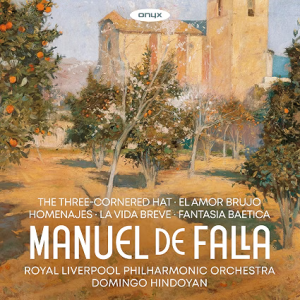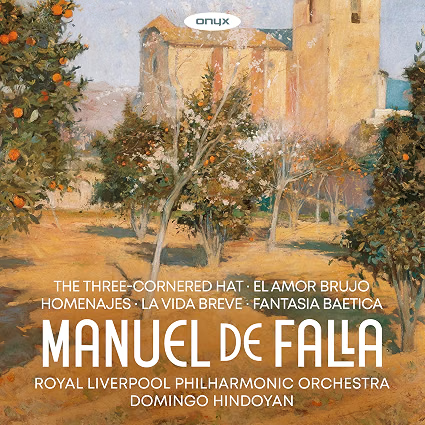
FALLA: The Three-Cornered Hat: Suites 1&2; Interlude and Dance from La vida breve; Homenajes; El amor brujo suite; Fantasia Baetica – Royal Liverpool Philharmonic Orchestra/ Domingo Hindoyan – Onyx 4277 (9/25/26) (80:00) [Distr. by PIAS] ****:
Pianist Artur Rubinstein recounts, in My Younger Years, his initial meeting with Spanish composer Manuel de Falla (1876-1946), in which Rubinstein’s first impression was that of having encountered a grocer, a banker, or a clerk. But, when Falla seated himself at the keyboard, there erupted from the instrument a torrent that literally captured and defined the very soul of Spain. The present collection, recorded April 2024 and February and November 2025, offers us selected orchestral works – without their vocal texts – that have served recordings and concert halls with Falla’s infectious contribution. Ernest Ansermet had been a great champion of Falla’s ballet scores, as had Leopold Stokowski, Igor Markevitch, and Dimitri Mitropoulos.
Falla’s scores brilliantly combine earthy, Spanish folk idioms with harmonic and color elements instilled by the French masters Debussy and Ravel. From the outset of the suites from The Three-Cornered Hat (1919), the Liverpool players relish the combustible gestures and erotic energies unleashed by Falla. The gruff color of the bassoon soon confronts the canto jondo (deep song) that Falla commands at will. The quick alertness of Los uvos suavely transitions into percussive and sparkling impulses, some of which arise from flamenco and Andalusian sources. The three familiar, The erotic dances from Suite No. 2 emerge with lyrical clarity and fine-tuned resonance. The bold strokes o the Miller’s Farucca vibrates with fierce, percussive
menace, while the concluding Jota explodes in urgent fanfares in triple time and furious stretti. The festive spirit becomes vivid, almost hallucinatory, and the scene sweeps us away in a paroxysm of elemental colors.
The Interlude and Dance (from Act II) remains the most successful excerpt from Falla’s 1905 opera La vida breve, and its immediate appeal struck me when I heard the Mitropoulos performance on Columbia LP. A voluptuous opening leads to a somber, nocturnal setting, bucolic and meditative. Then, the music breaks into the flowing dance, rich in flamenco colors, swirling and brilliant. Violinist Fritz Kreisler’s transcription of this dance as his “Spanish Dance No. 1” remains ever effective.
The 1939 Homenajes (“Tributes”) allow Falla to acknowledge four musicians who helped shape his career: Arbos, Debussy, Dukas, and Pedrell. His last completed work, Homenajes spells out as musical anagrams the names of his honored colleagues. Spain, as run by the dictator Franco, held no attraction for Falla, and he did not return to is native land. After a massive, raucous fanfare, the first tribute celebrates Enrique Fernanez Arbos, noted conductor. Follows an elegy in heavy cadences taken from a guitar piece in honor of Claude Debussy’s Spanish pieces. The fanfare reprises so as to lead to an homage to Paul Dukas, originally an austere piano piece now realized in haunted dissonances. The last, expansive commemoration involves Falla’s teacher Felip Pedrell, utilizing flowing themes and ennobled processionals from the latter’s failed opera, La celestina.
Around 1915, Falla accepted a commission to create a gitaneria, a Gypsy ballet, based on a libretto by Maria Martinez Sierra, with three songs for mezzo-soprano in conte flamenco style. Soon, Falla adapted the plot into a one-act pantomime rich in vibrant colors. Stokowski found the score exciting enough to document two commercial recordings – one with Nan Merriman, one with Shirley Verett-Carter – and a live performance from London with Gloria Lane. The exquisite, bravura trumpet work still commands our attention, as do the long, passionate melodies and (literally) fiery rhythms. Nostalgia, magic, and love for the Andalusian landscape blend into work of haunting glamour. Ever since Oscar Levant played the throbbing “Ritual Fire Dance” on the piano, the score has held me spellbound, especially in its orchestral guise. The “Pantomime” alone warrants the price of admission.
The final work on this disc, Fantasia Baetica (1919), comes to us as a transcription made by conductor Francsico Coll in 2023. Originally composed as a vehicle for pianist Artur Rubinstein, the work has now the benefit of an expanded orchestral ensemble that includes two piccolos, piccolo trumpet, and a startling array of percussion. The music pays aggressive homage to Spain’s antique, historically Roman past, the province of Boetica, noted for its fertile Guadquivir River valley. Falla’s music proves equally fructifying on all levels.
—Gary Lemco