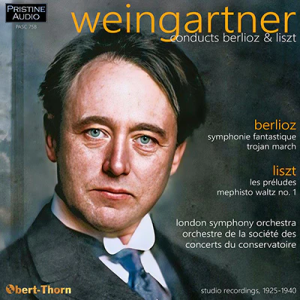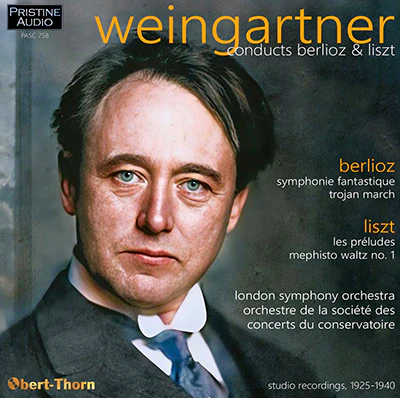
FELIX WEINGARTNER conducts = LISZT: Les Préludes; Mephisto Waltz; BERLIOZ: Trojan March from Les Troyens; Symphonie fantastique – London Symphony Orchestra, Orchestre de la Société des Concerts du Conservatoire – Pristine Audio PASC 758 (77:44; complete credits below) [www.pristineclassical.com]
Producer and Audio Restoration Engineer Mark Obert-Thorn turns his scrupulous attentions to the partial legacy of Austrian conductor Felix Weingartner (1863-1942), notable as the first to record the complete Beethoven symphonies and rediscover the C Major Symphony of the youthful Georges Bizet in 1935. Though trained and supported by Franz Liszt, Weingartner assumed a classical style, literalist and dynamically sensitive – much in the manner of Arturo Toscanini – unlike the more subjective and dramatically expressive wielders of the baton, like Willem Mengelberg.
The program opens with a reading (rec. 28 February 1940) of Liszt’s 1854 symphonic poem Les Préludes, after the poet Lamartine, the third of Liszt’s forays into the tone-poem genre. Less volatile and passionately driven than the famed Willem Mengelberg version from 1929 Amsterdam, the Weingartner performance has a distinct clarity of line, especially given the economy with which Liszt builds the entire one-movement structure from an initial grund-gestalt. The LSO’s interior lines, the woodwinds and low basses, add a rich sense of texture to Liszt’s progression that embraces tenderness and militant, brass aggression as two sides of the thematic coin.
From the same recording session, Weingartner leads a simmering, strutting performance of Liszt’s 1859 Mephisto Waltz, a realization that alternately throbs with pagan, sensuous life and pines in languorous, romantic enchantment. Based on Nikolaus Lenau’s 1836 poem, the music creates a stunning impression of a village wedding dance at which the devil steals the principal violin to intoxicate Faust and his smitten partner. The LSO strings steal the show with splendid, virtuosic runs, scales, and various whirling and galloping effects, while the winds and brass punctuate the occasion with sly intimations. The extended harp part, transparent and fluid, much suggests what Weingartner might have accomplished in Tchaikovsky. As it stands, Weingartner died short of bringing to fruition his concept of Liszt’s Tasso – Lament and Triumph, which he meant to record later in 1942.
Obert-Thorn provides auditors a moment in which Weingartner rivals Sir Thomas Beecham for potent expression, in the Trojan March from Berlioz’s Les Troyens (rec. 21 July 1939), with the Paris Conservatory Orchestra. Along with the ceremonial pomp in the brass and strings, the woodwinds retain tat especially, nasal character endemic to authentic French sonority. The graduated tension of the galloping figures, their collective, stratified crescendo, communicates a festive energy made opulent by the fiercely accurate musicianship from all participants.
Weingartner had already recorded the Berlioz 1830 “program” Symphonie fantastique for the acoustic process early in 1925, but the advent of the electrical medium obviated its release, since Weingartner was eager to seize upon the improved sound, returning to the score for sessions in London 28 & 29 October and 1 November 1925. Opening softly, the emphasis on the first, lyrical appearance of the so-called idée fixe that permeates the narrative, Weingartner keeps a flexible leash on the rhythmic pulse. Cramped sonics restrain the impact of the music as it stealthily creeps in demonic force, the narrator’s having been irresistibly compelled by the fatal attraction of his beloved. Wavering between dreamy, passionate intoxication and spasmodic despair, the music benefits from Weingartner’s directness of approach, which does not lack for singing lines. Plagal harmonies conclude the extended reverie with a sense of religious devotion.
Weingartner opens the grand ball sequence with more marcato than is the wont of other conductors, but the mesmeric flow soon enthralls our narrator. Only the tiniest bit of rubato informs the pulse, which soon delivers the beloved’s soft undulation into the ballroom. Given his existential doubts about his worthiness and her fidelity, the music becomes desperate, even manic, with a bass descending scale’s hinting at an awaiting abyss of calamity.
The consolations of Nature, much in the Romantics’ ethos and sensibility, invests this pastoral with temporary solace. Berlioz’s innate pantheism raises the ranz des vaches to a primal hymn akin to that of Beethoven of his Sixth Symphony, before primal doubts beckon a thunderstorm both ontological and spiritual. Weingartner’s brisk pacing does not detract from the vast contours he illuminates, the chiaroscuro of the Berlioz romantic syntax, especially bequeathed the bass drum.
The final two movements, both consisting of nightmare visions, make us regret the limited sonic image from the 1925 shellacs. The efficacies of the Berlioz counterpoint, however, suffer no diminishment. These two “episodes in the life of an artist” recount his murder of his beloved, his sentence and execution, and his otherworldly punishment. Ascribed to the effects of having imbibed opium, the phantasmagoria resemble moments in De Quincey, with the last movement’s bearing a strong resemblance to Hawthorne’s “Young Goodman Brown,” in which the eponymous hero and his beloved Faith find themselves inducted into a Devil’s coven. The “March to the Scaffold” proceeds with grinding malice, the “beloved” motif inverted and distorted for its spiteful power. At the coda, the plucked strings intimate our protagonist’s head severed, departed for the awaiting basket. Trumpets announce his advent into Hell’s Black Sabbath, where any number of polyphonic grotesqueries greet his descent, the mocking idée fixe now in concert with the Dies irae of the Requiem Mass.
Weingartner had recorded the two Liszt piano concertos with Emil von Sauer in 1938; and now, we lament that the two Liszt acolytes did not collaborate on the Totentanz.
—Gary Lemco
FELIX WEINGARTNER conducts BERLIOZ and LISZT
LISZT: Les Préludes; 1Mephisto Waltz No. 1;
BERLIOZ: 2Trojan March from Les Troyens; 1Symphonie fantastique, Op. 14a
1London Symphony Orchestra
2Orchestre de la Société des Concerts du Conservatoire