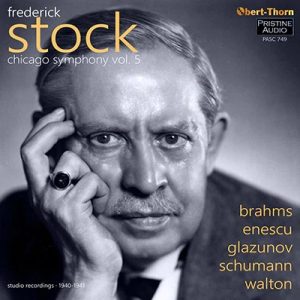
Frederick Stock Vol. 5 – Orchestral Works of Brahms, Walton, Schumann, Enescu, Gliere, Glazunov, Reznicek, Toch, Liadov, Paganini, Ponchielli, Benjamin – Chicago Symphony Orchestra – Pristine Audio PASC 749 (2 CDs = 2 hrs 33:02, complete content listing below) [www.pristne classical.com] *****:
Producer and restoration engineer Mark Obert-Thorn’s fifth edition of the recorded legacy of Frederick Stock (1872 -1942) just happens to revive those Chicago Symphony performances with which this reviewer had been familiar from having owned their 78 rpm incarnation. In particular, Stock’s frisky, articulate rendering (25 April 1941) of Emil von Reznicek’s 1884 Overture to the opera Donna Diana always had my admiration for the glistening work in the woodwinds, strings and brass.
Obert-Thorn mounts his 1940-1941 assemblage with Stock’s reading of the Brahms Third Symphony (23 November 1940), much admired by critic Virgil Thomson for its vivid, optimistic energy and forward drive. Stock captures the emotional – that is, tonal – ambiguity resonant within the score, its color contest between the major and minor modes of F, and its frequent allusions to the Schumann circle that gave it initial inspiration. The level of yearning, sehnsucht, of the Andante remains palpable, especially as Stock’s cello line and low basses convey the dark harmonies within what appears a high vocal lyric. That similar melancholy saturates the ensuing Poco allegretto, multi-layered and eminently molded with aristocratic poise. The final movement, Allegro – un poco sostenuto, bristles with ominous intimations of its spiritual ancestor Beethoven. Once the grip of the Bonn Master establishes itself, the momentum becomes inexorable, urgent, until the last measures, borrowing from movement one, offer some conciliatory sentiments.
Between the Brahms and the Schumann Fourth (25 April 1941), recorded the at the same session, we have a work commissioned in 1940 by Stock in honor of the CSO’s 50th anniversary, the Scapino Overture of William Walton. The character sketch involves a secondary figure in the commedia dell’arte, whose etymology, “escapade,” defines his role in assisting Harlequin in picaresque antics. Defined as a “comedy overture,” the piece displays two sides of human nature, vivacious and sentimental, which Stock and his ensemble carry off with suave gusto.
From the outset, Stock’s realization of Schumann’s D Minor Symphony exhibits a gravitas and concentration we could easily ascribe to Toscanini and Mitropoulos from the same period in American music-making. The work itself appears honed from a prime, motivic impulse and recycled in diverse affects. Stock does not linger on its metaphysical significances, a la Furtwaengler, but rather indulges its lyric impetus, speed, and lofty aspirations. Obedient to Schumann’s desire for attacca, the Romanze proceeds immediately, solemn and dignified. A heavy foot marks the Scherzo but without temperamental impediment – instead, Stock compensates by treating the transitions glibly. The dramatic segue to the Langsam – Lebhaft finale has direction and purpose, but it lacks the monumentality that both Cantelli and Furtwangler impart to its imitation of Beethoven’s Fifth. The fugato enjoys a hearty clarity, and the music assumes the heightened vigor of a resonant, though quickened, chorale. A performance of discipline and musical personality, this reading.
Disc One concludes with the fine display piece, the A Major Romanian Rhapsody of Georges Enescu (25 April 1941). Stock knows exactly how to make this music throb, cavort, weep, and exalt in it various guises, all while his individual players and their respective choirs exult shamelessly. After the required lassu sequence, the friss section erupts in appropriate gypsy colors, a deliciously dizzy pastiche to the ear. As seamlessly restored in sound as it had been recorded, the performance basks in Obert-Thorn’s and Pristine’s XR technology ministrations.
As Obert-Thorn points out in his accompanying notes, the essentially conservative group of “encore pieces” and “miniatures” of Disc 2 seem to belie Stock’s repute as a champion of new music, like that of Milhaud, Mahler, Stravinsky, and Kodaly. But like Toscanini, Stock lavishes on these popular items the same professionalism we hear from Toscanini in similar repertory. The side opens with Gliere’s epic 1908-1911 Third Symphony, based on the legendary hero Ilya Murometz. Specifically, the energetic movement three Allegro, “The Palace of Prince Vladimir,” depicts Ilya’s cruel assassination of Solovei the Brigand at a lavish feast. Like his contemporary Leopold Stokowski, Stock utilizes an abridged edition that still retains the composer’s vibrant colors, harps and whirling woodwinds in competition with the luxurious, Chicago strings and brass.
The music of Alexandre Glazunov receives an affectionate tribute by way of three selections, between 2 and 2 April 1941. The F major Carnaval Overture of 1895, scored for large orchestra and organ obbligato, finds in Stock a sympathetic acolyte eager to explore the composer’s gifts for active rhythm and gratifying melody. The 1893 Concert Waltz in D appeals to Stock’s affinity for the belle epoque, bathed in a soft glamour redolent with colors gleaned from Rimsky-Korsakov and Tchaikovsky. Perhaps only less innately vibrant, the Concert Waltz in F (1896) projects its own color charms, many of them fluently infectious, in the manner of the Strauss family.
Ernst Toch’s Pinocchio Overture (1935) exhibits a minimum of t he composer’s more modernist, even serial, attributes, as it bears the subtitle “A Merry Overture.” The fugal writing demonstrates Toch’s mastery of polyphony without its having become ostentatious. The largest work from the 25 April 1941 session belongs once more to Brahms, with his D minor Tragic Overture. The might of the two opening chords announces a driven reading, brisk in the Toscanini tradition. The brooding aspects of the piece do not dawdle, nor do the lyrical episodes become maudlin. The sense of dramatic breadth reigns as Stock adjusts his strings and brass to assume a whiplash, martial attitude. While the rendition may not “weep” as Brahms indicated, it does sing poignantly, indulging the CSO strings their vibrant capacity for exalted expressivity.
The set of four recordings from 28 April 1941 boasts the popular Ponchielli “Dance of the Hours” from the 1876 opera La Giaconda as its major entry; this performance comes on the heels of the Stokowski entry for the 1940 Disney film Fantasia. Alternately whimsical and ferocious, the piece assumes a structure similar to that of a Liszt rhapsody, with moments of intense, tragic lyricism.
The etched attacks from Stock’s strings and winds testify to a thorough sense of his ensemble’s acoustic powers. Liadov’s 1906 depiction of the evil witch Baba Yaga from Russian folklore in the Stock version never appeared on 78 rpm, so we thank Obert-Thorn for his visceral transfer. Shrieks alternate with jagged figures of the demon’s riding through the air in a mortar, the pestle’s serving as her rudder as she sails the woods in search of small, edible children.
The Brahms Minuet from the Serenade No. 1 in D plays almost as a parody of Haydn at first, with the bassoon’s persistent honking, but the music opens out into an aubade of compelling affection. Stock’s arrangement of Paganini’s Moto Perpetuo features a clever Beethoven counterpoint at 1:12, derived from The Creatures of Prometheus ballet to be later admitted into the Eroica Symphony. At last, from 22 December 1941, we hear Arthur Benjamin’s 1936 Overture to an Italian Comedy, lightweight and tarantella-colorful, in the manner of Respighi. The composer clearly indicates he wants the trumpets to play “in a vulgar manner,” and Stock’s personnel are adept to oblige.
–Gary Lemco
FREDERICK STOCK, Vol. 5
BRAHMS: Symphony No. 3 in F Major, Op. 90;
WALTON: Scapino, a Comedy Overture;
SCHUMANN: Symphony No. 4 in D Minor, Op. 120;
ENESCU: Romanian Rhapsody No. 1 in A Major, Op. 11;
GLIERE: Symphony No. 3 in B Minor, Op. 42 “Ilya Murometz”: 3rd Movement “The Palace of Prince Vladimir”;
GLAZUNOV: Carnaval Overture, Op. 45; Concert Waltz No. 1, Op. 47; Concert Waltz No. 2, Op. 51;
REZNICEK: Donna Diana Overture;
TOCH: Pinochio: A Merry Overture for Orchestra;
BRAHMS: Tragic Overture, Op. 81; Minuet from Serenade No. 1 in D Major, Op. 11;
LIADOV: Baba Yaga, Op. 56;
PAGANINI (arr. Stock): Moto Perpetuo, Op. 11;
PONCHIELLI: Dance of the Hours from La Giaconda;
BENJAMIN: Overture to an Italian Comedy