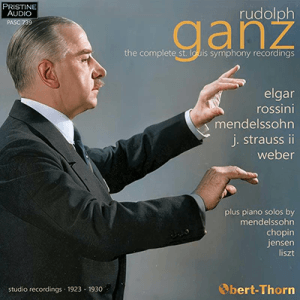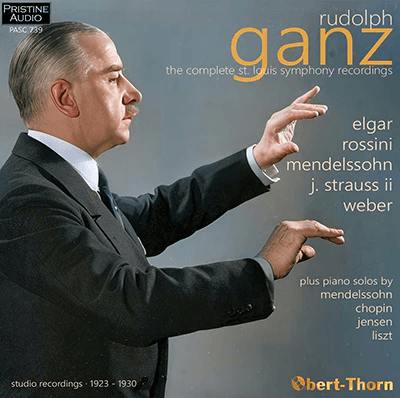
GANZ The Complete St. Louis Symphony Recordings (1923-30) = Orchestral Works by WEBER; LASSEN:; SINDING; D’ALBERT; J. STRAUSS6; ELGAR; ROSSIN; MENDELSSOHN; GERMAN; BOLZON; RIMSKY-KORSAKOV; JENSEN; MENDELSSOHN; LISZT; CHOPIN – Rudolf Ganz, piano and conductor/ St. Louis Symphony Orchestra – Pristine Audio PASC739 (79:01 – complete content listing below) [www.pristineclassical.com] ****
Producer and Audio Restoration Engineer Mark Obert-Thorn turns his attention to Swiss pianist and conductor Rudolf Ganz (1877-1972), his collection of studio recordings, made 1923-1930, a fine complement to the 2011 issue from Guild (GHD 2377), repeating only four of the solo piano selections by Chopin, Mendelssohn, Liszt, and Jensen. In 1913 Ganz committed some 50 works to the Welte Mignonreproducing piano, later (c. 1920) recording a number of pieces for the Duo-Art-Pianola of the Aeolian Company but discontinuing any solo documents after that period. Ganz accepted the conductor’s post in St. Louis in 1921, the second-oldest symphony organization in the United States, after the Philharmonic-Symphony of New York. That Ganz favored modern compositions by the likes of Busoni, Copland, Webern, and Schoenberg, however, ran the St. Louis Symphony into financial difficulties, and Ganz resigned from the conductorship in 1927. A recording of Grieg’s Holberg Suite with the Metropolitan Symphony Orchestra of New York (1948) is included in the Guild Collection. The pirate Dante label from 1996 (HPC 050) offered works by MacDowell (rec. 1945) and the Ganz Piano Concerto in E-flat, Op. 32 performed by Ganz and the Chicago Symphony under Frederick Stock (1941). Both Pristine and Dante issued MacDowell’s Marionettes Suite recorded by Ganz with the Metropolitan Symphony in 1945, the former on a separate release of “American Piano Music” from Pristine (PAKM 044).
In his accompanying liner notes, Mark Obert-Thorn characterizes the conducting style of Rudolf Ganz as one favoring “swift but flexible tempi, with string portamenti still the norm during this era.” Ganz opens with the Overture to Weber’s 1823 grand opera Euryanthe, whose lovely main melody manages an attractive arioso and solid, chromatic progressions, in spite of the age (30 October 1923) of the recording process and its tinny acoustic, especially in the woodwinds. Eduard Lassen’s 1874 Festival Overture in E-flat Major, Op. 51 (31 October 1923) enjoys some pleasant interchange between harp, winds, and strings after the brief brass fanfare. Though out-doorsy, the main body of the music seems rather pedestrian. Microphone placement, too, sounds distant and emaciates the girth of the full orchestral projection. The piece resumes the fanfare element at the close, second-rate Wagner, in my opinion. Christian Sinding”s ever popular (and brief) Rustle of Spring in its orchestral form (31 October 1923) exercises many of the same sound effects as we have in Lassen’s piece, here in D-flat major and moving through a few remote and dark keys. D’Albert’s 1902 opera The Improvisator, set in an oppressed Padua, has its lively Overture performed (31 October 1931) in hastily busy figures by the St. Louis Symphony that come and go in under three-and-one-half minutes, hardly a preface to the intrigue surrounding the main character, Cassio Belloni, a noted vocal improviser suspected of conspiracy.
Johann Strauss created his 1867 Artist’s Life Waltz as an antidote to the depressions of the Austrian army’s defeat in 1866 at Battle of Königgrätz, which left Vienna uneasy about their oncoming Vienna Carnival. Heralded as a glowing companion to The Blue Danube Waltz, the piece retains its natural buoyancy and vibrancy, moving from A minor to the tonic major, much abbreviated in this Ganz rendition (1 November 1924). Scratchy, whiny strings and a thumpy snare drum do not deter the elan of the occasion. Recall my remarks always suffer my innate dislike of acoustic recordings. Edward Elgar’s ubiquitous D major Pomp and Circumstance March No 1 (1 November 1924) has a frothy, muscular energy, even if I impatiently await the graduation to the electrical recording process in 1925.
The enduring, canny Overture to The Barber of Seville (1816) delivers the sound I appreciate, having been recorded 4 December 1925, the electrical process immediate in its acoustical rewards. The string sound is more focused, the winds and brass differentiated in a way the old horn process could not provide, and the effect generally warmer in tone, Once Ganz has the music moving Allegro, he has nothing to fear from Toscanini. The Ganz control over ascending and descending crescendos proves colorful and nuanced, certainly a rival for any ensemble’s rending of this favorite. The dark side of Romanticism finds controlled expression in Mendelssohn’s 1833 Hebrides Overture, whose main B minor theme has haunted many a film score. The contrapuntal excellences of the music do not suffer in the new electronic medium, and Ganz (5 and 7 December 1924) keeps the flowing motion of the seascape active and variegate in the string, horn, and wind hues.
The novel Simon Dale by Anthony Hope provides the impetus for Welsh composer Edward German’s 1900 opera Nell, from which Ganz (5 December 1925) performs three dances, The Country Dance, Pastoral Dance, and The Merrymakers’ Dance. An idiomatic, homey lightness pervades each of the dances, with Ganz attuned to the rhythmic inflections and vivacious spirit informing them all. Composer Giovanni Bolzoni (1841-1919) seems a singular success, noted for his Minuet for String Orchestra. Its gently tripping figures achieve a light, balletic confidence in galant style from Ganz (5 December 1925) and the St. Louis strings. The last of the orchestral selections, Rimsky-Korsakov’s “Song of India” from the 1867 (rev. 1892) opera Sadko, provides a reading whose murmured, muted effects afford us some exotic luxury.
Conductor Felix Weingartner commented on Rudolf Ganz as a performing piano artist: “a sensational success in his art. . .great honesty and manliness without affectation. Natural warmth, vast knowledge and marvelous technic produce wonderful sympathetic expression. Ganz stands today unequaled among the younger piano virtuosos.” The Mendelssohn “Spring Song” (23 April 1930) provides a good example of the light suasion Ganz delivers, a rival to Ignaz Friedman. From the same session, Ganz performs the A-flat Liszt Third Liebestraum with flair and facility, a good sense of the natural course of the melodic line that enjoys subtle metric shifts and increases in dynamics. His cascading descending scales projects an ease of technical fluency that many of today’s virtuosi could envy. Finally, from 17 June 1930, Chopin’s Valse brilliante, Op. 34, No. 1 tossed off in delicious security and dragonfly touch, in the manner of the best of Josef Hofmann. The Ganz sense of rubato appears quite idiosyncratic but entirely in the Chopin idiom. This performance would illumine any salon that cared to invite Ganz for a demonstration of his especial gifts.
—Gary Lemco
GANZ The Complete St. Louis Symphony Recordings (1923-30)
WEBER: Euryanthe Overture, Op. 81;
LASSEN: Festival Overture, Op. 51;
SINDING: Rustle of Spring;
D’ALBERT: The Improvisator Overture;
J. STRAUSS: Artist’s Life Waltz, Op. 316;
ELGAR: Pomp and Circumstance March No. 1;
ROSSINI: The Barber of Seville Overture;
MENDELSSOHN: Hebrides Overture, Op. 26;
GERMAN: 3 Dances from Nell Gwyn;
BOLZONI:Minuet;
RIMSKY-KORSAKOV: Song of India from Sadko;
JENSEN: Murmuring zephyrs (arr. Niemann);
MENDELSSOHN: Spring Song;
LISZT: Liebestraum No. 3;
CHOPIN: Valse Brilliante, Op. 34, No. 1 (arr. Joseffy