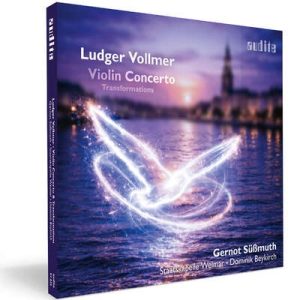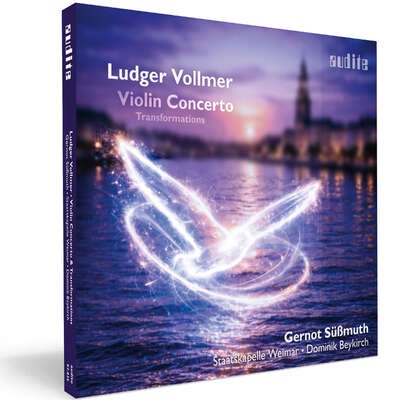
VOLLMER: Violin Concerto; Transformations for Solo Violin – Gernot Süßmuth, violin/ Staatskapelle Weimar / Thüringer Bach Collegium/ Dominik Beykirch – Audite 97.835 (39:44) [Distr. by Naxos] ****:
Ludger Vollmer (b. 1961) is a prolific opera composer who use of modern techniques manages to include social messages in his works, advocating interpersonal tolerance in the course of seeking an identity that the theater itself helps to create. The Violin Concerto (2020) owes its etiology to the composer’s friendship with the concertmaster of the Staatskapelle Weimar whose technique expressive tone proved eminently suitable to Vollmer’s demands. A six-note melodic line or “nucleus” informs all four movements of the piece, which unfolds with a particular sense of freedom, “a seagull gliding over the water.” Vollmer favors modal harmony, invoking s deliberately “antique” sonority to the character of the four movements. His driving rhythms and color combinations invest an attractive impulse to savor his invention, suggestive at once of Bartok and Ligeti.
Scored for violin, low strings, woodwinds, and percussion, the first movernent Modus prsents an alternately biting and lyrical sense of the ison, the Greek notion of the fundamental, leading tone. The movement often shivers with a nervous energy reminiscent of the second movement of the Prokofiev D Major Concerto, but more savage. The second movement Hoquetus exploits monophonic techniques popular with the 12th Century Notre Dame school, having selective voices silenced while other voices carry the melodic line. Rather intimate and softly expressed, the texture manages to vary and increase in girth and color, bearing a winding, Oriental or Eastern sensibility. The constant layering of voices soon becomes polyphonic in texture, girded by a pulsating rhythm, like we often find in the music of Alan Hovhaness. The music comes to a false stop, only to end with a melodic epilogue.
The third movement, Scherzo, offers a musical contest between the solo violin and the percussion, at moments creating a dream-scape as a foil to potential cacophony. The extended parlando slow sections or the violin against the harp or wooden blocks become eerily enchanted. At times the bravura, percussive texture reminds one of the gamelan orchestra that inspired Ravel and Debussy. The last movement, Concerto grosso, Vollmer contrasts a small concertino group – three recorders, harpsichord and cello – against the ripieno, the full complement of players. The intent, to paraphrase Vivaldi, means to envision a “battle between harmony and invention.” The solo violin has a cappella moments of high tessitura that insert a sense of expectant drama. The cello adds a distinct tone and color to the procession. The recorders invest a touch of otherworldly lightness to the texture. More insistent and strident the music becomes volatile and hypnotic, the horns, strings and deep basses luxuriant in the sonority. Suddenly, the violin part assumes something of Szymanowski’s eruptive temper while bells and ostinato chords impale us with their insistence. The solo cadenza realized by soloist Süßmuth sustains an ineluctable progress to a voluptuous coda. Bravo!
Vollmer’s 2004 solo piece Transformations yet again pays homage to Gernot Süßmuth, who gave the debut in Weimar. Again, a through-composed “melodic formula” dictates the unity of the piece, conceived as a passacaglia. The work abounds in slicing, acerbic dynamic effects, glissandos, muted sequences, and various shits in registration and note duration. The major influence would appear to be Bartok, especially in the application of microtonal effects. The more meditative episodes try for a distinct melodic curve but do not necessarily succeed. Rather, the whole sounds like a challenging étude in violin figurations. The piece ends quietly.
A challenging, inventive disc, whose brevity has not prevented my awarding it 4 stars.
—Gary Lemco