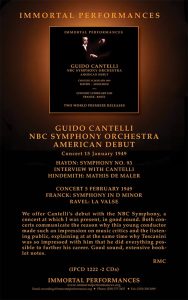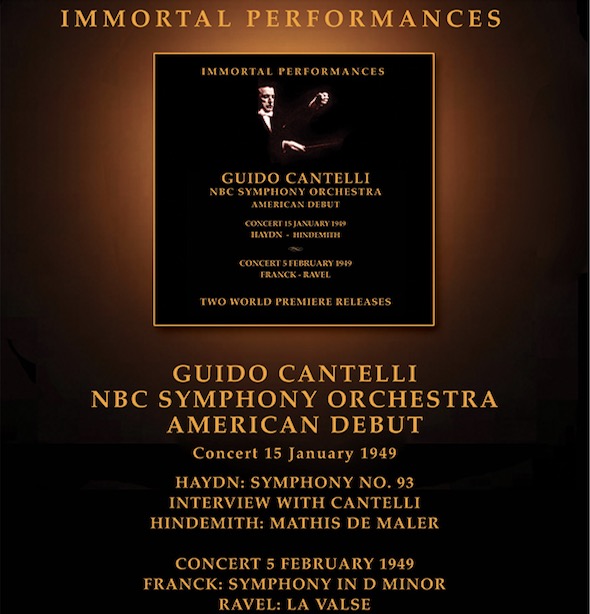
Guido Cantelli NBC Orchestra: American Debut = HAYDN: Symphony No. 93 in D Major; HINDEMITH: Mathis der Maler; Interview with Cantelli; FRANCK: Symphony in D Minor; RAVEL: La Valse – NBC Symphony Orchestra/ Guido Cantelli – Immortal Performances IPCD 1222-2 (2 CDs = 61:00; 58:29) [www.immortalprformances.org] *****:
I have commented often on the subject of Italian maestro Guido Cantelli (1920-1956), whose especial musical gifts, charismatic personality, and supple enthusiasm for his chosen repertory had made him Arturo Toscanini’s heir apparent. Cantelli, however, evolved along his own, inner-directed course, no mere clone of greatness. He embraced scores which often raised hackles in Toscanini as empty rhetoric, and Cantelli bore a flamboyant conducting style close to that of Leonard Bernstein, youthfully acrobatic. In my estimate of Cantelli’s Schumann Fourth Symphony, I found likeness closer to Furtwaengler’s measured approach rather than to any Italianate model. What remains undeniable, besides the fluid musicianship, lies in Cantelli’s passionate sense of focus, his fixed notion of the musical structure at hand. For me, it is this last quality, the impress of the points of emphasis, the curve to a predestined closure, that aligns Cantelli with the Maestro, Arturo Toscanini. Both men bore the torch of musical enlightenment with a solemn dignity and sense of mystery that cannot be taught, only instilled by Nature.
Immortal Classics presents two concerts by the NBC Symphony under Cantelli: the 15 January 1949 debut and the 5 February 1949, concerts that glow with the heat of fertile musical imagination. The opening work, Haydn’s Symphony No. 93 in D Major (1791), the first of the Salomon set of twelve such works. After a 20-measure Adagio of stately temper, Cantelli leads the Allegro assai sonata form with a buoyant clarity that delights all of us who ascribe such bustling ease of balanced execution strictly with Sir Thomas Beecham. The secondar theme in A major almost waltzes across our imagination, for the melody quite approaches a Vienna model we find later in Schubert.
The G major Largo cantabile proceeds with regal dignity, a martial carriage. The extended delicacy of phrase and transparency of motion embraces notable woodwind contributions, supported by arioso strings and ardent tympani. All such genteel politeness, however, dissipates rudely with a discourteous bassoon ff moment of flatulence. A few audience titters testify to the success of Haydn’s rustic humor.
Cantelli moves the Menuetto: Allegro with a robust vigor that keeps a fine line from becoming a scherzo in the Beethoven mold; the ländler, as such, relishes the punctuations between kettle drums and strings. The offbeat accents and energetic fanfares prove grist for the Cantelli color mill. Both sonata and rondo forms define the last movement, Finale: Presto ma non troppo, Cantelli’s idea of “ma non troppo” verges on the “troppo.” The effervescent charm and polished wit of the symphony glow in Cantelli’s suave hands, and an audience previously unacquainted with this new talent acknowledges his mastery.
Guido Cantelli harbored a fondness for Paul Hindemith’s suite from his opera Mathis der Maler,* arranged as an abbreviated, three-movement symphony (1932) at the request of conductor Wilhelm Furtwaengler. The story of German master Matthias Grunewald (c1475-1528) compels Hindemith’s orchestral treatment more than any immediate depiction of the actual panels of the Isenheim altarpiece in Colmar: Matthias (mistakenly) assumed the artist should take a political position, and so joined the Peasants’ Revolt again serfdom, c. 1524. His witness of various wartime atrocities led him back to his natural calling, painting, creating his wonderful altarpiece for the Church of St. Anthony in Isenheim, Alsace. If Hindemith saw the story as emblematic of a stance against Hitler’s regime in Germany, Cantelli may well have embraced the three-panel allegory as resistance against Mussolini’s fascist government in Italy. Virgil Thomson would likely agree that a psychological reaction to the artwork trumps any attempt to limn the panels in music, since he deemed Hindemith “the least pictorial composer alive.”
The opening movement, “The Angelic Concert,” serves as an overture that utilizes the folksong, Es sungen drei Engel, which Cantelli realizes with a studied, shimmering series of figures that bear chorale impulses in the trombones. The musical themes from the opera, wrought in polyphony, progress with a clear blending of the divided, NBC orchestral choirs, the musical arch sustained even as the levels of dynamics alter. Cadences land and erupt with artful, seamless transitions, especially as the NBC brass assert their acoustical dominance.
Drawn from the final moments of the opera, “The Entombment” celebrates the most mournful of events, given at the predella of the altarpiece. A sustained lament evolves, bittersweet with a lyric quality that remains at once agonized and mysterious. Meditative and groping for some sense of exaltation, this music serves as an interlude, a grim presentation of mortality and human vulnerability. The last movement, “The Temptation of St. Anthony,” asks Hindemith to suggest demonic presences, physical and moral. Dissonances and suspended harmonies approach a German equivalent to Mussorgsky, as Saint Anthony must suffer (galloping) personal attacks on his person and his psyche.
Cantelli’s stop-on-the-dime discipline controls metric and dynamic shifts with economy and intimacy. A grueling sense of humanity arises from the rubble of Saint Anthony’s afflicted spirit, music that sounds like Berlin will look by spring of 1945. Modal trumpets announce a triumph of the spirit, since we dare not invoke “the triumph of the will.” Saint Anthony has reclaimed his artistic self and his natural sense of mission, the music’s warm polyphony and chorale fanfare’s now bolstering a refined conscience, for what has not killed Saint Anthony has made him stronger. Listen to that NYC reception!
The three-minute interview reveals Guido Cantelli (with Ben Grauer) in full possession of his English, just having performed with the Boston Symphony. Along with Rossini’s The Siege of Corinth Overture, Cantelli continues with the Haydn 93rd and Hindemith’s Mathis der Maler. Cantelli plans concerts with the New York Philharmonic and concerts in London.
(*Immortal Performances lists the work as Mathis de Maler.)
A Gallic – Franck is Belgian rather than French – program defines the final concert by Guido Cantelli with the NBC Symphony, 5 February 1949, consisting of Franck’s Symphony in D minor (1888) and Ravel’s La Valse (1920). Consistently, commentators and musicians ascribe a “religious” or “mystical” significance to the Franck Symphony; and, while interpreters like Furtwaengler, Monteux, Bernstein, Stokowski, Paray, and Ormandy have rendered grand and luminous renditions, I have yet to experience any transcendent moment, only the periodic resolutions of four-square architecture set in the (here, organ) harmonies established orchestrally by Schumann, Liszt and Wagner. But I do not mean to “profane” Franck’s intent, celestial or otherwise. And I well recall (and admire) Cantelli’s 1955 commercial RCA recording with the NBC Symphony (LM 1852), a potent interpretation.
Cantelli establishes a haunted, lugubrious Lento that contains the (cyclic) seeds permeating the entire work. The breath between the shimmering notes testifies to a grand sense of dramatic design. Extended exposition and sumptuous development sections bequeath no recapitulation; but in the course of the balanced phraseology we hear Franck’s assertion of the organ diapason as the basis of his layered harmony and strident counterpoint. Rarely has the NBC bass line evoked such mournful, serpentine resonance. Cantelli manipulates the various pushes and pulls of the music’s momentum and dynamic shifts, never losing the taut rein of essential pulse and melodic continuity. The insistent energy of the NBC brass will win many adherents to Cantelli’s glamorous sense of peroration, retreating and then building in dark repetitions whose chiaroscuro renders the music in the mode of Caravaggio.
The second movement Allegretto, for all of its initial transparency, economically blends the forms of an intermezzo with a quicksilver scherzo. Harp and pizzicato strings set the tone initially, with a tiny moment of metric shift and the introduction of the oboe theme. Only the slightest hint of portamento lends an old-world sensibility to Cantelli’s otherwise new objectivity. A moment of mystery expands the bucolic gestures of the occasion, then Franck polyphonically synthesizes the two impulses. In a more martial sensibility, the music regretfully fades away, leaving a haunted nostalgia to carry us into the energetic finale, Allegro non troppo.
Cantelli has patiently guided us to a most thrilling finale, punctuated by a kind of fate motif. The cyclic recurrence of former motifs finds balances in the allocation of orchestral voices to enunciate the cornucopia of melodic kernels. The second movement’s sad refrain becomes a prevailing motto countered by variants from movement one, then stratified. Despite triumphant fanfares, Cantelli maintains the meditative flow of the music without having engendered an anti-climax. Brass and tympani collaborate without shattering the sonic homogeneity of the music’s grand gestures, especially from movement two. The coda under Cantelli becomes a kind of epilogue we find in Dvorak, an “and so my children” set in mysterious tones from the prior movements against the urgency of the final Allegro. The afterburners explode the last chords into the stratosphere, where we find the vivid applause of the patrons.
Ravel’s La Valse evokes the world of the 19th Century Vienna ballroom, but the sensibility of Johann Strauss has uneasy harmonies. Like many of the large Ravel dance forms, this one, too, will explode, as though the contemporary world had exhausted the humane message of the past. For Cantelli, the piece serves as an exercise in perpetual color motion, as he will prove in the “impressionist” repertory that includes Debussy and works like the Le martyre de Saint sebastien, which Toscanini did not address on record. The compulsive swirling figures and crashing octaves that mark the eccentric conclusion of La Valse testify to the paroxysm of emotion Cantelli could muster for the music he so cherished. Even Ben Grauer seems caught up in the exhilaration of the Cantelli phenomenon.
—Gary Lemco