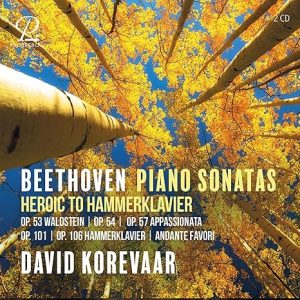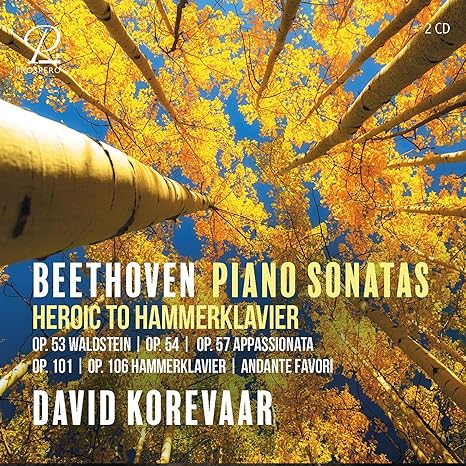
BEETHOVEN: Piano Sonatas Op. 53 “Waldstein”; Op. 54; Op. 57 “Appassionata”; Op. 101; Op. 106 “Hammerklavier”; Andante favori WoO 57; – David Korevaar, Piano – Prospero Records PROSPO111 (2 CDs = 71:17; 66:57)(3/4/25) [Distr. by PrestoMusic] *****:
I recently received the Prospero 2-CD set of five Beethoven sonatas and the Andante favori as performed by David Korevaar, himself a pupil of both Earl Wild and Abbey Simon, who deeply recognizes the historical significance and influence of Beethoven’s epic contribution to the genre. The complete recording of Ludwig van Beethoven’s 32 piano sonatas was published digitally in six volumes in the Fall 2025.
I called David Korevar at his Colorado residence to speak at some length of his – yet another – Beethoven cycle on records.
Gary Lemco: You refer to this latest installment of the 32 as “an act of hubris”, invoking the Greek sense of a fatal flaw. Why so?
David KorevaarK: Perhaps it lies in my having heard Rudolf Serkin live at Carnegie Hall performing the Waldstein. There are dozens of monumental readings by great pianists, and now I offer my own perspectives.
GL: You point out the thematic and rhythmic similarities between this sonata and Mozart’s The Abduction from the Seraglio.
DK: Besides the literal transposition of Mozart’s figures, there lies in Beethoven the capricious sense of humor that commentators often overlook. The sense of spontaneity and improvisation is there, too, characteristics both composers share in abundance.
GL: You obviously relish the recording process, not such a common trait among musicians.
DK: I do, though certain masters did not – like Artur Schnabel. He could become quite impatient with the entire process of making records, though he could achieve wonderful results, like his Mozart Rondo in A Minor, K. 511. His line is fluid and operatic, the rhetoric feels spontaneous.
GL: Schnabel left copious notes to his edition of the Sonatas, but he seems to abandon all his careful detail when he sits down and plays, given the sheer emotionality of the documents we have.
DK: That’s a bit too general a statement. Schnabel can be precise, when he is not hurried. He, like many of us who follow Beethoven, felt troubled by the metronome markings left either by Beethoven or his editors. Some of these can be downright bewildering or obstructive, though Perahia did a convincing job in my opinion with the Hammerklavier. Beethoven’s slow movements need to be clear in texture, as should be his fugues. On the other hand, the finale of the Waldstein proffers a phantasmagoria of comic opera colors that pure speed can blur.
GL: You mention the humor that pervades Beethoven’s music, and you begin your first set with the F Major, Op. 54. You play this piece, which I first heard via Sviatoslav Richter, with a deft verve.
DK: This sonata has its quirks: the influence of Haydn merges with the style of C.P.E. Bach, and the Romantic impulse is evident. Beethoven had acquired an Erard instrument, and he felt eager to exploit a larger dynamic range. We certainly feel the grandeur in the Op. 57 “Appassionata,” where what you mentioned the “Aeolian harp” effect has become prominent.
GL: The early sonatas, too, indicate a grandeur of their own; and here, I am thinking of the Sonata No. 4 in E-flat Major, Op. 7.
DK: Definitely, there and in the Op. 2, No. 2, when you take the repeats: the design is vast, symphonic. Beethoven explicitly calls his second movement Largo, con gran espressione. I venture that the Op. 7 already anticipates much of the Hammerklavier Sonata. They both advance a “leisurely” conception of music. The undervalued Op. 22 reverses the application of virtuosity in the Op. 7, though they have similar rondos.
GL: I always think of the 32 sonatas an experimental laboratory, a workshop to explore possibilities in melody, rhythm, and harmony, as well as in design, especially in counterpoint.
DK: A good analogy, if I think of the Op. 78 and its economical use of intervallic ideas, its witty compression. Even frequently used measures become unrecognizable after a lyrical presentation and then in patterns of sudden density. I have also come to appreciate the less “ambitious” sonatas, like the two of Op. 14, which are wonderful, given the beauty of the middle movement of that in E Major.
GL: And then there are the late sonatas. . .
DK: There are so many challenges in these, not the least of which is coherence amongst conjunctive and disjunctive ideas. The liberation of the trill proffers a whole new series of prospects. The intense intimacy seems at war with the limits of the instrument. And how does one capture “profundity”?
GL: You cite “superlatives” in your notes to this first edition. You have achieved several, I’d say,
DK: Thanks; it’s been a pleasure talking to you.
David Korevaar: Heroic to Hammerklavier
Piano Sonata No. 3 in C Major, Op. 53 “Waldstein”;
Andante favori in F Major, WoO 57;
Piano Sonata No. 22 in F Major, Op. 54;
Piano Sonata No. 23 in F Minor, Op. 57 “Appassionata”;
Piano Sonata No. 28 in A Major, Op. 101;
Piano Sonata No. 29 in B-flat Major, Op. 106 “Hammerklavier”